Why Classical Physics Seemed Complete
By 1900, physics had a problem most fields would envy: it looked finished. Two centuries of work by Isaac Newton, James Clerk Maxwell, and the physicists who built on them had produced a picture of the universe so complete that some of the era’s leading scientists genuinely wondered whether there was anything major left to discover. What remained, as one retrospective account of the period puts it, were just a handful of loose threads — including a stubborn puzzle about how hot objects radiate heat and light. That puzzle, it turned out, was not a loose thread at all. It was the seam where the entire classical fabric came apart.
This is the story of how confident physics became right before it wasn’t — and of the one experiment-shaped crack, called blackbody radiation, that widened into the ultraviolet catastrophe.
Also read: Discovery of Atoms: From Dalton’s Chemistry to Einstein’s Proof
A Universe Governed by Two Men’s Equations
By the close of the nineteenth century, essentially all of physical reality seemed to answer to two towering frameworks.
The first was Isaac Newton’s mechanics, more than two centuries old by 1900 but still the working language of motion and force. Newton’s laws explained falling apples and orbiting planets with the same three equations, and his law of gravitation had already predicted the existence of Neptune decades before anyone pointed a telescope at it. If you wanted to know where a cannonball would land or how the Moon stayed in orbit, Newton’s mechanics gave you an answer accurate to as many decimal places as you cared to compute.
The second framework was younger and, in some ways, even more startling. In 1861, the Scottish physicist James Clerk Maxwell published a set of equations unifying electricity, magnetism, and light into a single theory. Physicists already knew that electric charges created electric fields, that moving charges created magnetic fields, and that changing magnetic fields could induce electric ones. Maxwell’s insight was that a changing electric field could also generate a magnetic field — and once that piece was in place, the equations allowed for self-sustaining waves of electricity and magnetism that could travel through empty space. When Maxwell calculated the speed of these waves, it came out equal to the known speed of light. In subsequent work, he concluded that light was just such a wave, and identified a single propagation velocity in empty space for all electromagnetic radiation — now known to apply to radio, infrared, and ultraviolet waves, as well as X-rays and gamma rays. Electricity, magnetism, and optics — three subjects that had been taught as separate disciplines — turned out to be the same phenomenon viewed from different angles. As Einstein later put it, the leap was so bold that it took other physicists decades to fully grasp its significance.
Between Newton’s mechanics and Maxwell’s electromagnetism, plus a well-developed statistical theory of heat, physicists had equations for essentially every observable force in the everyday world: motion, gravity, electricity, magnetism, light, and heat. It is easy to see why confidence ran high.
“The End of Classical Physics?”
The confidence was not vague optimism — it was a specific, widely held belief among working scientists. At the end of the nineteenth century, most scientists thought that classical physics, built on Newton’s mechanics and Maxwell’s electromagnetism, reigned supreme and could explain all aspects of matter and radiation. The sense wasn’t that everything was already known in detail — new effects were still being measured constantly — but that the rules were known. Whatever new phenomenon turned up, someone would eventually show how Newton’s and Maxwell’s equations accounted for it. Physics, in this view, was a matter of filling in details, not rewriting foundations.
There appeared to be just a few things which needed to be fully understood — small residual puzzles that hadn’t yet been folded into the classical framework. One of them concerned something almost mundane: what happens to the light and heat given off by a hot object as its temperature changes.
The Puzzle of the Glowing Object
Heat a piece of iron and it eventually starts to glow — first a dull red, then orange, then a brighter yellow-white if you keep heating it. This everyday observation hides a genuinely difficult physics problem: exactly how much energy does a hot object radiate, and at which wavelengths, as a function of its temperature?
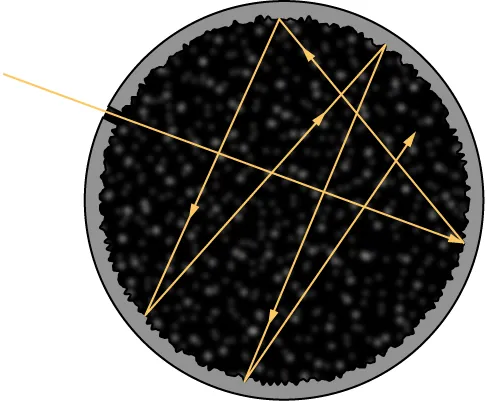
To study this cleanly, physicists used an idealized object called a blackbody — something that absorbs all the radiation that hits it and, in equilibrium, re-emits exactly as much energy as it absorbs. In practice, a good stand-in for a blackbody is a small hole in the wall of a hollow, heated cavity: light that wanders in through the hole bounces around inside so many times that it effectively never escapes unabsorbed, so whatever comes back out through the hole is a clean sample of the cavity’s thermal radiation. The term “blackbody” was coined by Gustav Kirchhoff in 1862, and the physical model is that of electromagnetic waves enclosed in a cavity at thermodynamic equilibrium with its walls.
By the 1890s, experimentalists had carefully measured how the intensity of this radiation is distributed across wavelengths, at different temperatures. Two patterns emerged clearly. Wien’s displacement law described how the wavelength of peak emission shifts to shorter wavelengths as temperature rises — which is exactly why a heated object moves from red toward blue as it gets hotter. Stefan’s law described how the total power radiated across all wavelengths grows very quickly, as the fourth power of temperature. Together, these curves — one for each temperature, with the peak sliding toward shorter wavelengths as the object got hotter — were well established experimentally by the end of the century.
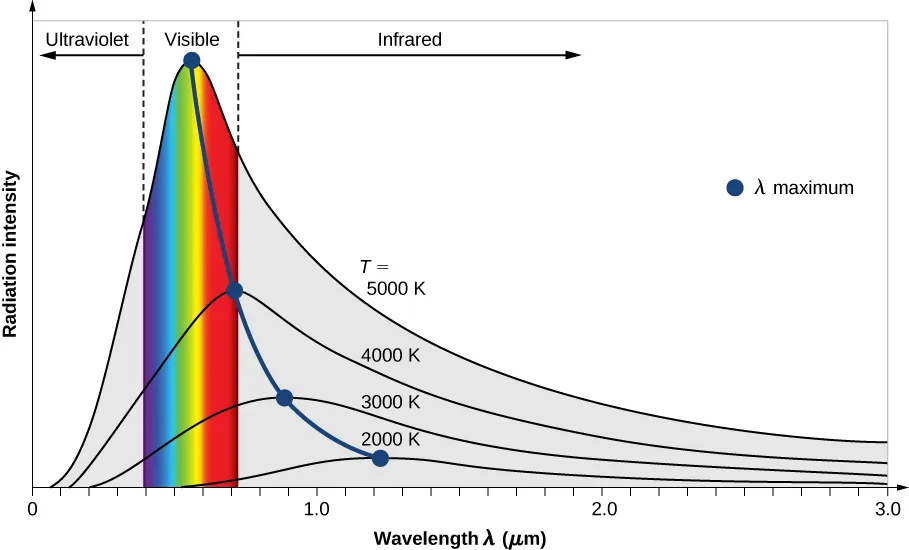
What physicists lacked was a single theoretical formula, derived from first principles, that could reproduce this entire curve — not just its peak or its total area, but its exact shape at every wavelength. That should have been a solvable problem. Maxwell’s electromagnetism already described how radiation and matter exchange energy, and statistical mechanics already described how energy distributes itself among many interacting parts. Combining the two seemed like a matter of bookkeeping, not upheaval.
When the Bookkeeping Broke
It wasn’t bookkeeping. It was catastrophe — literally.
The classical calculation, carried out independently by Lord Rayleigh and Sir James Jeans, treated the electromagnetic waves trapped inside the cavity the way classical physics treated any wave: as free to exchange energy with the cavity walls in any amount, continuously, with no restrictions. By the late nineteenth century the laws of physics were based on Newton’s mechanics and gravitation, Maxwell’s electromagnetism, and statistical mechanics — laws that described nature very well under most conditions, though some measurements of the era could not be understood. Applying those laws in full to the blackbody problem, the calculation predicted that shorter and shorter wavelengths should carry more and more radiated energy, without limit. The calculation, based on Maxwell’s equations and statistical mechanics, showed that the radiation rate went to infinity as the wavelength went to zero — a result later nicknamed “the ultraviolet catastrophe.”
That is a strange kind of wrong. It isn’t a small numerical discrepancy of the sort that experimentalists chase down and quietly correct. Rayleigh and Jeans’s formula, known as the Rayleigh–Jeans law, matched the experimental data reasonably well at long wavelengths — but as wavelength shortened toward the ultraviolet, theory and observation split apart entirely, with theory racing off toward infinite energy while real, measured blackbodies just kept glowing at ordinary, finite intensities.
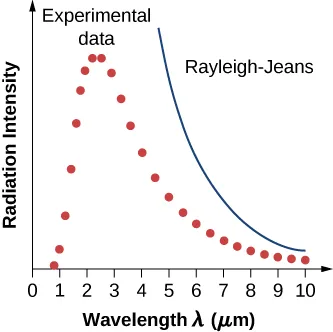
The Nobel Prize’s own account of the episode makes the absurdity vivid: if the classical prediction of ever-increasing radiation toward the ultraviolet had actually been correct, anyone studying a hot blackbody would have been severely injured by the intensity of the radiation coming off it. Nobody was. Ordinary hot objects — ovens, filaments, stars — radiated finite, measurable, well-behaved amounts of energy. The theory said they shouldn’t be able to.
This wasn’t an isolated embarrassment, either. Physicists working through the standard list of unresolved problems at the end of the century — blackbody radiation, the photoelectric effect, the stability of atoms, the discrete spectra of heated gases — found that these were the very measurements of the late nineteenth and early twentieth century that classical physics could not explain, and that ultimately led to the development of quantum mechanics. Blackbody radiation was simply the first of these cracks to be pried open in earnest.
Why a Small Puzzle Mattered So Much
It would have been easy, in 1900, to treat the ultraviolet catastrophe as a technical glitch — a case where Rayleigh and Jeans had made some simplifying assumption too many, fixable with a better model built on the same classical foundations. That is more or less how it was treated at first, including by the man who would go on to solve it.
Max Planck had spent years attempting to derive the known experimental formula for blackbody radiation, known as Wien’s law, from the second law of thermodynamics, only for colleagues’ new experiments to show by October 1900 that Wien’s law, while valid at high frequencies, broke down completely at low frequencies. Planck went back to the drawing board, found a new formula that fit the data at both extremes, and presented it to the German Physical Society in October 1900. Even Planck himself considered this new formula, at first, to be little more than a lucky guess rather than a result grounded in physical principle.
The deeper resolution — and the reason blackbody radiation turned out to be the crack that split classical physics wide open rather than a footnote — is itself the next chapter of this story. What matters here is what the crack revealed: that the two frameworks which had explained essentially everything, Newton’s mechanics and Maxwell’s electromagnetism, produced nonsense the moment they were pushed to their logical limit on a problem as simple as a glowing hot object. Planck ultimately resolved the catastrophe by introducing the concept of energy “quanta,” effectively limiting the energy that could be emitted at high frequencies — a fix so alien to nineteenth-century physics that it would take physicists, including Planck, years to accept what it actually implied.
What This Doesn’t Mean
It’s worth being precise about what the ultraviolet catastrophe does and doesn’t show. Newton’s mechanics and Maxwell’s electromagnetism were not wrong in any everyday sense — they still describe orbits, circuits, optics, and engineering to extraordinary precision, and they still do today. The catastrophe is a failure at an extreme: the short-wavelength limit of a very particular thermal radiation problem, where classical assumptions about how energy is exchanged between matter and radiation break down completely. It’s a boundary case, not a wholesale collapse.
But boundary cases are exactly where old theories reveal the limits of their own assumptions. The ultraviolet catastrophe wasn’t a rounding error to be patched. It was a sign that something in the basic picture of how radiation and matter trade energy needed to change — and that change turned out to be one of the largest in the history of physics.
The Takeaway
In 1900, physics had every right to feel finished. Newton and Maxwell had, between them, accounted for motion, gravity, electricity, magnetism, and light with equations of remarkable power and reach. The gaps that remained looked small — a few loose threads in an otherwise complete tapestry, blackbody radiation among them. But when physicists finally worked out, in full classical detail, how a heated cavity should radiate energy, the answer they got was infinity. That contradiction — quiet, technical, and almost bureaucratic in how it first appeared — was the opening move in the dismantling of classical physics, and the beginning of quantum theory.
Sources
- Nature — A Bold Unifying Leap (Maxwell’s Equations)
- American Physical Society — October 1900: Planck’s Formula for Black Body Radiation
- Nobel Prize — A Quantum Theory for Energy: The End of Classical Physics?
- OpenStax University Physics Volume 3 — 6.1 Blackbody Radiation
- University of California San Diego — The Problems with Classical Physics
- ScienceDirect — Classical Physics: Overview
- ScienceDirect — Black Body Radiation: Overview
- APS Physics — The Tumultuous Birth of Quantum Mechanics
- arXiv — Blackbody Radiation in Classical Physics: A Historical Perspective
- arXiv — Classical Physics and Blackbody Radiation
- arXiv — Understanding Zero-Point Energy in the Context of Classical Electromagnetism
- arXiv — Any Classical Description of Nature Requires Classical Electromagnetic Zero-Point Radiation
- NASA History Office — James Clerk Maxwell and Electromagnetism
- NASA Science — Electromagnetic Spectrum
- Encyclopaedia Britannica — Isaac Newton
- Encyclopaedia Britannica — James Clerk Maxwell
- Encyclopaedia Britannica — Blackbody Radiation
- Encyclopaedia Britannica — Ultraviolet Catastrophe
- MIT OpenCourseWare — Electromagnetism
- MIT OpenCourseWare — Classical Mechanics
- The Feynman Lectures on Physics, Volume I — feynmanlectures.caltech.edu
- The Feynman Lectures on Physics, Volume II (Electromagnetism) — feynmanlectures.caltech.edu/II_toc.html
- Internet Archive — Newton, Philosophiae Naturalis Principia Mathematica
- Internet Archive — Maxwell, A Treatise on Electricity and Magnetism
- Project Gutenberg — The Scientific Papers of James Clerk Maxwell
- Physical Review (APS Journals) — journals.aps.org
- Reviews of Modern Physics — journals.aps.org/rmp
- American Institute of Physics History — aip.org/history
- CERN — History of Physics Resources

One Comment