Gravitational Waves: An Epic Journey from Einstein’s Doubt to LIGO’s Triumph
On September 14, 2015, two lengths of vacuum-sealed steel pipe — one in the Louisiana swamp, one in the Washington high desert, each four kilometers long — flexed by an amount smaller than a thousandth the width of a proton. That flex was a gravitational wave: a ripple in spacetime itself, arriving at Earth after traveling for 1.3 billion years. It confirmed the last untested prediction of general relativity, launched an entirely new branch of astronomy, and set off a chain of discoveries that, within two years, let scientists watch and listen to the same cosmic event at once for the first time. This is the story of how we learned to listen to spacetime, and what it has let us hear so far.
Also read: Black Holes: 1 Century From Einstein’s Equation to an Incredible Photo
A Prediction Even Einstein Doubted
In 1916, a year after publishing general relativity, Einstein worked out that his field equations predicted something strange: an accelerating mass with an asymmetric shape should radiate waves of spacetime curvature outward at the speed of light. He returned to the problem in 1918 with a fuller derivation of how such a system loses energy this way. Yet for decades afterward, Einstein himself was unsure whether gravitational waves were physically real or simply a mathematical artifact of the coordinate system he had chosen — and even if they were real, he doubted anyone could ever measure something so faint.
That doubt was well-founded. Gravity is the weakest of the four fundamental forces by a wide margin, and a gravitational wave from a typical cosmic source stretches and squeezes space by only around one part in $10^{21}$ by the time it reaches Earth. Catching one means measuring a length change smaller than an atomic nucleus across an instrument kilometers long.
The first evidence came indirectly. In 1974, Russell Hulse and Joseph Taylor discovered a binary pulsar — two ultradense neutron stars orbiting each other — using the Arecibo radio telescope. Tracking the pair for years, they found its orbit was shrinking at exactly the rate general relativity predicted if the system were radiating energy away as gravitational waves. It won them the 1993 Nobel Prize in Physics, but it was still an inference. Nobody had caught a wave in the act.
What Is Actually Rippling
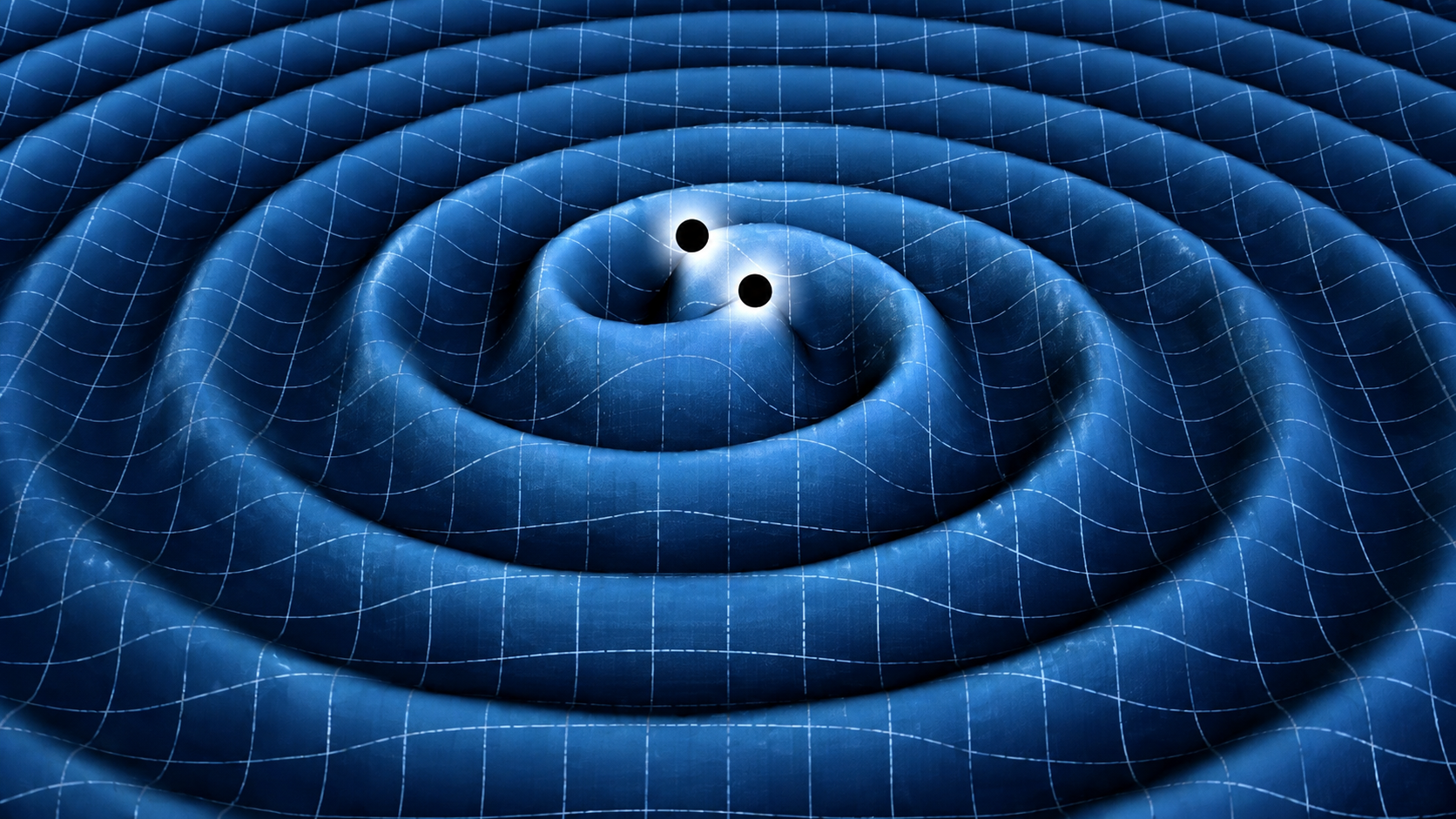
General relativity describes gravity not as a force but as curvature: mass and energy bend spacetime, and objects moving through that curved spacetime follow the paths we call orbits and free fall. A gravitational wave is what happens when that curvature itself becomes dynamic — when an accelerating, lopsided mass distribution, like two black holes locked in a death spiral, sends a disturbance rippling outward the way a stone sends ripples across a pond.
As the wave passes through a region of space, it doesn’t push or pull matter the way sound waves push air. Instead, it alternately stretches space in one direction while squeezing it in the perpendicular direction, then reverses, over and over as the wave passes. The effect is tiny at any real distance from the source, but it’s real: two masses in circular orbit continuously radiate this way, bleeding orbital energy into gravitational waves and slowly spiraling closer together — precisely the effect Hulse and Taylor measured in their pulsar.

Building an Instrument to Measure the Immeasurable
The design that finally worked is a laser interferometer. Each LIGO observatory is built as two four-kilometer tunnels arranged in an L-shape, meeting at a corner where a laser beam is split in two and sent down each arm to a suspended mirror at the far end. In the absence of any disturbance, the two beams recombine at the corner perfectly out of phase and cancel out. If a gravitational wave passes through, it lengthens one arm while shortening the other by an infinitesimal amount, throwing the beams out of sync and producing a measurable flicker of light.
Rainer Weiss at MIT worked out this interferometer design and painstakingly catalogued the sources of noise that would have to be suppressed — seismic vibration, thermal jitter in the mirrors, quantum noise in the laser itself. Kip Thorne at Caltech supplied the theoretical framework for what signals to expect and how to dig them out of the noise, working initially alongside Ronald Drever, who built early prototypes in Glasgow before joining Thorne’s group. In 1994, Barry Barish took over leadership of the project and transformed what had been a research group of around 40 people into an international collaboration of more than a thousand scientists — the scale needed to actually build and run two instruments precise enough to detect a signal smaller than a proton’s width. LIGO’s twin detectors sit roughly 3,000 kilometers apart, in Hanford, Washington, and Livingston, Louisiana, so that a real gravitational wave — arriving at both sites within milliseconds of each other — can be distinguished from local noise at a single site.
September 14, 2015: The First Chirp
LIGO had barely restarted after a major upgrade, still days from its official observing run, when the signal arrived. It hit Livingston first, then appeared at Hanford seven milliseconds later, exactly the light-travel time between the two sites. The waveform rose in frequency and amplitude over a fraction of a second before cutting off abruptly — the signature “chirp” of two massive objects spiraling together and merging.
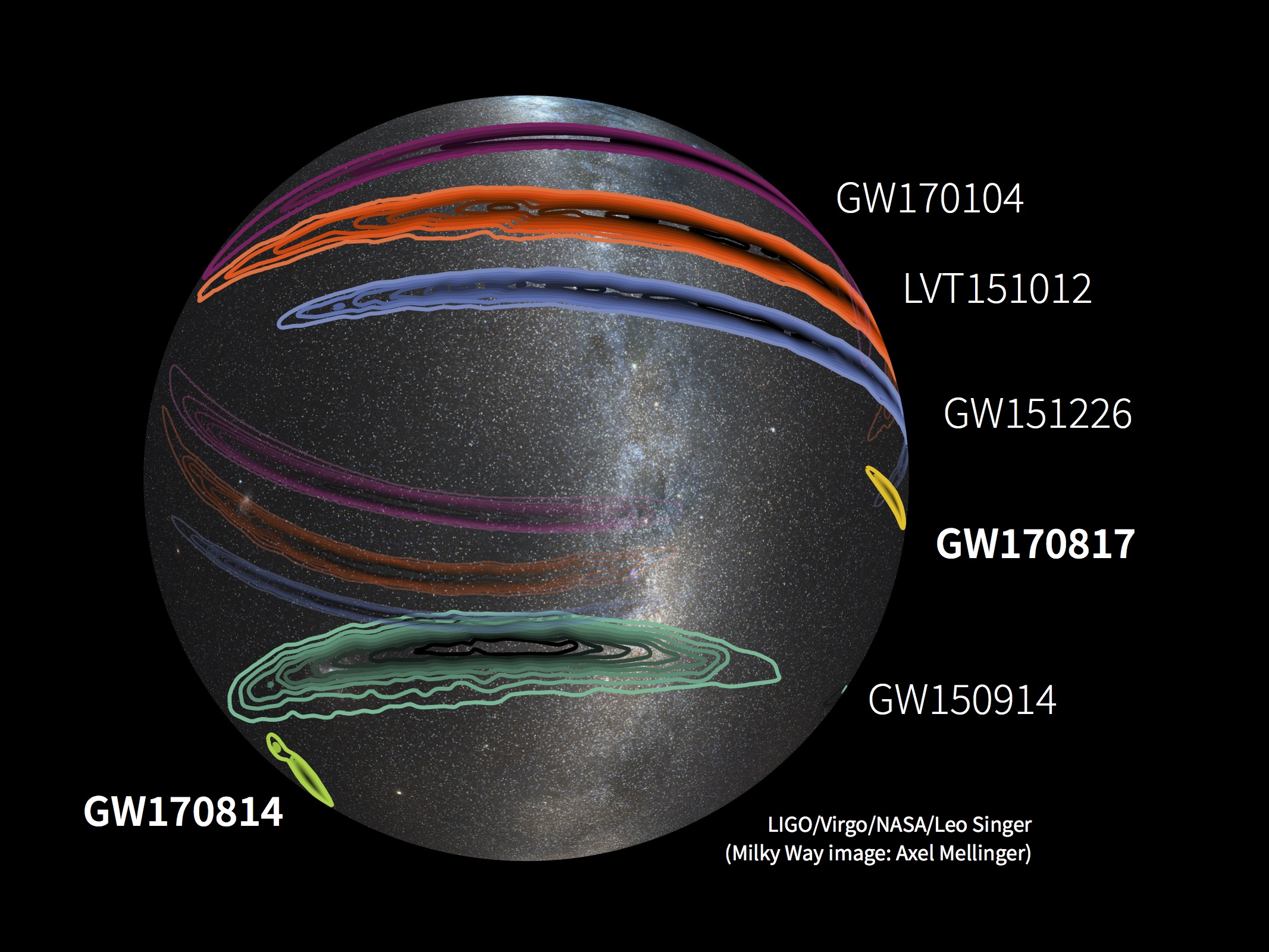
Analysis showed the signal, designated GW150914, came from two black holes of about 29 and 36 solar masses merging into a single black hole of around 62 solar masses, some 1.3 billion light-years away. The missing three solar masses had been radiated away as gravitational-wave energy in a fraction of a second — for that brief instant, the merger outshone, in gravitational radiation, the combined light of every star in the observable universe. Researchers spent five months quietly verifying the result before announcing it on February 11, 2016. In 2017, Rainer Weiss, Kip Thorne, and Barry Barish shared the Nobel Prize in Physics for the detector’s design and the observation itself.

August 17, 2017: When Astronomy Learned to Listen and See
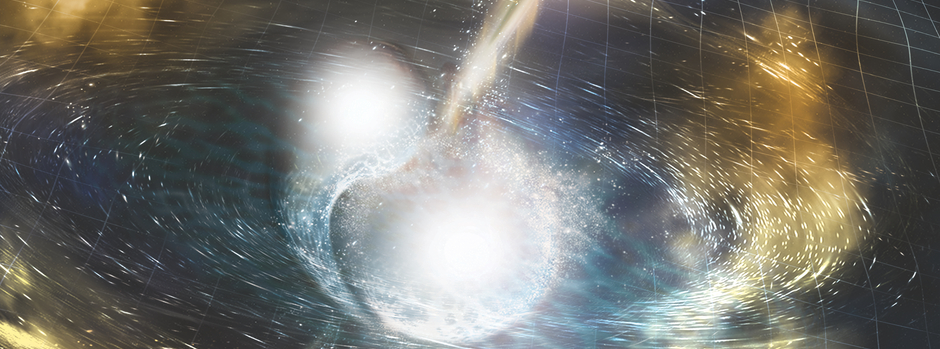
Black hole mergers are gravitationally loud but electromagnetically silent — nothing escapes a black hole, so there’s no light to see. Neutron stars are different: they’re made of ordinary matter, just crushed to inconceivable density, so their collisions should produce both gravitational waves and light. On August 17, 2017, LIGO and the newly upgraded Virgo detector in Italy caught exactly that.
The signal, GW170817, looked nothing like the black hole chirps seen before. Instead of lasting a fraction of a second, it lasted about 100 seconds, sweeping through the same frequency range as common musical instruments. The inferred masses — roughly 1.17 to 1.6 times the Sun’s mass each, totaling about 2.74 solar masses — matched neutron stars, not black holes. About two seconds after the gravitational-wave signal ended, NASA’s Fermi space telescope detected a short burst of gamma rays from the same patch of sky, confirming a decades-old suspicion that at least some short gamma-ray bursts are produced by merging neutron stars. Roughly 70 observatories around the world, from radio telescopes to the Hubble Space Telescope, then followed up across the electromagnetic spectrum, tracking the glowing debris — a kilonova — left behind by the collision. Those observations showed the merger had forged heavy elements including gold and platinum, resolving a long-standing question about where roughly half the elements heavier than iron actually come from.
Why It Matters: Multi-Messenger Astronomy
GW170817 mattered for more than its elemental chemistry. Because the gravitational-wave signal and the gamma-ray burst arrived within about two seconds of each other after traveling 130 million light-years together, the event confirmed to extraordinary precision that gravitational waves travel at the speed of light, exactly as general relativity requires. It also opened what astronomers had anticipated for decades but never achieved: multi-messenger astronomy, in which the same cosmic event is studied simultaneously through gravitational waves and light, each carrying different information the other can’t provide. Gravitational waves reveal the masses, spins, and dynamics of the colliding objects directly from spacetime itself; light reveals the composition, temperature, and afterglow of the debris. Together, they turned one neutron-star collision into one of the most thoroughly studied astrophysical events in history.
What Detectors Still Can’t Hear
Ground-based interferometers like LIGO and Virgo are only sensitive to a fairly narrow band of frequencies — roughly tens to thousands of hertz — set by the length of their arms and the noise sources they have to fight. That band captures the final inspiral and merger of stellar-mass black holes and neutron stars, but it misses slower, lower-frequency sources such as supermassive black hole binaries, which will require space-based detectors to observe. A faint background of gravitational waves left over from the universe’s earliest moments, and continuous waves from spinning, slightly asymmetric neutron stars, are predicted but haven’t yet been directly detected. Every detection so far has also come from a relatively small, biased sample of nearby, unusually massive or unusually close systems — the ones loud enough to clear the noise floor.
The detector network has, however, grown substantially. Virgo joined LIGO in 2017, KAGRA in Japan has since come online, and LIGO-India broke ground in 2026 as a planned fifth global observatory. As of the most recent LIGO–Virgo–KAGRA catalog release in 2026, the network has logged 390 confirmed gravitational-wave signals, including evidence for black holes that were themselves built from earlier mergers, and localizations far more precise than the first detections a decade ago.
The Takeaway
In 1916, Einstein predicted a phenomenon he wasn’t sure was real or, if real, could ever be measured. It took most of a century, a technology capable of measuring a distance change smaller than a proton, and an international collaboration of well over a thousand scientists to prove him right — and then to turn that proof into a working observational tool. Less than a decade after the first detection, gravitational-wave astronomy has gone from a single confirmed signal to a network logging hundreds of events, routinely combining with telescopes across the electromagnetic spectrum to reconstruct some of the most violent moments in the universe’s history. Spacetime, it turns out, has been ringing all along. We only recently learned how to listen.
Sources
- Einstein 1916: Approximate Integration of the Field Equations of Gravitation — https://einsteinpapers.press.princeton.edu/vol6-trans/281
- Einstein 1918: On Gravitational Waves — https://einsteinpapers.press.princeton.edu/vol7-trans/100
- LIGO Laboratory — https://www.ligo.caltech.edu/
- LIGO Scientific Collaboration — https://www.ligo.org/
- GW150914 Discovery Paper (Physical Review Letters) — https://journals.aps.org/prl/abstract/10.1103/PhysRevLett.116.061102
- GW151226 Discovery Paper — https://journals.aps.org/prl/abstract/10.1103/PhysRevLett.116.241103
- GW170104 Discovery Paper — https://journals.aps.org/prl/abstract/10.1103/PhysRevLett.118.221101
- GW170817 Binary Neutron Star Detection — https://arxiv.org/abs/1710.05832
- Multi-Messenger Observations of GW170817 — https://dcc.ligo.org/LIGO-P1700294/public
- Low-Latency GW Alerts for Multi-Messenger Astronomy — https://dcc.ligo.org/LIGO-P1800255/public
- Nobel Prize in Physics 2017 — https://www.nobelprize.org/prizes/physics/2017/
- Nobel Popular Information: Cosmic Chirps — https://www.nobelprize.org/prizes/physics/2017/popular-information/
- NASA: Gravitational Waves — https://science.nasa.gov/universe/gravitational-waves/
- ESA: Gravitational Waves — https://www.esa.int/Science_Exploration/Space_Science/Gravitational_waves
- Caltech LIGO — https://www.ligo.caltech.edu/
- MIT LIGO — https://space.mit.edu/LIGO/
- APS Physics Focus: First Gravitational Waves — https://physics.aps.org/
- Physical Review Letters Journal — https://journals.aps.org/prl/
- Reviews of Modern Physics — https://journals.aps.org/rmp/
- Living Reviews in Relativity — https://link.springer.com/journal/41114
- Nature collection: gravitational waves — https://www.nature.com/subjects/gravitational-waves
- Science Magazine — https://www.science.org/
- Virgo Collaboration — https://www.virgo-gw.eu/
- KAGRA Observatory — https://gwcenter.icrr.u-tokyo.ac.jp/en/
- Fermi Gamma-ray Space Telescope — https://fermi.gsfc.nasa.gov/