What Is Quantum Computing? Understanding the Second Quantum Revolution
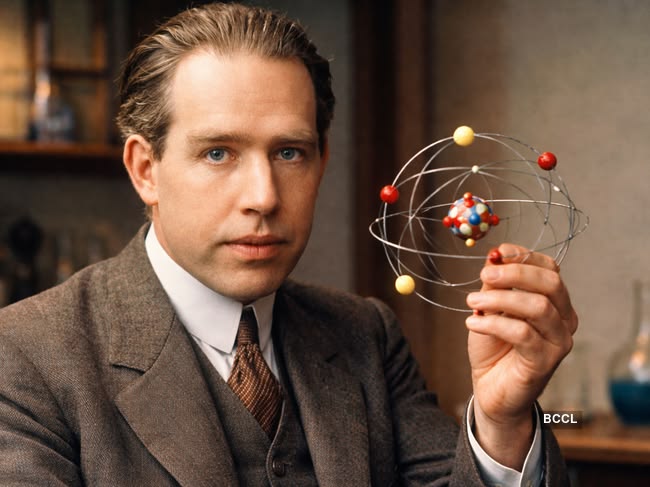
For most of the twentieth century, physicists used quantum mechanics as a rulebook to explain why the world behaves strangely at small scales, not as a set of instructions to run. The transistor and the laser both exist because engineers understood and exploited quantum rules, but the devices themselves still store and shuffle information as ordinary bits — a switch is either on or off. That era is now sometimes called the first quantum revolution . A second one is underway, and it treats quantum mechanics differently: instead of just relying on quantum effects to make a component work, researchers are now trying to directly control individual quantum systems — single atoms, single photons, single electrons — and use their most counterintuitive properties, superposition and entanglement, as the raw material for computation itself. NIST physicist Ray Simmonds put the distinction plainly: the first revolution had quantum mechanics working quietly in the background of a device with “special properties”; the second is about “engineering the quantum mechanics itself to do something.” this is quantum computing.

Also read: How 3 Brilliant Physicists Created the Quantum Revolution
What a qubit actually is
A classical computer, from a pocket calculator to a supercomputer, ultimately reduces every calculation to strings of bits: 0s and 1s, realized physically as high or low voltage in a transistor. A quantum computer replaces the bit with a qubit, which can be built from a trapped ion, a superconducting circuit cooled near absolute zero, a photon, or a neutral atom held in place by lasers, depending on which hardware approach a given lab or company has bet on.
What makes a qubit different isn’t the object itself but the mathematics that describes its state. A classical bit’s state is a single number, 0 or 1. A qubit’s state is described by a superposition — a weighted combination of both 0 and 1 at once, formally written as amplitudes rather than a single value. This isn’t a claim that the qubit is secretly 0 and 1 simultaneously in some ordinary sense; it’s a statement that until the qubit is measured, its state is genuinely undetermined between the two, and the measurement itself is what forces a definite outcome, with the weighting of the superposition setting the odds of getting one result over the other. That distinction — real indeterminacy before measurement, not disguised classical ignorance — is what separates a qubit from a coin spinning in the air, whose outcome is technically fixed by physics we simply haven’t tracked closely enough.
Why superposition and entanglement do useful work
Superposition alone doesn’t make a computer powerful; a single qubit in superposition still only yields one bit of classical information once measured. The payoff comes from scale and from a second property: entanglement, the correlation that can exist between two or more qubits such that their combined state can’t be described by treating each qubit separately, however far apart they end up. Measuring one instantly constrains what a measurement of its entangled partner will show, a correlation stronger than anything classical probability allows.
Put a modest number of qubits into superposition together and entangle them, and the system’s state has to be described across an exponentially large space of possibilities — n qubits span a space of 2ⁿ amplitudes, growing far faster than n classical bits ever could. A well-designed quantum algorithm doesn’t brute-force its way through that space; it manipulates the amplitudes so that paths leading to wrong answers interfere destructively and cancel out, while paths leading to the right answer interfere constructively and reinforce each other. That interference-based search is the actual source of quantum speedups, not simply having “more states to check at once.” NASA’s Ames Research Center, whose Quantum Artificial Intelligence Laboratory studies this directly, frames it as harnessing superposition and entanglement to run algorithms that would be practically impossible for classical machines — calculations that, for the right problem, would otherwise take longer than the age of the universe to finish on a conventional supercomputer.

How a qubit is actually built and controlled
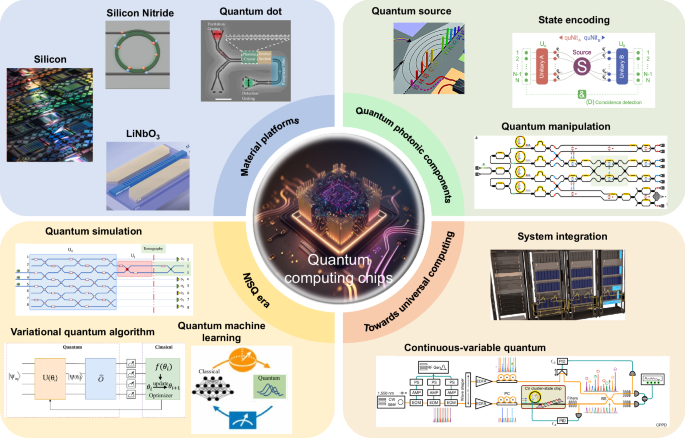
Different hardware platforms encode and manipulate qubits in different physical degrees of freedom, and none has yet definitively won. Superconducting circuits, the approach used by Google and IBM’s flagship processors, use microwave pulses to control current flowing without resistance through a chip cooled to a fraction of a degree above absolute zero. Trapped-ion systems hold individual charged atoms in place with electromagnetic fields and control them with laser pulses. Photonic systems, championed by companies building light-based processors, encode qubits directly in properties of single photons — their path, polarization, or arrival time — an approach that has the advantage of working at room temperature and interfacing naturally with existing fiber-optic infrastructure, though generating and detecting single photons reliably is its own hard engineering problem. NIST’s atomic-clock work is a good illustration of the general trend across all these platforms: the same techniques developed to control individual atoms with extraordinary precision for timekeeping are now being borrowed to build and calibrate quantum logic gates.

A 2026 review in npj Nanophotonics on integrated photonic quantum computing captures how far one of these approaches has come: researchers have moved from early demonstrations of a single quantum logic gate on a chip to programmable processors juggling dozens of photonic modes, on-chip entangled-photon sources, and chip-to-chip quantum teleportation over fiber links. The review frames the field’s progress in two stages — the current “noisy intermediate-scale quantum,” or NISQ, era, where today’s imperfect, error-prone devices are already being used for specialized simulation and sampling tasks, and a longer-term goal of universal, fault-tolerant quantum computation, where errors are actively corrected faster than they accumulate.
What quantum computers are actually good for
Quantum computers are not a faster version of the laptop on your desk, and they won’t be. For most everyday computing — spreadsheets, web browsers, video — classical machines will remain the better, cheaper, more practical tool indefinitely. The excitement is about a narrower set of problems where quantum interference offers a structural advantage that no amount of classical brute force closes: simulating the behavior of molecules and materials at the quantum level, a task that scales so badly on classical hardware that even modest molecules are out of reach; optimization problems in logistics and finance with enormous numbers of interacting variables; and certain cryptographic problems, including the integer factorization that underlies much of today’s public-key encryption, where a sufficiently large fault-tolerant quantum computer running Shor’s algorithm could in principle succeed where classical computers cannot in any practical amount of time. A 2020 taxonomy of the field also points to drug design, clean-energy research, and industrial chemistry as domains actively being explored for quantum advantage, alongside secure quantum communication protocols that use entanglement itself, rather than computational hardness, as the basis for security.
NASA’s own interest is instructive here: its Quantum Artificial Intelligence Laboratory isn’t trying to build a general-purpose quantum computer for its own sake, but is investigating whether quantum algorithms can help with mission scheduling, machine learning on Earth-science data, and simulating new materials for aeronautics and spaceflight — narrow, well-matched problems rather than a wholesale replacement for classical computing.
The honest state of the hardware — and why it’s suddenly looking better
For years, the standard caveat on any quantum computing article was that useful, large-scale machines were probably decades away. A February 2026 Nature news feature on the field, by science journalist Davide Castelvecchi, describes a shift in that consensus: a string of recent hardware results — spanning improved error-correction schemes, longer-lived qubits, and new demonstrations from teams working on superconducting, trapped-ion, and neutral-atom platforms — has moved expert opinion toward the view that genuinely useful quantum computers could arrive within a decade, a much shorter horizon than researchers were giving the field just a few years earlier.
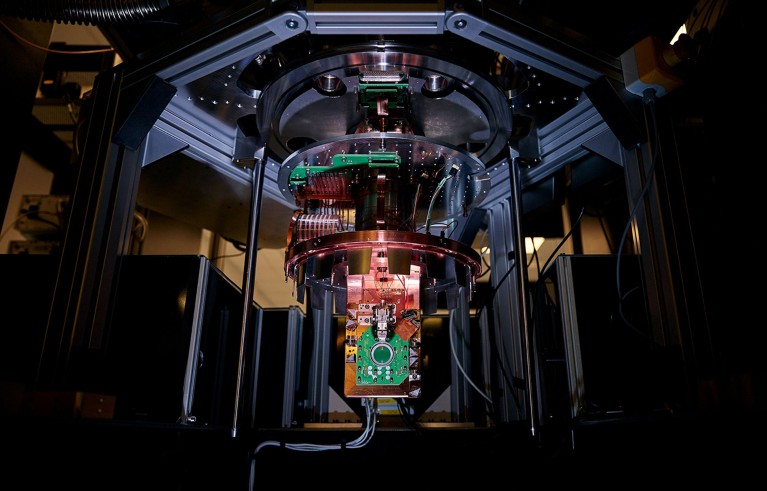
That optimism should be read carefully rather than as a countdown clock. The central obstacle hasn’t gone away: qubits are fragile. Interaction with their environment — stray electromagnetic fields, vibrations, temperature fluctuations, even cosmic rays — causes decoherence, the loss of the delicate superposition and entanglement a calculation depends on, usually within microseconds to milliseconds depending on the platform. A 2020 taxonomy of the quantum computing literature singles out decoherence and qubit interconnectivity — the difficulty of wiring together enough qubits with enough fidelity to do useful work — as two of the field’s defining open challenges on the road from today’s noisy, error-prone NISQ devices toward genuinely fault-tolerant machines. Quantum error correction, which spreads the information of one reliable “logical” qubit across many physical qubits, is the accepted path forward, but it is expensive: current estimates suggest that breaking modern encryption or simulating industrially useful molecules will require thousands to millions of physical qubits working together, once the overhead of error correction is included, far beyond the few hundred physical qubits that today’s best processors from IBM, Google, and others have demonstrated.
Why it matters, and what’s still genuinely open
The stakes explain why the field has attracted government labs, national initiatives at CERN and ESA, and sustained corporate investment from IBM, Google, and Microsoft, among others, all racing along different hardware paths at once. As NIST’s Carl Williams put it, describing the field’s competitive intensity, “the reality is that the global race is on.” What that race will actually deliver first — a machine that meaningfully speeds up drug discovery, one that threatens current encryption standards, or something unanticipated — remains an open question, and researchers are candid that they don’t yet know which applications will turn out to matter most. Whether a quantum computer large enough to break today’s encryption is even achievable within a reasonable timeframe is also still unsettled, which is precisely why cryptographers are already developing post-quantum encryption standards designed to resist a quantum attack that hasn’t arrived yet.
What is clear is that quantum computing has moved from a purely theoretical curiosity to an engineering problem with real, if partial, solutions and a research community that increasingly believes the remaining obstacles are hard but not fundamental. The second quantum revolution, as NIST frames it, is really a change in ambition: not just using quantum mechanics’ side effects, but building the tools to make quantum systems do exactly what we ask of them, one carefully controlled atom or photon at a time.
Sources
- NIST: The Second Quantum Revolution — https://www.nist.gov/physics/introduction-new-quantum-revolution/second-quantum-revolution
- NASA: What is Quantum Computing? — https://www.nasa.gov/technology/computing/what-is-quantum-computing/
- Nature News: Quantum computers will finally be useful — https://www.nature.com/articles/d41586-026-00312-6
- PubMed: Quantum computers will finally be useful — https://pubmed.ncbi.nlm.nih.gov/41639579/
- ScienceDirect: The Fundamentals of Quantum Computing — https://www.sciencedirect.com/science/chapter/bookseries/pii/S0065245825000956
- Nature Index: Quantum Technologies — https://www.nature.com/nature-index/topics/l3/quantum-technologies
- Nature Index: Quantum Entanglement in Quantum Computing Systems — https://www.nature.com/nature-index/topics/l4/quantum-entanglement-in-quantum-computing-systems
- arXiv: Quantum Technology: The Second Quantum Revolution — https://arxiv.org/abs/quant-ph/0206091
- arXiv: Harnessing the Power of the Second Quantum Revolution — https://arxiv.org/abs/2010.10283
- arXiv: Quantum Computing: A Taxonomy, Systematic Review and Future Directions — https://arxiv.org/abs/2010.15559
- arXiv: IBM Quantum Computers: Evolution, Performance, and Future Directions — https://arxiv.org/abs/2410.00916
- Nature npj Nanophotonics: Recent progress towards large-scale integrated photonic quantum computation — https://www.nature.com/articles/s44310-026-00114-8
- IBM Quantum Documentation — https://quantum.ibm.com/
- IBM Qiskit Documentation — https://qiskit.org/
- Google Quantum AI — https://quantumai.google/
- Microsoft Azure Quantum — https://azure.microsoft.com/products/quantum
- CERN Quantum Technology Initiative — https://quantum.cern/
- ESA Quantum Technologies — https://www.esa.int/Enabling_Support/Space_Engineering_Technology/Quantum_Technologies
- MIT Center for Quantum Engineering — https://cqe.mit.edu/
- Caltech Institute for Quantum Information and Matter — https://iqim.caltech.edu/
- University of Oxford Quantum Group — https://www.physics.ox.ac.uk/research/subdepartment/atomic-and-laser-physics/quantum
- Perimeter Institute Quantum Information — https://perimeterinstitute.ca/research/research-areas/quantum-information
- NIST Quantum Information Program — https://www.nist.gov/programs-projects/quantum-information
- APS Physics Quantum Information — https://aps.org/
- Quanta Magazine Quantum Computing — https://www.quantamagazine.org/tag/quantum-computing/