How James Clerk Maxwell’s 4 equations Unified Electricity and Magnetism
By 1861, physicists had three separate, well-tested subjects on their hands: electricity, magnetism, and optics. Each had its own laws, its own instruments, its own experts. James Clerk Maxwell looked at Michael Faraday’s rough, unmathematical picture of invisible “lines of force” filling the space around a magnet or a charge, translated it into a rigorous set of equations, and found something nobody had asked for: that the equations predicted a wave, moving at a speed that matched the speed of light almost exactly. Electricity, magnetism, and light were not three subjects. They were one.
Also read: Electricity and Magnetism Before Maxwell
From Faraday’s Field Lines to a Mathematical Theory
Maxwell did not discover electromagnetism from scratch. By the 1850s, Hans Christian Ørsted had shown that current produces magnetism, André-Marie Ampère had worked out the force between current-carrying wires, and Faraday had discovered that a changing magnetic field induces a current — the principle behind every generator and transformer built since. What was missing was a single mathematical framework tying these results together.
Faraday supplied the intuition but not the mathematics; he had almost no formal training in it and thought about electricity and magnetism visually, as lines of force stretching through space rather than as equations. Maxwell, a Cambridge-trained mathematician, spent much of the 1850s and 1860s doing something unusual for the time: taking Faraday’s physical pictures seriously enough to build a mathematical structure around them, rather than dismissing them as unrigorous. His first major paper on the subject, “On Faraday’s Lines of Force,” appeared in 1855–56. By 1865, in “A Dynamical Theory of the Electromagnetic Field,” he had assembled the complete theory. The equations reached their final, most compact form in his 1873 textbook, A Treatise on Electricity and Magnetism.
Four Equations, One Framework
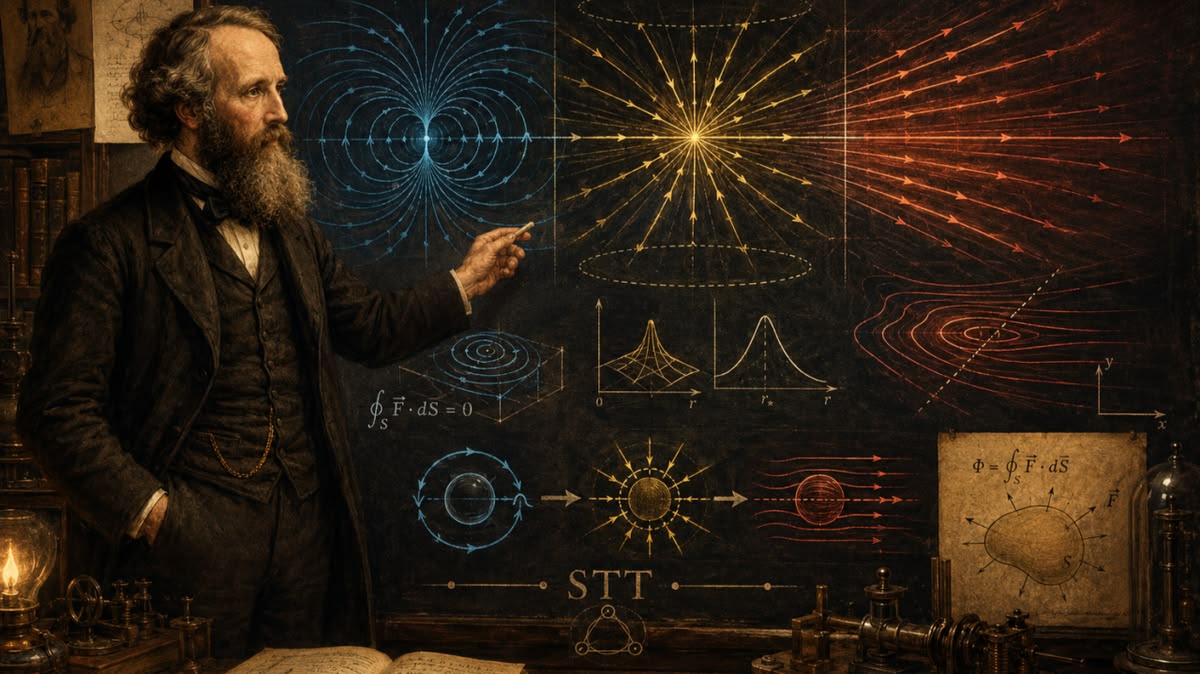
What we now call Maxwell’s equations describe how electric and magnetic fields are generated and how they relate to one another. In modern notation there are four of them, and while the full mathematics is beyond the scope of this piece, the physical content of each is straightforward:
- Gauss’s law for electricity, — electric field lines radiate outward from positive charges and inward toward negative ones; the total field passing through any closed surface is set by the charge enclosed.
- Gauss’s law for magnetism, $\nabla \cdot \mathbf{B} = 0$ — magnetic field lines never start or stop anywhere; every one forms a closed loop. There is no such thing as an isolated magnetic charge, or “magnetic monopole.”
- Faraday’s law of induction, $\nabla \times \mathbf{E} = -\dfrac{\partial \mathbf{B}}{\partial t}$ — a magnetic field that changes over time creates a circulating electric field around it. This is the principle Faraday discovered experimentally in 1831.
- The Ampère–Maxwell law, $\nabla \times \mathbf{B} = \mu_0 \mathbf{J} + \mu_0 \varepsilon_0 \dfrac{\partial \mathbf{E}}{\partial t}$ — a changing electric field creates a circulating magnetic field, and so does an electric current. The second term on the right was Maxwell’s own addition.
That last equation is where Maxwell’s real originality shows up. Ampère’s law, as it stood before Maxwell, only accounted for magnetic fields generated by currents actually flowing through a wire. Maxwell noticed the equation broke down in situations involving a charging capacitor, where current flows into one plate and out of the other but nothing physically crosses the gap between them. To patch the inconsistency, he proposed that a changing electric field acts exactly like a current for the purposes of generating a magnetic field — a term he called the “displacement current.” It was a mathematical repair with no experimental evidence behind it at the time. It turned out to be the single piece that made the whole theory self-consistent, and the piece responsible for everything that follows.
The Leap: Light Is an Electromagnetic Wave
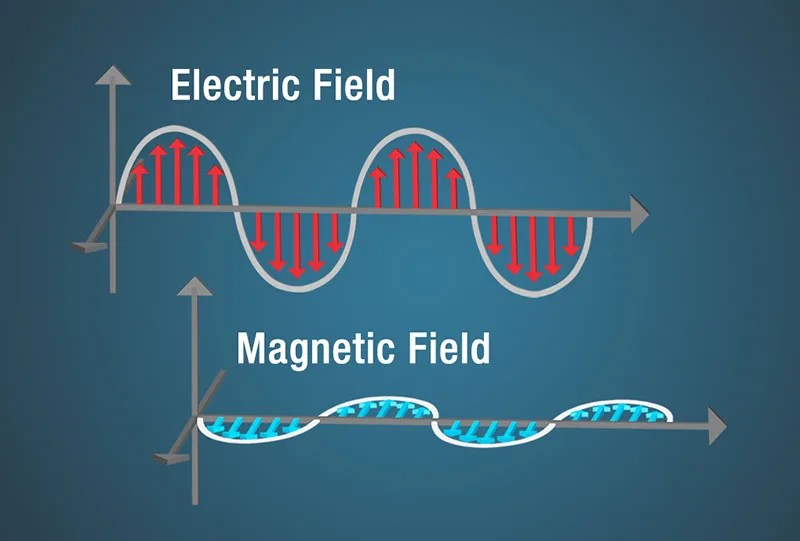
Once Faraday’s law and the Ampère–Maxwell law were both in place, Maxwell noticed something almost accidental. A changing magnetic field creates an electric field; a changing electric field creates a magnetic field. Combine the two, and a disturbance in either field can regenerate the other, over and over, propagating outward through space on its own — with no wire, no charge, and no matter required to carry it. His equations described a self-sustaining electromagnetic wave.
Maxwell then did the calculation that made this more than a mathematical curiosity. The speed of that wave, according to his equations, is fixed entirely by two measurable properties of empty space: the electric permittivity and the magnetic permeability. Both had already been measured in ordinary laboratory experiments having nothing to do with light. When Maxwell worked out what speed those two constants implied, the number came out within about one percent of the best available measurements of the speed of light.
That was too close to be a coincidence, and Maxwell said so directly: light itself, he concluded, is an electromagnetic disturbance, propagating as a wave according to the same laws that govern static electricity and magnetism. Optics — the study of lenses, mirrors, and colour, which had been its own scientific tradition since antiquity — turned out to be a special case of electromagnetism. Visible light was just the narrow band of electromagnetic waves that the human eye happens to detect.
Predicting the Invisible: Radio Waves
If visible light was only one slice of a broader electromagnetic spectrum, Maxwell’s equations implied that other slices should exist too — waves of different wavelengths, invisible to the eye but obeying exactly the same physics. Maxwell died in 1879 without seeing this confirmed. It fell to the German physicist Heinrich Hertz, working in the 1880s, to build the apparatus that could generate and detect these predicted waves directly.
Hertz’s experiments accomplished two things at once. First, they demonstrated in the laboratory what Maxwell had only calculated on paper: that these new waves traveled at the same velocity as light. Second, Hertz showed how to make electric and magnetic fields detach entirely from a wire and radiate freely through space, exactly as Maxwell’s theory said they should. The waves Hertz produced are what we now call radio waves, and the unit of wave frequency — one cycle per second — is named the hertz in his honor. Within a few decades, that same physics underpinned radio broadcasting, radar, and eventually the entire electromagnetic spectrum now used for everything from microwave ovens to medical X-rays.
Why Einstein Called It a Bold Leap
Albert Einstein, writing decades later, singled out Maxwell’s introduction of the displacement current as an act of unusual scientific courage — a step so bold that, in Einstein’s words, it took physicists years to grasp its full significance. What impressed Einstein specifically was not just the result but the method: Maxwell proposed a field theory, describing physical reality in terms of continuous fields filling space rather than particles acting on each other at a distance, which was a genuine break from the Newtonian tradition. Einstein later built his own general theory of relativity, in 1915, as a field theory in exactly this sense, and he credited Maxwell’s example as the template.
There is a more direct line as well. Maxwell’s equations imply that the speed of light in empty space is a fixed constant, set by the properties of the vacuum itself rather than by the motion of the observer or the source. That single feature of the equations refused to fit comfortably into Newtonian physics, where velocities simply add together depending on how the observer is moving. Reconciling that contradiction is essentially what Einstein’s 1905 special theory of relativity set out to do, and Maxwell’s equations survived the transition to relativity completely unchanged — a rare compliment for a nineteenth-century theory.
Why It Matters
Maxwell’s unification did more than tidy up three branches of physics into one. It changed what counted as a fundamental question. Before Maxwell, asking “what is light?” and “what is electricity?” were unrelated questions handled by different specialists. After Maxwell, they were the same question, answered by the same four equations. That shift from separate laws toward a single underlying field is the same pattern that later drove the search for a unified theory of the fundamental forces, a project still unfinished today.
The practical consequences are just as large. Every radio transmitter, television broadcast, mobile phone signal, Wi-Fi router, and satellite communication link is, at bottom, a direct engineering application of the electromagnetic wave that Maxwell’s equations predicted more than a century before any of those technologies existed. Very few theoretical results in the history of science have translated so directly and so completely into the built environment of everyday life.
Open Questions and Caveats
A few things are worth being precise about. Maxwell himself believed his equations described vibrations in a physical medium called the “luminiferous aether,” which he thought filled all of space and carried electromagnetic waves the way air carries sound. That part of his thinking did not survive: later experiments failed to detect any trace of the aether, and Einstein’s special relativity eventually did away with the need for one entirely. The equations themselves needed no correction; only Maxwell’s mechanical picture of what was doing the waving turned out to be wrong.
It’s also worth being clear that Maxwell’s theory is a classical field theory. It describes electromagnetism completely at the scale of everyday currents, radio transmitters, and optics, but it does not include quantum effects — those had to wait for quantum electrodynamics in the twentieth century, which absorbed Maxwell’s equations as a limiting case rather than replacing them. And while this piece credits Maxwell with the decisive synthesis, the underlying experimental results he unified were themselves the product of decades of work by Ørsted, Ampère, Faraday, and others; Maxwell’s achievement was the mathematical unification, not the discovery of electromagnetism from nothing.
Sources
- James Clerk Maxwell — A Dynamical Theory of the Electromagnetic Field (1865): https://royalsocietypublishing.org/doi/10.1098/rstl.1865.0008
- Nature — James Clerk Maxwell Collection: https://www.nature.com/collections/xllsfwrbfp
- Nature — A Bold Unifying Leap: https://www.nature.com/articles/471265a
- Nature — A Treatise on Electricity and Magnetism (1873 Review): https://www.nature.com/articles/007478a0
- NASA Science — Anatomy of an Electromagnetic Wave: https://science.nasa.gov/ems/02_anatomy/
- NASA Science — Forces: Electromagnetic Force: https://science.nasa.gov/universe/overview/forces/
- NASA Goddard — Maxwell and Hertz: https://pwg.gsfc.nasa.gov/Electric/-E27-Waves.htm
- ScienceDirect (Endeavour) — Exploring the Mathematical and Interpretative Strategies of Maxwell’s Treatise: https://www.sciencedirect.com/science/article/abs/pii/S0160932700013831
- ScienceDirect — James Clerk Maxwell, A Treatise on Electricity and Magnetism (Landmark Writings): https://www.sciencedirect.com/science/article/abs/pii/B978044450871350125X
- Nature Materials — Classical Monument: Maxwell’s Equations: https://www.nature.com/articles/milephotons02
- Clerk Maxwell Foundation — The Impact of James Clerk Maxwell’s Work: https://clerkmaxwellfoundation.org/html/maxwell-s_work.html
- MIT OpenCourseWare — Electricity and Magnetism: https://ocw.mit.edu/courses/8-02sc-physics-ii-electricity-and-magnetism-fall-2010/
- MIT OpenCourseWare — Electromagnetism: https://ocw.mit.edu/courses/8-07-electromagnetism-ii-fall-2012/
- Feynman Lectures on Physics, Volume II: https://www.feynmanlectures.caltech.edu/II_toc.html
- Encyclopaedia Britannica — James Clerk Maxwell: https://www.britannica.com/biography/James-Clerk-Maxwell
- Encyclopaedia Britannica — Maxwell’s Equations: https://www.britannica.com/science/Maxwells-equations
- APS Physics — September 1905: Energy and Mass are Equivalent: https://www.aps.org/apsnews/2005/04/september-1905-energy-mass-equivalent
- APS News — Einstein and the Photoelectric Effect: https://www.aps.org/apsnews/2005/01/einstein-photoelectric-effect
- Physics Magazine (APS) — Quantum Milestones: Einstein and the Photoelectric Effect: https://physics.aps.org/articles/v18/15
- Einstein Papers Project (Caltech): https://www.einstein.caltech.edu/
- American Institute of Physics — James Clerk Maxwell and Einstein: https://history.aip.org/exhibits/einstein/ae18.htm
- Institute for Advanced Study — Albert Einstein: The Great Works: https://www.ias.edu/albert-einstein-great-works
- National Archives — Collected Papers of Albert Einstein: https://www.archives.gov/nhprc/projects/catalog/albert-einstein
- Cambridge Digital Library — James Clerk Maxwell Papers: https://cudl.lib.cam.ac.uk/collections/maxwell
- University of St Andrews — MacTutor Biography of James Clerk Maxwell: https://mathshistory.st-andrews.ac.uk/Biographies/Maxwell/
- IEEE History Center — History of Electromagnetism: https://ethw.org/
- Physics World: https://physicsworld.com/
- Encyclopedia of Mathematics — Maxwell Equations: https://encyclopediaofmath.org/wiki/Maxwell_equations
- Internet Archive — A Treatise on Electricity and Magnetism (1873): https://archive.org/details/electricandmagne01maxw
- Internet Archive — A Treatise on Electricity and Magnetism, Volume II: https://archive.org/details/electricandmagne02maxw
- Project Gutenberg — Scientific Papers of James Clerk Maxwell: https://www.gutenberg.org/
- NASA History Office — Electromagnetic Spectrum Resources: https://history.nasa.gov/
- ESA — Electromagnetic Spectrum Overview: https://www.esa.int/
- HyperPhysics (Georgia State University) — Maxwell’s Equations: http://hyperphysics.phy-astr.gsu.edu/
- HyperPhysics — Electromagnetic Waves: http://hyperphysics.phy-astr.gsu.edu/hbase/Waves/emwv.html
- Khan Academy — Magnetic Forces, Magnetic Fields, and Faraday’s Law: https://www.khanacademy.org/science/physics/magnetic-forces-and-magnetic-fields
- Khan Academy — Maxwell’s Equations and Electromagnetic Waves: https://www.khanacademy.org/science/physics/light-waves
- Stanford Encyclopedia of Philosophy — James Clerk Maxwell: https://plato.stanford.edu/
- NIST Digital Library — Electromagnetism Resources: https://www.nist.gov/
- Perimeter Institute — Electromagnetism Educational Resources: https://perimeterinstitute.ca/
- Royal Society — James Clerk Maxwell Archive: https://royalsociety.org/

One Comment