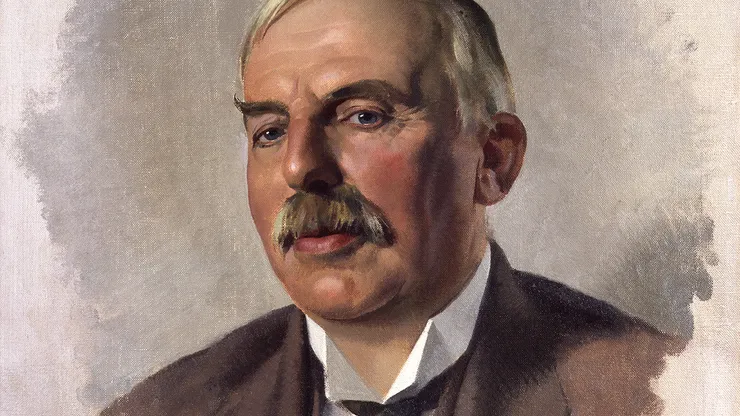
Rutherford and the Discovery of the Atomic Nucleus
In 1909, a nineteen-year-old undergraduate at the University of Manchester was handed an experiment nobody expected to produce anything. Ernest Rutherford told him to check whether alpha particles, fired at a thin sheet of gold foil, ever bounced straight back. They weren’t supposed to. The prevailing model of the atom offered no mechanism for it. When the student, Ernest Marsden, reported that a small fraction of the particles were indeed scattering backward, Rutherford later said it was almost as hard to believe as a heavy shell bouncing off tissue paper.
That single, unexpected result forced Rutherford to abandon the atomic model everyone had been using and propose something stranger: an atom that is almost entirely empty space, with nearly all of its mass and all of its positive charge crammed into a tiny core at the centre. This article walks through how the plum pudding model fell apart, what the gold foil experiment actually showed, how Rutherford reasoned his way to the nucleus, and the questions his discovery left wide open.
Also read: 1905: Einstein’s miracle year
The atom everyone believed in
By the first decade of the twentieth century, physicists had already accepted that atoms weren’t indivisible. J.J. Thomson, working at the Cavendish Laboratory in Cambridge, had discovered the electron in 1897 — a tiny, negatively charged particle far lighter than any atom. That discovery created an obvious problem. If atoms contained negative electrons, and atoms themselves are electrically neutral overall, something inside the atom had to carry an equal and opposite positive charge.
Thomson’s answer, proposed in 1904, became known as the plum pudding model. He pictured the atom as a sphere of positively charged material, roughly the size of the whole atom, with electrons distributed through it like raisins suspended in a pudding — or, in Thomson’s own preferred picture, more like currants floating in a fluid than fixed in a solid. There was no dense centre in this model. The positive charge and the mass of the atom were both spread out evenly across its full width.

The model wasn’t a guess pulled from nowhere. It accounted for the two things anyone knew for certain about atoms at the time: that they contained electrons, and that they carried no net charge. It also predicted something specific and testable — that if you fired a fast, heavy, positively charged particle through a thin sheet of matter, it would pass through with only slight, gentle deflections, because the positive charge it encountered along the way would always be thinly spread out, never concentrated enough in one place to give it a hard shove.
An experiment nobody expected to matter
Rutherford had moved from Montreal to Manchester in 1907, bringing with him a research programme built around alpha particles — the positively charged, helium-nucleus-sized projectiles thrown off by radioactive elements like radium. Working with Hans Geiger, a skilled experimentalist he’d inherited from his predecessor, Rutherford spent 1908 refining ways to detect and count individual alpha particles, including an early ancestor of the Geiger counter.
By late 1908, Geiger and a young Ernest Marsden were firing alpha particles at thin metal foils and measuring how far the beam spread out after passing through — exactly the small-angle scattering the plum pudding model predicted. Almost as an aside, Rutherford suggested Marsden also check for any particles scattered at large angles, well off to the side or even backward. It was a long shot, and Rutherford didn’t expect it to turn up anything. Marsden ran the test anyway.
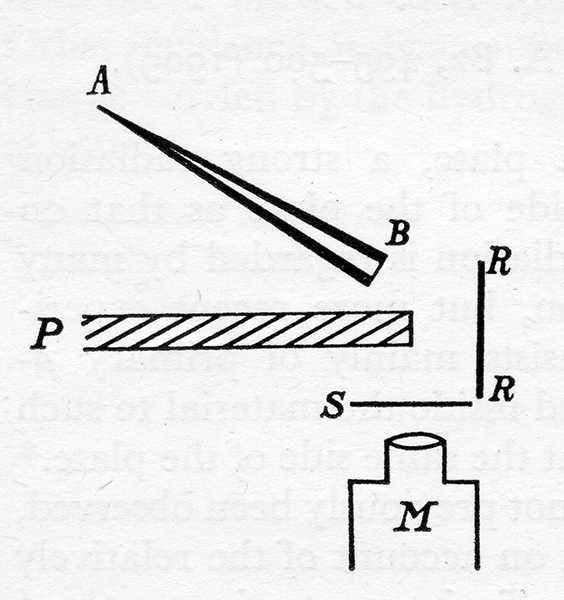
Sitting in a darkened room, watching a zinc-sulfide screen flash faintly each time it was struck, Marsden found something the plum pudding model had no way to explain: roughly one in every few thousand alpha particles bounced back at an angle greater than ninety degrees. Geiger and Marsden published the finding in 1909, and Rutherford spent more than a year turning the puzzle over before he had an explanation he was willing to publish.
Why a diffuse positive charge couldn’t do it
The reasoning that convinced Rutherford something was wrong with the plum pudding model comes down to a simple point about forces and distances. An alpha particle is thousands of times more massive than an electron, and it’s moving fast — deflecting it sharply, let alone sending it backward, takes a genuinely strong shove. In Thomson’s model, the positive charge of an atom is smeared across the entire atomic volume, so an alpha particle passing through never gets very close to a concentrated source of charge. The forces it feels are always gentle, and the small nudges from many atoms mostly average out. Rutherford worked out that this kind of diffuse charge simply couldn’t generate a force big enough to turn a fast alpha particle around, no matter how many atoms it passed by.
The only way to produce that kind of dramatic deflection, Rutherford reasoned, was if the alpha particle occasionally passed very close to a much smaller, much more concentrated source of positive charge — something dense enough that its electric field, right at close range, could be strong enough to repel a fast, heavy particle straight back the way it came. Everywhere else in the atom, that same particle would sail through untouched, because the rest of the atom would turn out to be almost entirely empty.
The nuclear atom
Rutherford announced his new model in 1911, first at a talk in Manchester and then in a paper in the Philosophical Magazine that May. Nearly all of an atom’s mass and all of its positive charge, he proposed, are concentrated in a tiny central body — what would later be called the nucleus — with the negatively charged electrons occupying the much larger volume of mostly empty space around it. He worked out that this central charge had to be extremely small: on the order of one hundred-thousandth the diameter of the atom as a whole.

It’s worth being precise about what Rutherford had and hadn’t shown at this point. He hadn’t yet settled whether the central charge was positive or negative — his May 1911 paper noted that the mathematics of the scattering worked out the same either way, since the sharp deflection depends on the strength of the charge, not its sign. He also had no idea what the nucleus was made of. What he had established, carefully and mathematically, was that an atom’s positive charge and mass are not spread out but concentrated in a space many thousands of times smaller than the atom itself.
Putting the model to the test
An idea this disruptive needed more than one striking result behind it. Over 1912 and 1913, Geiger and Marsden went back to the foils and ran a much more systematic set of measurements, rotating a microscope and screen around the target to map out exactly how many alpha particles scattered at every angle, through a range of different metal foils and particle speeds.
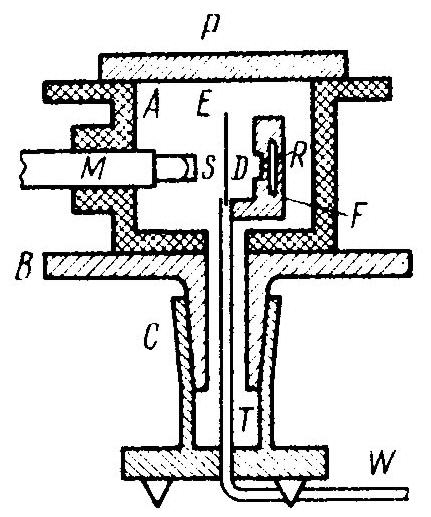
Their results matched three specific predictions that fell directly out of Rutherford’s nuclear model: the number of particles scattered through a given angle rose in proportion to the thickness of the foil, rose with the square of the nuclear charge of the target atoms, and fell off sharply — inversely with the fourth power — as the speed of the alpha particles increased. Getting all three relationships to hold up against real measurements, across different elements, was strong quantitative confirmation that the nuclear picture wasn’t just a plausible story but a mathematically precise description of what was happening inside the atom.
Why the discovery mattered
The nuclear atom didn’t just replace one diagram with another — it reframed what an atom actually is. Matter, it turned out, is overwhelmingly empty space: if you scaled a hydrogen atom up so its nucleus were the size of a marble, the electron would orbit more than a kilometre away. Almost everything solid about the world we touch and stand on is really the electric repulsion between electron clouds, not densely packed material.
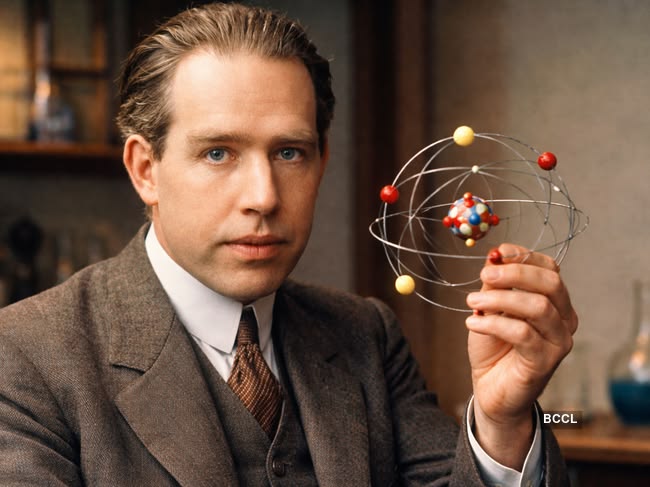
The model also had an immediate problem that classical physics couldn’t answer. According to the electromagnetic theory of the day, an electron circling a nucleus should continuously radiate energy and spiral inward within a fraction of a second, collapsing the atom. Rutherford’s structure was right about where the charge and mass sat, but it took Niels Bohr, who joined Rutherford’s Manchester group in 1912, to save the model by borrowing the new idea of quantised energy levels — electrons could only occupy specific, fixed orbits, not spiral gradually between them. That fix, in 1913, became the doorway into quantum mechanics.
Inside the nucleus itself
Rutherford wasn’t finished with the atom’s centre. During and after the First World War, he and his lab steward William Kay began firing alpha particles through hydrogen and nitrogen gas, looking for signs that the nucleus itself had internal structure. In 1919, Rutherford reported something unexpected: when alpha particles passed through nitrogen, they occasionally knocked loose a fast-moving hydrogen nucleus — far more of them than a simple collision with stray hydrogen contamination could explain.
His conclusion, stated cautiously, was that the nitrogen nucleus itself had been broken apart by the collision, and that a hydrogen nucleus was a fundamental building block found inside heavier nuclei too. In 1920, Rutherford proposed the name proton for this particle. It was the first artificially induced nuclear disintegration ever observed, and it meant the atomic nucleus — barely a decade old as a concept — already had pieces of its own.
The questions Rutherford couldn’t answer
Rutherford’s nucleus raised at least as many questions as it settled. If the nucleus contained positively charged protons packed into an impossibly small space, what stopped their mutual electric repulsion from tearing the nucleus apart instantly? The force responsible — what physicists would eventually call the strong nuclear force — was entirely unknown in 1911 and wouldn’t be properly understood for decades.
There was also a straightforward arithmetic problem. The mass of most atoms was roughly double what you’d expect from counting protons alone against their atomic charge, which meant something else with mass but no charge had to be sitting in the nucleus too. Rutherford himself speculated as early as 1920 that a neutral particle of about the same mass as the proton must exist, though it took until 1932, and Rutherford’s former student James Chadwick, to actually detect the neutron and confirm it. And Rutherford’s own scattering experiments, however carefully done, could only measure how alpha particles behaved from the outside — they said nothing about what, if anything, was moving inside the nucleus, or how it was held together.
A discovery still being built on
Rutherford always described his method as testing an idea against the harshest evidence he could find, and refusing to claim more than the data supported. That’s exactly the pattern that runs through the whole story: a plum pudding model that fit the known facts until one deliberately awkward experiment broke it, a nuclear model proposed cautiously and only after the numbers were checked, and then a decade of further experiments — Geiger and Marsden’s systematic angle measurements, Bohr’s quantum fix, Rutherford’s own proton experiments — that turned a startling result into settled physics.
What makes the 1911 paper remarkable in hindsight isn’t that it answered everything. It answered almost nothing about what the nucleus contained or what held it together. What it did was correctly relocate the problem, showing exactly where in the atom the real physics was hiding. Every major advance in nuclear and particle physics since — the neutron, the strong force, fission, the entire standard model of particle physics — has been an attempt to answer the questions Rutherford’s tiny, dense, unexplained centre of the atom first forced into existence.
Sources
- Ernest Rutherford – The Scattering of α and β Particles by Matter and the Structure of the Atom: https://www.tandfonline.com/doi/abs/10.1080/14786440508637080
- Hans Geiger & Ernest Marsden – On a Diffuse Reflection of the α-Particles: https://royalsocietypublishing.org/doi/10.1098/rspa.1909.0054
- Hans Geiger – The Scattering of the α-Particles by Matter: https://royalsocietypublishing.org/
- J.J. Thomson – On the Structure of the Atom: https://royalsocietypublishing.org/
- American Physical Society – May 1911: Rutherford and the Discovery of the Atomic Nucleus: https://www.aps.org/apsnews/2006/05/rutherford-discovery-atomic-nucleus
- American Institute of Physics – Rutherford’s Nuclear World: https://history.aip.org/exhibits/rutherford/
- American Institute of Physics – Alpha Particles and the Atom: https://history.aip.org/exhibits/rutherford/sections/alpha-particles-atom.html
- American Institute of Physics – Exploring Radioactivity: https://history.aip.org/exhibits/rutherford/sections/exploring-radioactivity.html
- American Physical Society – June 1911: Invention of the Geiger Counter: https://www.aps.org/apsnews/2012/06/june-1911-invention-geiger-counter
- American Physical Society – Bohr Describes His Model of the Atom to Rutherford: https://www.aps.org/apsnews/2012/03/bohr-model-atom-rutherford
- NASA HEASARC – History of Gamma-Ray Astronomy: https://heasarc.gsfc.nasa.gov/docs/history/
- Helge Kragh – Rutherford, Radioactivity, and the Atomic Nucleus: https://arxiv.org/abs/1202.0954
- Charles Baily – Early Atomic Models: From Mechanical to Quantum (1904–1913): https://arxiv.org/abs/1208.5262
- Nature Education – The Structure of the Atom: https://www.nature.com/scitable/
- Encyclopaedia Britannica – Ernest Rutherford: https://www.britannica.com/biography/Ernest-Rutherford
- Encyclopaedia Britannica – Gold-Foil Experiment: https://www.britannica.com/science/Rutherford-model
- Royal Society – Ernest Rutherford Papers: https://royalsociety.org/
- Nobel Prize – Ernest Rutherford Biography: https://www.nobelprize.org/prizes/chemistry/1908/rutherford/biographical/
- Nobel Prize – Ernest Rutherford Facts: https://www.nobelprize.org/prizes/chemistry/1908/rutherford/facts/
- CERN – The Structure of Matter: https://home.cern/science/physics
- CERN – Protons: https://home.cern/science/physics/protons
- HyperPhysics (Georgia State University) – Rutherford Scattering: http://hyperphysics.phy-astr.gsu.edu/
- MIT OpenCourseWare – Atomic Physics: https://ocw.mit.edu/
- Stanford Encyclopedia of Philosophy – The Development of Atomic Theory: https://plato.stanford.edu/
- Physics LibreTexts – Rutherford Model of the Atom: https://phys.libretexts.org/
- Chem LibreTexts – Rutherford’s Gold Foil Experiment: https://chem.libretexts.org/
- OpenStax Chemistry – Early Models of the Atom: https://openstax.org/books/chemistry-2e/
- Feynman Lectures on Physics – Atomic Theory: https://www.feynmanlectures.caltech.edu/
- University of Cambridge – Cavendish Laboratory History: https://www.phy.cam.ac.uk/
- Encyclopaedia Britannica – J.J. Thomson: https://www.britannica.com/biography/J-J-Thomson
- Encyclopaedia Britannica – Proton: https://www.britannica.com/science/proton
- Encyclopaedia Britannica – Atomic Nucleus: https://www.britannica.com/science/atomic-nucleus
- Reviews of Modern Physics – Historical Reviews on Atomic Structure: https://journals.aps.org/rmp/
- Physical Review Journals: https://journals.aps.org/
- Nature Reviews Physics: https://www.nature.com/natrevphys/
- Science History Institute – Ernest Rutherford: https://www.sciencehistory.org/
- Royal Society Publishing – Historical Papers on Atomic Structure: https://royalsocietypublishing.org/
- Proceedings of the Royal Society A: https://royalsocietypublishing.org/journal/rspa
- Philosophical Magazine Archive: https://www.tandfonline.com/journals/tphm20
- National Institute of Standards and Technology (NIST) – Atomic Physics: https://www.nist.gov/pml/atomic-physics
- Institute of Physics – Rutherford and the Nuclear Atom: https://www.iop.org/



2 Comments