
How Ancient Humans First Tried to Understand Nature
Before there was science, there was wonder. And long before wonder became systematic, it became myth.
The World Before Explanations
Imagine waking up every morning without knowing why the Sun rises. You do not know what it is, where it goes at night, or whether it will return. A storm kills your livestock. A drought starves your village. An eclipse blots out the midday sky without warning. You have no instruments, no written records, no scientific tradition to draw from. What you have is a mind — restless, pattern-hungry, and desperate to make sense of a world that can seem deeply hostile.
This was the condition of early human beings for most of our existence as a species. And their first response to that condition was not silence. It was story.
The birth of human understanding did not begin in a laboratory. It began around fires, in caves, under open skies — with people telling each other why things are the way they are. That process, messy and imaginative and deeply human, eventually gave rise to something extraordinary: science itself.
Myths as the First Explanations of Nature
A myth, in its original sense, is not a falsehood. According to Britannica’s entry on myth, it is “a symbolic narrative, usually of unknown origin and at least partly traditional, that ostensibly relates actual events and that is especially associated with religious belief.” Myths were accounts of gods or superhuman beings involved in extraordinary events — and crucially, they were treated as authoritative truth, not fiction.
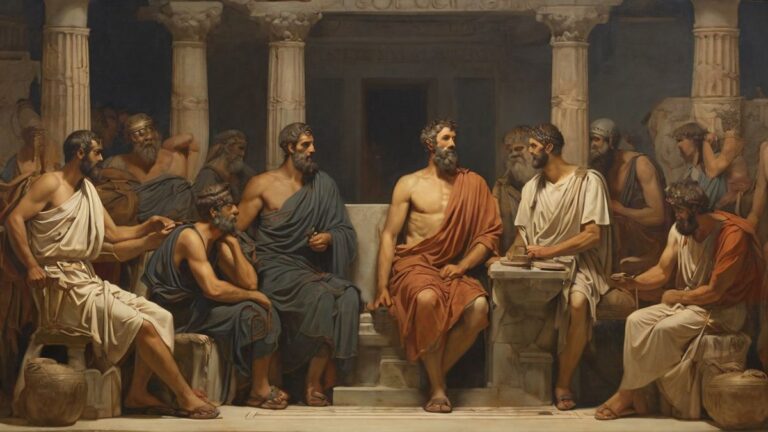
Early humans confronted natural events they could not control or comprehend: thunder, floods, disease, the movements of stars. Their solution was to personify these forces. Rain did not fall because of atmospheric pressure — it fell because a deity willed it. The Sun did not rise because of Earth’s rotation — it was carried across the sky by a divine being. Lightning was the weapon of a god in a bad mood.
This was not ignorance in the careless sense. It was explanation — the only kind available. Myth served several vital functions at once. It provided a causal account of the world (“the river flooded because the river god was angry”). It embedded the community within a moral and cosmic order. And it gave people a way to act: if the flood came from a god, you could make offerings, perform rituals, seek forgiveness. Myth gave agency in a world that otherwise offered none.
The Greek word mythos — from which “myth” derives — originally meant simply “word” or “story.” Its opposite was logos, the word whose truth could be argued and demonstrated. This contrast is not incidental. It sits at the very heart of the transition from myth to science.
The Sky as the First Laboratory
Long before myths gave way to systematic reasoning, early humans were already doing something that looked surprisingly like science: they were watching the sky, noting patterns, and recording what they saw.
They had very good reasons to pay attention. The movements of the Sun determined the rhythm of daily life. The seasons — critical for agriculture and animal migration — were written in the sky. The Moon provided a reliable way to track time across months. In a world without calendars or clocks, the heavens were the only reliable clock humanity had.
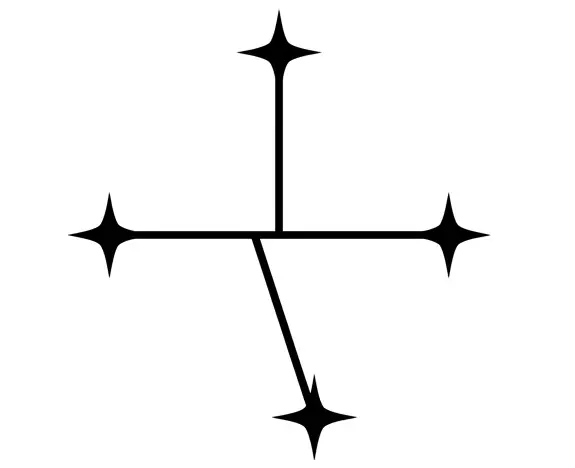
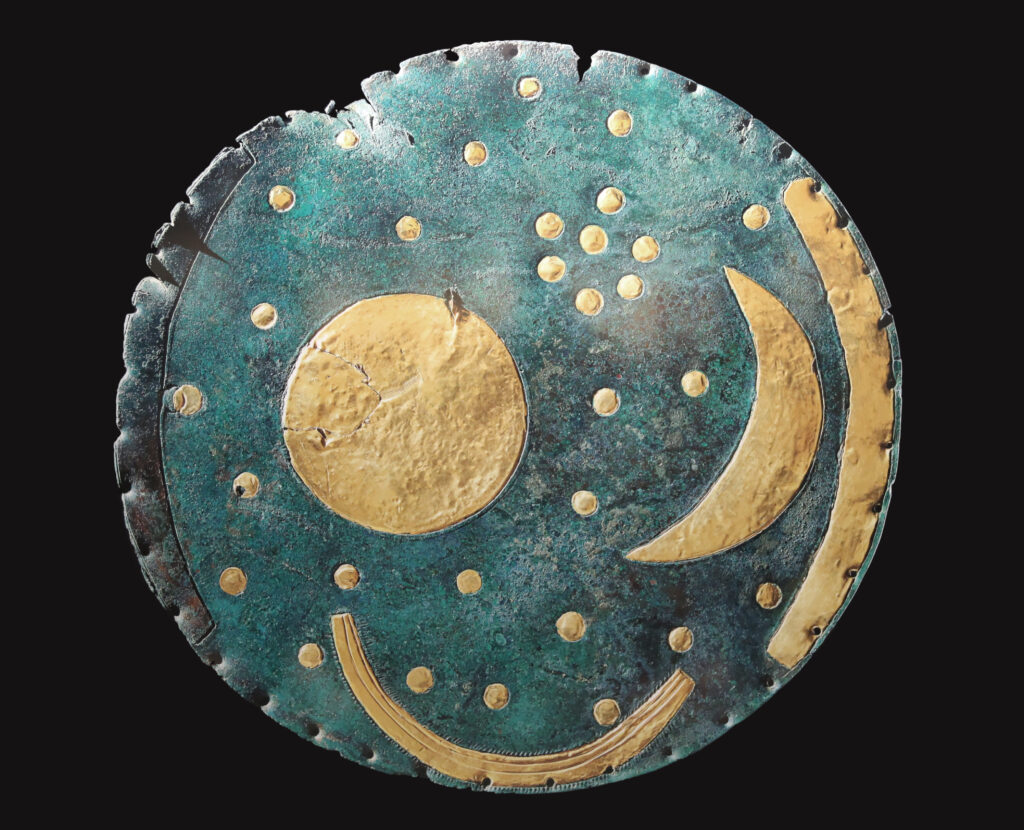
Archaeological evidence shows how deep this preoccupation ran. In France’s Vallée des Merveilles, Bronze Age petroglyphs dating to roughly 2900–1800 BCE include a clear image of the Sun with rays radiating outward, and what archaeoastronomers believe may be depictions of the Pleiades star cluster. The Nebra Sky Disk, a circular bronze plate found in Saxony-Anhalt, Germany and dated to around 1600 BCE, bears golden images of a crescent Moon, the Sun or full Moon, and seven dots almost certainly representing the Pleiades — one of the most striking pieces of prehistoric astronomical imagery ever discovered.
Stonehenge, constructed between roughly 3000 and 1520 BCE on England’s Salisbury Plain, was deliberately aligned so that its principal axis pointed toward sunrise on the summer solstice. The builders had no writing, no mathematics as we know it, no formal astronomical theory. And yet they arranged massive stones across a landscape to mark the sky’s most significant moment of the year. Whatever beliefs drove that construction — and they remain genuinely obscure — they required sustained, careful observation over generations.

As the European Space Agency’s history of astrometry notes, “Archaeological records show that astronomy is one of the first natural sciences developed by early civilisations all over the globe.” These prehistoric skywatchers “could perform only limited investigations of the sky, using rudimentary aids to the human eye” — but they had already begun measuring the positions of celestial bodies, laying the foundations of what would eventually become a formal science.
Mesopotamia: Where Astronomy Became Systematic
The leap from informal sky-watching to something recognizably scientific happened first, and most dramatically, in ancient Mesopotamia — the region between the Tigris and Euphrates rivers that now forms much of modern Iraq.
Babylonian astronomy stands out in the ancient world for a specific reason: it was institutionalized. Temple scribes — often priests — were employed to watch the sky every night and record what they saw. They had a social mandate to do so, because in Babylonian thought, the heavens sent signs from the gods to warn the king about war, famine, or epidemic.

The sky was not merely interesting; it was politically and religiously necessary to understand. This gave astronomical observation a stable, funded, bureaucratic home.
They also had a technology for preserving records that other early civilizations lacked: the clay tablet. Pressed with cuneiform script, baked and stored in temples, these tablets were nearly indestructible. When one broke, it was recopied. The result was an accumulating database of celestial observations that no other ancient culture possessed at comparable scale.
The earliest sophisticated astronomical records from Babylonia date to around the early second millennium BCE, with Venus observations preserved from that period. By the 7th century BCE, Babylonian astronomers were keeping detailed astronomical diaries — night-by-night records of when planets passed reference stars, when Venus reemerged from invisibility near the Sun, when Jupiter reversed direction into retrograde motion. These observations were not always precise, but as Britannica notes, “it is far more important to have a long run of observations than to have precise ones.”
That long run paid off. Within a few generations, Babylonian astronomers discovered that planetary motions were cyclical. Venus completes its repeating pattern of retrograde behavior every 8 years. Mars every 47 years. Saturn every 59 years. By identifying these cycles, Babylonian scribes could predict future planetary behavior by simply looking back in the records. This was the first predictive astronomy in history — achieved not through physical theory, but through pattern recognition and careful record-keeping.
By around 300 BCE, Babylonian astronomers had gone further still, developing complex arithmetical theories that could predict planetary positions without waiting for the repeating cycles. They divided the sky into the 360-degree zodiac — a convention still in use today — and assigned each planet a mathematical model describing how it moved through it. This was genuinely abstract, quantitative, systematic science, developed in service of what was ultimately a religious and state function.
Egypt and the Practical Stars
Egypt’s astronomical tradition ran alongside Babylon’s, though with a different character. Where Babylonian astronomy was primarily predictive and tied to celestial divination, Egyptian astronomy was more immediately practical.
The Egyptians used the stars to regulate their calendar and religious life with extraordinary precision. The annual flooding of the Nile — the foundation of Egyptian agriculture and civilization — was heralded by the heliacal rising of Sirius, the brightest star in the sky. When Sirius appeared just before dawn on the eastern horizon after weeks of invisibility, the flood was coming. This single celestial event organized the Egyptian year.
The great pyramids at Giza, constructed during the Old Kingdom (roughly 2600–2500 BCE), were aligned with remarkable precision to the cardinal directions, with shafts in the Great Pyramid oriented toward specific stars. The Egyptians divided the night sky into 36 groups of stars called decans, each rising consecutively through the year, and used them as a kind of stellar clock to track the hours of the night. These were not casual observations — they required systematic, sustained attention to the sky across seasons and years.
Egyptian astronomical knowledge fed into later Hellenistic and then Islamic science. The fusion of Egyptian star lore with Babylonian mathematical astronomy, mediated by Greek thinkers at Alexandria, eventually produced one of the most sophisticated astronomical systems of the ancient world.
Why Curiosity Gave Birth to Science
It is tempting to read the history of early astronomy as purely utilitarian — people watched the sky because they needed to know when to plant crops or predict floods. That is part of the story, but not the whole of it.
The ESA history of astrometry puts it plainly: “Curiosity alone did not inspire the earliest astronomers: astronomy and astrometry were practical sciences too.” But the phrasing implies that curiosity was present alongside the practical motive — and the evidence supports that. People gave names to stars, told stories about constellations, built monuments to mark solstices, debated the nature of the cosmos. These are not the actions of people who were only solving logistical problems.
Britannica’s history of science makes the point that science, in its deepest sense, is “knowledge of natural regularities that is subjected to some degree of skeptical rigour and explained by rational causes.” What makes the Babylonian astronomical tradition so remarkable is that it gradually moved toward exactly this. The early celestial omen literature was mythological — the gods were sending signs. But the arithmetic planetary theories of 300 BCE were mathematical models, not stories about divine will. The interpretive frame had shifted.
This shift was driven by accumulation. When you record observations night after night, year after year, century after century, patterns emerge that cannot be explained by caprice. The planets do not move randomly; they follow rules. And once you notice that, the temptation to ask why — and to seek a systematic answer — becomes irresistible. Curiosity and need together pushed observation into theory.
The Difference Between Myth and Systematic Observation
Myth and early science are not simply opposites. They share something important: both are attempts to explain the world. The difference lies not in the desire to understand, but in the method.
A myth explains by narrating. The Sun crosses the sky because the god Ra drives his solar boat across the celestial river. This is a complete explanation in the sense that it is satisfying, coherent, and actionable within its cultural context. But it cannot be tested. It cannot be refined by observation. If the Sun behaves differently than expected, the myth can always accommodate the anomaly by adding another story.
Systematic observation, by contrast, is self-correcting. When Babylonian astronomers noticed that their early predictions were wrong, they went back to the records and revised their models. Their goal-year texts — looking back 8 years for Venus, 47 for Mars, 59 for Saturn — were not stories. They were empirical tools, built on the recognition that if the pattern held before, it should hold again, and if it does not, the model is wrong.
The Greek philosophical tradition sharpened this distinction by insisting on logos over mythos — on explanation through reason rather than narrative. But it was the Babylonian observational tradition that provided the data which Greek thinkers later transformed into geometric models of the cosmos. Neither tradition alone produced modern science; together, they set the stage for it.
What separates myth from science is not imagination — both are imaginative. It is accountability. Science demands that explanations answer to evidence. Myth answers to tradition and authority. The long, slow transition from one to the other is the story of the first chapter of human knowledge.
The Legacy of the First Astronomers
The continuity from ancient sky-watching to modern science is more direct than it might seem. The 360-degree circle still used in mathematics and navigation was a Babylonian convention. The 60-minute hour is Babylonian. The magnitude system used by astronomers today to describe stellar brightness was invented by Hipparchus of Nicaea in the second century BCE, building on Babylonian foundations. The very zodiac that appears in modern horoscopes is a relic of Babylonian celestial bookkeeping.
The prehistoric people who carved the Sun into rock in the French Alps, the Babylonian temple scribes logging Venus’s behavior on clay tablets, the Egyptian priests watching for Sirius at dawn — they were not doing science in the modern sense. But they were doing something that made science possible: they were looking carefully at the world, noting what they saw, and trying to make sense of it.
That impulse — the unwillingness to accept the world as merely given, the insistence on asking why — is not a feature of modernity. It is a feature of the human mind. Ancient myth and ancient astronomy are its first expressions.
Sources
- History of Science — Encyclopaedia Britannica
- History of Astronomy — Encyclopaedia Britannica
- The Oldest Sky Maps: A History of Astrometry — ESA / Gaia Science Portal
- Science and Ancient Mesopotamia — The Cambridge History of Science
- Tablet of Shamash — British Museum Collection
- Metropolitan Museum of Art — Ancient Near East Collection
- A Brief Timeline of the History of Science — Phillip and Phyllis Morrison / NASA
- Myth — Encyclopaedia Britannica