Greek Philosophers and the Birth of Rational Thinking
Before science, there was myth. Then, in a small coastal city in what is now Turkey, a few remarkable thinkers asked a different kind of question — not who made the world, but what it is made of, and how it works. That shift, quiet as it seems, changed everything.
The Problem with Gods: Why Ancient Greece Needed a New Kind of Explanation
For most of human history, the natural world was explained through stories. Thunder was the anger of the gods. Floods were divine punishment. The sun crossed the sky because a deity drove it. These explanations were emotionally satisfying and culturally powerful, but they had a serious limitation: they answered every question by pointing to something beyond investigation.
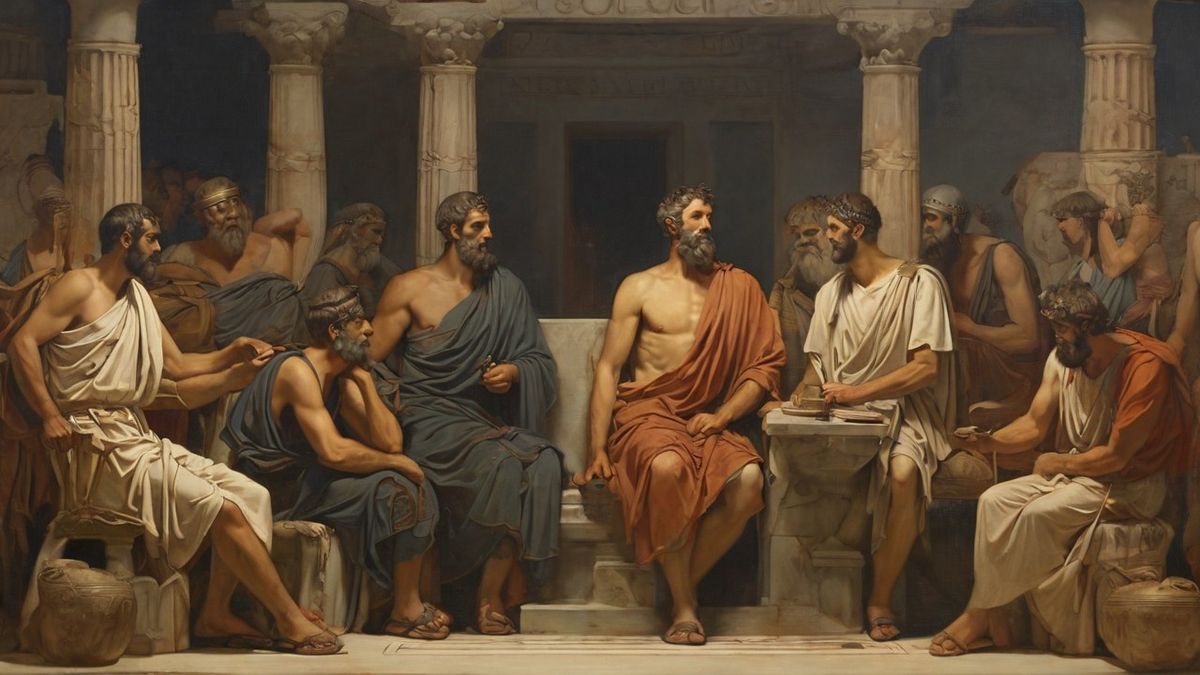
Around the 6th century BCE, in the Greek-speaking world along the Aegean coast, a different tradition began to emerge. A small number of thinkers started asking whether nature could explain itself — whether the behavior of things in the world could be accounted for without calling on supernatural forces at all. They did not abandon religion entirely, and they were not scientists in the modern sense. But they introduced something genuinely new: the idea that the world operates according to intelligible principles that the human mind can discover through observation and reasoning.
This tradition, stretching from Thales of Miletus in the 6th century BCE to Aristotle in the 4th, formed the roots of what we now call natural philosophy — and, eventually, science itself.
Thales of Miletus: The First Question
The story usually begins with Thales, a figure from Miletus on the Ionian coast, who lived around 624–546 BCE. Aristotle, writing two centuries later, identified him as the first philosopher — the first person to ask systematically what the world is fundamentally made of, and to answer that question without appealing to myth.
Thales proposed that everything, at its most basic level, is water. This sounds strange to modern ears, but it was a radical act of intellectual reorientation. Instead of saying “the world is as it is because the gods made it so,” Thales said: “the world is as it is because of a fundamental natural substance and its transformations.” Whether or not his answer was correct, the form of his question was new and consequential.
As the philosopher and historian of ideas notes in the Internet Encyclopedia of Philosophy, Thales introduced a mode of explanation where natural phenomena are understood through natural causes — observation, inference, a search for underlying order — rather than through the arbitrary will of divine beings.
This did not mean Thales abandoned the sacred entirely. Ancient sources record that he believed “all things are full of gods” and that a divine power animated the elemental moisture. But his cosmology was different from traditional Greek religion: the divine, for Thales, was woven into nature itself rather than standing above it and intervening in it capriciously. Aristotle distinguished him sharply from the “myth-makers” and the “poetical theologians,” placing him instead at the head of a line of “inquirers into nature.”
Thales also investigated astronomy, predicted a solar eclipse, and explored geometry. Whether or not the details of these achievements are accurate — ancient biography was not always reliable — they point to a recognizable intellectual type: someone who looked at the sky and the earth and asked how things work.
Pythagoras: Mathematics as the Language of the Cosmos
A generation after Thales, a very different kind of thinker was born on the island of Samos. Pythagoras (c. 570–490 BCE) eventually settled in Croton, in southern Italy, where he founded a philosophical and religious community that was part school, part brotherhood, part spiritual sect.
What made the Pythagoreans distinctive was their conviction that reality, at its deepest level, is mathematical in nature. Numbers were not merely tools for measurement; they were, in some fundamental sense, the structure of the world. The Pythagoreans taught that the cosmos had an order, and that this order was numerical — that the harmony of the universe could be read through mathematical relationships.
This idea had a striking early confirmation in music. The Pythagoreans discovered that the pleasing intervals of the musical scale — the octave, the fifth, the fourth — correspond to simple numerical ratios between the lengths of vibrating strings. The octave is a 2:1 ratio. The fifth is 3:2. This was not an abstract philosophical claim; it was something you could hear and measure. And if numbers governed harmony in music, why not in the heavens? The Pythagoreans extended this idea to cosmology, proposing that the planets moved in orbits governed by similar mathematical harmonies — what they called the “harmony of the spheres.”
The historian Geoffrey Lloyd observed that the Pythagoreans were among the first thinkers to deliberately attempt to give knowledge of nature a quantitative, mathematical foundation. That ambition — to describe the world in the language of mathematics — would not fully bear fruit for another two thousand years, with Galileo and Newton. But Pythagoras planted the seed.
The Pythagorean Brotherhood also had a more mystical side: beliefs about the transmigration of souls, strict dietary rules, a cult of secrecy. A man named Hippasus was reportedly expelled — or, in darker versions of the story, drowned — for revealing that irrational numbers exist, directly contradicting the Pythagorean doctrine that all quantities could be expressed as ratios of whole numbers. Whether or not the story is literally true, it captures the real tension at the heart of Pythagorean thought: a collision between mathematical discovery and doctrinal belief.
What survived and mattered most was not the mysticism but the insight: that mathematics might be the language in which nature is written.
Democritus and the Atom: Reality at Its Smallest
If Thales asked what the world is made of, and Pythagoras asked what mathematical structure underlies it, Democritus (c. 460–370 BCE) asked a different question: what is the smallest possible piece of matter?
Working in the tradition established by his teacher Leucippus, Democritus proposed one of the most consequential ideas in the history of thought. He argued that the physical world is composed of two and only two things: atoms and void. Atoms — from the Greek atomos, meaning “uncuttable” — are tiny, indivisible, indestructible particles that move through empty space. The void is simply emptiness, the space that allows atoms to travel and combine. Everything that exists — every rock, every plant, every human body — is a particular arrangement of atoms moving through void.
This was a philosophically bold move on several fronts. First, it required taking seriously the existence of “nothing.” The earlier philosopher Parmenides had argued that non-being cannot exist — that emptiness is a logical contradiction. Democritus simply rejected this argument: motion is an observable fact, and motion requires space to move through. Therefore, void must exist.
Second, the atomic theory eliminated the need for purpose or divine intention in explaining natural phenomena. Atoms move, collide, combine, and separate according to their shapes, sizes, and arrangements. The diversity and complexity of the world — its colors, textures, living things, and changing seasons — emerges entirely from these interactions. As the Stanford Encyclopedia of Philosophy notes, atomism was “the most influential of the ancient materialist accounts of the natural world which did not rely on some kind of teleology or purpose.”
Third, Democritus confronted an uncomfortable epistemological consequence of his own theory. If reality consists of colorless, odorless, tasteless atoms moving through void, then the colors, smells, and tastes we perceive are not truly “out there” in the world — they are products of the interaction between atoms and our senses. Democritus reportedly acknowledged this with the formulation: “by convention sweet, by convention bitter, by convention hot, by convention cold, by convention color; but in reality, atoms and void.”
This is a strikingly modern thought. The gap between the world as we experience it and the world as it actually is — a distinction that would become central to the scientific revolution — was already visible here.
Democritus did not have experimental evidence. He arrived at atomism through philosophical argument, not laboratory observation. He got significant details wrong: he believed atoms had tiny hooks that caused them to stick together, and his theory of perception involved “images” (eidôla) of objects streaming off surfaces and entering the body. But the core intuition — that matter is granular at some fundamental scale, and that the properties of things emerge from arrangements of simpler constituents — turned out to be essentially correct. Modern atomic theory, developed in the 19th and 20th centuries, vindicated Democritus in ways he could not have imagined.
His ideas were sidelined in his own era, largely because of the dominance of Aristotle. It took almost two thousand years for atomism to resurface as a serious scientific framework.
Aristotle’s View of Motion: The Logic of Natural Place
Aristotle (384–322 BCE) was the most systematic and influential of the ancient Greek philosophers. A student of Plato and tutor to Alexander the Great, he wrote on virtually every subject — logic, biology, ethics, politics, rhetoric, drama — and his Physics remained the dominant account of natural motion for nearly two thousand years.
Aristotle’s theory of motion begins with the four elements: earth, water, air, and fire. Each element has a natural place in an ordered cosmos. Earth belongs at the center; water above it; air above water; fire at the outermost terrestrial sphere. This is not an arbitrary assignment — it follows from the properties of each element as Aristotle understood them. Earth is cold and dry, and naturally heavy. Fire is hot and dry, and naturally light.
Natural motion, on this account, is the tendency of an element to move toward its proper place. A stone falls because its nature is earthly, and the natural place of earth is the center of the cosmos. Fire rises because its nature is fiery, and fire belongs at the top of the terrestrial order. These motions require no external cause; they are the expression of each thing’s inner nature seeking its fulfillment.
Violent motion is any motion that departs from this pattern — a stone thrown upward, a cart pushed across a road. For Aristotle, violent motion requires a continuous external cause. The moment the mover stops, the motion stops. This led to a famous puzzle about projectiles: what keeps an arrow flying after it has left the bow? Aristotle’s answer — that the air displaced by the arrow rushes around behind it and pushes it forward — was one of the weaker points of his system, and it was challenged by later thinkers.
Aristotle also distinguished between terrestrial and celestial motion. In the realm below the moon, things are subject to change, generation, and decay. The heavenly bodies — composed of a fifth, perfect element he called aether — move in eternal circular orbits. Circular motion, for Aristotle, was the most perfect because it has no beginning or end, befitting the eternal heavens.
There is also an Unmoved Mover at the apex of Aristotle’s physics: a first cause that initiates the chain of motion in the universe without itself being moved. This was not a personal god intervening in human affairs, but a kind of ultimate metaphysical anchor — the entity whose existence explains why anything moves at all.
Aristotle’s physics was wrong in many of its particulars. Galileo’s experiments in the 16th and 17th centuries dismantled the idea that heavier objects fall faster, and Newton’s laws showed that motion does not require a continuous cause. But dismissing Aristotle as simply wrong misses something important. His framework was internally coherent, empirically motivated (it accounts reasonably well for observable motion in a resisting medium, as the physicist Carlo Rovelli has argued), and provided a comprehensive vocabulary for thinking about nature — change, cause, matter, form, place, time — that shaped both science and philosophy for centuries. The scientists who overthrew his system were, in many ways, still working within the conceptual categories he had established.
The Lasting Influence: What the Greeks Actually Changed
The most important thing the Greek natural philosophers did was not any particular theory. It was something more structural: they introduced a new mode of inquiry.
Before Thales, the dominant explanatory framework for natural events was mythological. Things happened because of divine will — which meant that the world was, in principle, arbitrary. If the gods could do anything, then there were no laws of nature to discover. The Greek philosophers proposed something different: that the world has an order, that this order is intelligible, and that the human mind can discover it through observation, argument, and the search for underlying principles.
This shift has consequences that are easy to underestimate. The idea that there are laws of nature — regularities that hold across all times and places, independent of the intentions of any particular being — is not obvious. It is a presupposition that had to be introduced, and the early Greek philosophers introduced it.
Pythagoras added the further idea that these laws might be mathematical. Democritus added that the complexity of the visible world might be reducible to simpler, invisible constituents. Aristotle added systematic classification, the theory of causes, and the demand that explanations account for why things happen, not merely that they happen.
None of these ideas were accepted immediately, and none were fully correct as originally stated. The Greek philosophers argued vigorously with each other, proposed competing frameworks, and often reached conclusions that later turned out to be wrong. But the practice they established — of asking what things are, how they work, and why — was the practice that eventually became science.
Atomism was revived in the 17th century by Pierre Gassendi, influencing Newton and Boyle. The Pythagorean conviction that nature speaks in the language of mathematics was vindicated by Kepler, Galileo, and every physicist since. Aristotle’s four causes remain a framework in philosophy of science, even if his specific physics has been superseded. And the basic ambition of Thales — to explain the world in terms of the world, without appealing to what lies outside it — remains the foundational commitment of natural inquiry.
The Greek philosophers did not discover the laws of nature. But they made the discovery possible, by being the first to seriously believe that such laws existed.
Sources
- Stanford Encyclopedia of Philosophy — Presocratic Philosophy
- Internet Encyclopedia of Philosophy — Thales
- Internet Encyclopedia of Philosophy — Presocratics
- Stanford Encyclopedia of Philosophy — Democritus
- Stanford Encyclopedia of Philosophy — Aristotle’s Natural Philosophy
- Aristotle — Physics (MIT Internet Classics Archive)
- Encyclopaedia Britannica — Aristotle: Physics and Metaphysics
- Encyclopaedia Britannica — Pythagoras
- Science News — How Pythagoras Turned Math into a Tool for Understanding Reality
- Philosophy Institute — Aristotle’s Physics
- Philosophy Institute — Democritus and Leucippus: Atomism

One Comment