The Search for Dark Matter and Dark Energy
Roughly 95% of the universe is made of something we cannot see, touch, or directly detect with any instrument ever built. We only know it’s there because of what it does to the things we can see — the way galaxies spin, the way light bends around clusters, the way the cosmos itself is stretching apart faster with each passing billion years. That invisible majority has two names: dark matter and dark energy. They are not the same thing, they were discovered decades apart, and in some ways they are opposite problems — one holds galaxies together, the other tears the universe apart. This is the story of how astronomers found evidence for both, and why, a century after the first clues turned up, we still don’t know what either one actually is.

Ordinary matter — everything we can see with a telescope — makes up less than 5% of the universe. Dark matter accounts for about 27%, and dark energy for roughly 68%. (NASA/Goddard Space Flight Center)
Also read: The Discovery of Cosmic Microwave Background
A Universe That Doesn’t Add Up
Normal matter — the atoms that make up stars, planets, and people — is the part of the universe we can photograph, weigh, and study directly. But when astronomers in the 20th century started adding up the mass of galaxies and galaxy clusters, the numbers didn’t work. Things were moving as if there were far more mass around than telescopes could account for.
The first person to notice was the Swiss astronomer Fritz Zwicky, who in the 1930s studied the Coma cluster, a collection of more than a thousand galaxies. Galaxies inside a cluster move at speeds that depend on how much mass is holding the cluster together. Zwicky found that the Coma galaxies were moving far too quickly for the visible matter alone to keep the cluster from flying apart. He called the missing mass dunkle Materie — dark matter. For decades, the idea sat on the margins of astrophysics.
Vera Rubin and the Galaxies That Refused to Slow Down
The case for dark matter became impossible to ignore in the 1970s, thanks to the work of the American astronomer Vera Rubin. Rubin studied how fast stars orbit the centers of spiral galaxies at different distances from the galactic core — what astronomers call a rotation curve.
Simple physics predicts that stars farther from a galaxy’s center, where there’s less visible matter pulling on them, should orbit more slowly, the same way outer planets in the solar system move more slowly than Mercury. Rubin measured the actual speeds, and found something strange: stars far out at the edges of spiral galaxies were moving just as fast as stars close to the center. The rotation curves stayed flat instead of tapering off.
In her own words, published in a landmark 1983 paper in the journal Science, the evidence pointed to a universe where <cite index=”5-1″>as much as 90 percent of all mass is non-luminous and clustered in halo-like formations around individual galaxies, with that unseen matter’s gravity responsible for the unexpectedly fast rotation of gas and stars in spiral galaxy disks</cite>. There was simply more mass out there than could be seen — and it had to be arranged in a vast, invisible halo enveloping each galaxy to explain the flat curves. Rubin’s rotation-curve measurements, later expanded in her work on optical rotation curves and dark matter constraints, gave dark matter its first genuinely strong observational footing. Dark matter is not easily detected, but its presence is inferred from gravitational effects such as lensing and galactic rotation curves.

The Coma galaxy cluster, the same system Fritz Zwicky studied in the 1930s when he first proposed dark matter, seen here by NASA’s Hubble Space Telescope. (NASA, ESA, and the Hubble Heritage Team, STScI/AURA)
What Dark Matter Is — and Isn’t
Here’s the honest, slightly uncomfortable truth: nobody knows what dark matter actually is made of. What astronomers know is what it does. It has mass, so it exerts gravity. It doesn’t interact with light — it doesn’t absorb it, emit it, or reflect it — which is exactly why it’s invisible to every telescope ever built, from optical to radio to X-ray. And it appears to outweigh ordinary matter by roughly six to one across the universe.
The leading theoretical candidates are exotic particles that would rarely, if ever, interact with ordinary matter — hypothetical particles connected to ideas like supersymmetry, which proposes a heavier partner particle for every particle already known. Facilities like CERN’s Large Hadron Collider have spent years hunting for signs of such particles: if lightweight dark matter particles were produced in a collision, they would escape the detector unnoticed, but they would carry away energy and momentum, letting physicists infer their existence from what’s missing afterward. So far, no such particle has turned up, and researchers have also had to seriously entertain the alternative that dark matter isn’t made of any single new particle at all, but instead points to a flaw in our understanding of gravity itself.
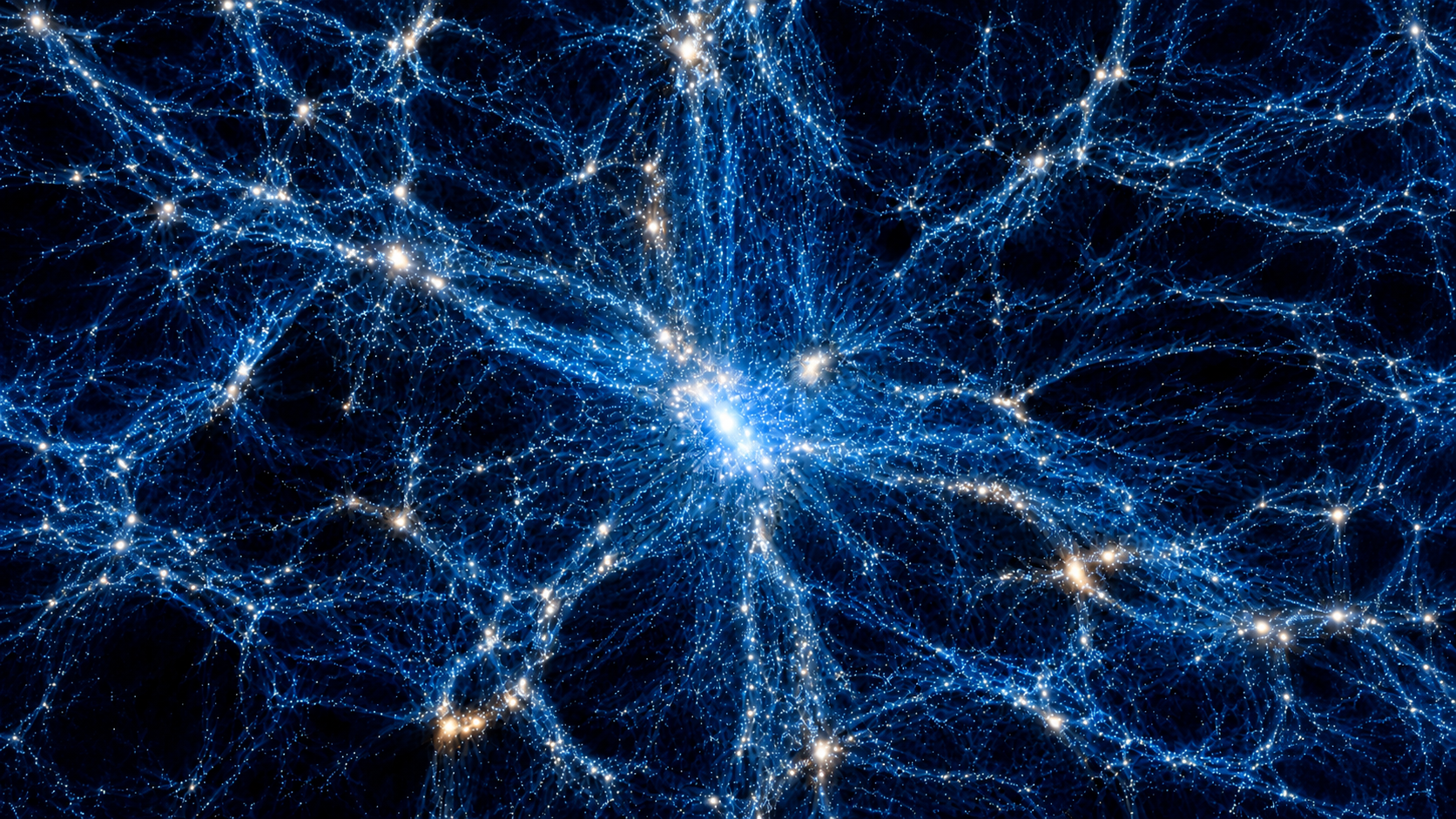
What’s clearer is the structure it builds. Cosmologists now believe dark matter forms a cosmic web — a vast, filament-like scaffold stretching across the universe — that pulls ordinary matter into place, seeding the galaxies and clusters we see today. Recent work on dark matter’s self-interactions is also probing whether it behaves as a perfectly “cold” and inert substance, or whether it collides gently with itself in ways that could shape the smallest structures in the cosmos — a question still very much open.
A Universe That’s Speeding Up, Not Slowing Down
Dark energy is a completely separate mystery, and its discovery came more than sixty years after Zwicky’s first hints of dark matter — and from a completely different kind of evidence.
Astronomers had known since the late 1920s, thanks to Edwin Hubble’s observations of galaxy redshifts, that the universe is expanding. Given gravity’s relentless pull, the natural assumption was that this expansion should be slowing down over time, the way a ball thrown into the air decelerates as gravity tugs it back. In 1998, two independent teams — one led by Saul Perlmutter, the other by Brian Schmidt and Adam Riess — set out to measure exactly how much the expansion was decelerating by studying a special class of exploding stars called Type Ia supernovae, which reliably shine with a known brightness and so can be used to gauge cosmic distances.
What they found instead upended the field. The distant supernovae were dimmer, and therefore farther away, than a slowing, gravity-dominated universe would allow. The only way to explain it was if the universe’s expansion had been speeding up for the last several billion years, pushed apart by something unaccounted for in the equations. That something was named dark energy, and the discovery earned Perlmutter, Schmidt, and Riess the 2011 Nobel Prize in Physics.
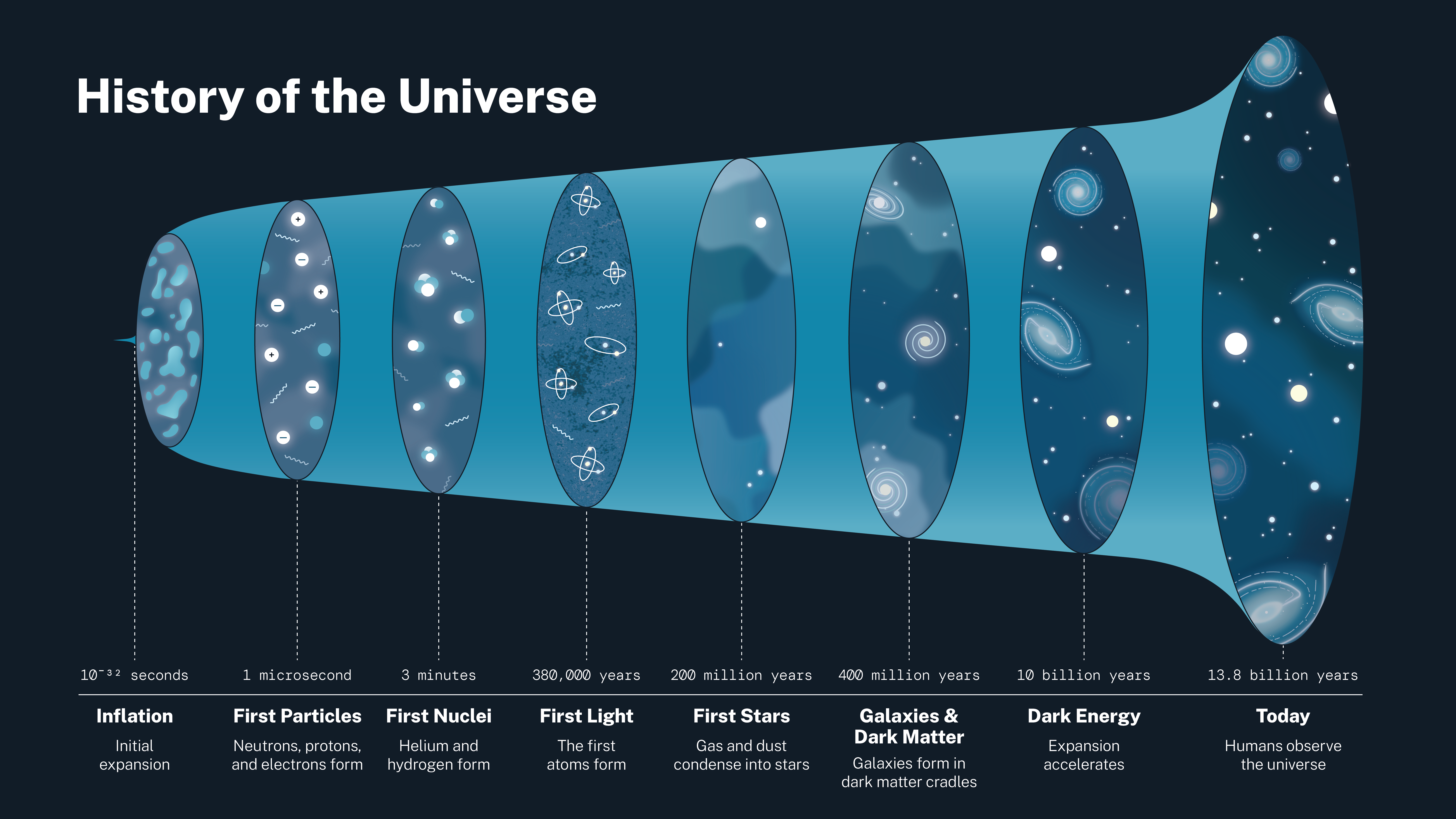
A timeline of cosmic expansion: after the initial burst of the Big Bang, gravity slowed the expansion for billions of years — until dark energy began accelerating it roughly nine billion years in. (NASA)
So What Is Dark Energy?
Unlike dark matter, which at least has plausible particle candidates, dark energy resists even a clean guess. It behaves like a kind of negative pressure pushing space outward, evenly distributed through the universe, both in space and in time — its effect doesn’t dilute as the cosmos expands, which is part of what makes it so strange.
Four broad explanations currently compete for scientists’ attention:
Vacuum energy. The idea is that empty space itself carries a background energy — tied to Einstein’s cosmological constant, a term he originally added to his equations of general relativity to keep the universe static, then discarded after Hubble showed the universe was expanding, reportedly calling it his biggest blunder. The trouble is that when physicists try to calculate how much vacuum energy quantum theory predicts, the answer comes out wildly, almost absurdly, larger than what’s observed — a mismatch known as the cosmological constant problem, and one of the most stubborn unsolved puzzles in physics.
Quintessence. Some theorists propose a dynamic energy field, one that can vary across space and time rather than staying constant, nicknamed after the mythical fifth element of ancient philosophy.
Space wrinkles. A more exotic possibility is that defects in the fabric of spacetime itself — hypothetical one-dimensional structures called cosmic strings, thought to have formed in the universe’s earliest moments — could produce the same push.
A flaw in gravity. The most radical option is that dark energy isn’t a substance at all, but a sign that general relativity itself needs revision at the largest cosmic scales — that once gravity is properly understood on that scale, no extra mysterious energy is needed to explain what we see.
Einstein himself, in 1919, sketched an early version of this last idea, called unimodular gravity — a reminder that some of today’s frontier questions have surprisingly old roots.
The Case for Alternatives
It’s worth being honest about the limits of the standard picture. The dominant cosmological model, known as ΛCDM (Lambda Cold Dark Matter), treats dark energy as a cosmological constant (Λ) and dark matter as “cold,” meaning slow-moving and gravitationally clumpy. It fits an enormous range of observations remarkably well, from the pattern of the cosmic microwave background to the large-scale distribution of galaxies. Current estimates derived from that background radiation put cold dark matter’s share of the universe’s density at close to a quarter of the total, a figure refined by missions like Planck and WMAP, though the two haven’t always agreed to the last decimal point.
But ΛCDM isn’t the only framework taken seriously. Because direct detection experiments for dark matter particles have so far come back empty, researchers continue to study alternatives such as Modified Newtonian Dynamics (MOND) and other modifications to general relativity, which try to explain galaxy rotation curves and cosmic acceleration without invoking any unseen substance at all. No alternative currently matches ΛCDM’s overall explanatory power, but the fact that serious researchers still pursue them says something important: this is not settled science. It’s an open field with a leading theory, not a closed case.
Why This Search Matters
It’s tempting to treat dark matter and dark energy as abstract bookkeeping problems — labels for gaps in an equation. They’re not. Between them, they determine the past, present, and future shape of the universe. Dark matter’s gravity is why galaxies formed at all; without its scaffolding, ordinary matter would likely have been too diffuse to clump into stars and galaxies within the age of the universe. Dark energy, meanwhile, is actively deciding what happens next — if its current behavior continues unchanged, galaxies beyond our local group will eventually accelerate away faster than light can reach us, fading from view over cosmic time.
Understanding what these two components actually are isn’t just a matter of intellectual completeness. It’s the difference between having a truly predictive theory of the cosmos and having a very good approximation held together by two placeholders.
The Next Chapter: New Instruments, New Answers
What makes this moment in the search genuinely exciting is that, for the first time, astronomers have instruments built specifically to test these ideas at scale rather than stumble onto evidence incidentally.
The Vera C. Rubin Observatory, named for the astronomer whose rotation-curve work helped establish dark matter as real physics, is a ground-based telescope built to repeatedly image the entire visible sky, tracking subtle changes over time that can reveal both dark matter’s distribution and dark energy’s influence on cosmic structure. The European Space Agency’s Euclid mission, launched in 2023, is constructing a 3D map of billions of galaxies across ten billion light-years to trace how dark energy has pulled matter apart over cosmic history. And NASA’s Nancy Grace Roman Space Telescope, with a field of view roughly a hundred times larger than Hubble’s at similar resolution, is designed explicitly to build a 3D dark matter map and track how dark energy’s effects have changed over time. Together, Euclid, Roman, and Rubin are expected to bring in a new golden age of cosmology, gathering more detailed information than ever before about these two central mysteries.
None of these missions is guaranteed to solve the puzzle. But each is designed to narrow the space of possible answers — ruling explanations in or out with a precision the twentieth century’s astronomers, working from photographic plates and painstaking rotation-curve measurements, could only have dreamed of.
The Honest Bottom Line
Dark matter and dark energy are not competing theories or two versions of the same idea — they are two separate, unsolved problems that happen to share a name pattern and a defining trait: we detect both only through their effects on things we can see. One holds the universe’s structure together. The other is pulling that same universe apart, faster with each passing era. Together they make up around 95% of everything that exists, and by any honest reckoning, we don’t yet know what either of them is.
That’s not a failure of modern cosmology — it’s the field’s most active frontier. The tools now coming online may finally begin to close the gap between what we’ve inferred and what we can actually confirm.
Sources
- Vera Rubin – The Rotation of Spiral Galaxies — https://pubmed.ncbi.nlm.nih.gov/17730634/
- Vera Rubin – Constraints on the Dark Matter from Optical Rotation Curves — https://www.cambridge.org/core/journals/symposium-international-astronomical-union/article/constraints-on-the-dark-matter-from-optical-rotation-curves/54A2B63DFC9F94D566D47E027BF2B829
- NASA Science – Building Blocks: Dark Matter and Dark Energy — https://science.nasa.gov/universe/overview/building-blocks/
- NASA Science – What is Dark Energy? — https://science.nasa.gov/dark-energy/
- NASA LAMBDA – ΛCDM Density — https://lambda.gsfc.nasa.gov/resources/graphic_history/cdmdensity.html
- Annual Review of Astronomy and Astrophysics – Dark Energy and the Accelerating Universe — https://www.annualreviews.org/content/journals/10.1146/annurev.astro.46.060407.145243
- arXiv – Dark Energy and the Accelerating Universe — https://arxiv.org/abs/0803.0982
- arXiv – Dark Matter and Dark Energy — https://arxiv.org/abs/astro-ph/0403324
- Advances in Space Research – Dark Matter, Dark Energy, and Alternate Models — https://www.sciencedirect.com/science/article/pii/S027311771730248X
- arXiv – Dark Matter, Dark Energy, and Alternate Models: A Review — https://arxiv.org/abs/1704.06155
- New Astronomy Reviews – The Rotation Curve of the Milky Way — https://www.sciencedirect.com/science/article/pii/S1387647326000126
- arXiv – Dark Matter Self-interactions and Small Scale Structure — https://arxiv.org/abs/1705.02358
- NASA – Universe Overview — https://science.nasa.gov/universe/
- ESA – Cosmology — https://www.esa.int/Science_Exploration/Space_Science/Cosmology
- Planck Legacy Archive — https://pla.esac.esa.int/
- Dark Energy Survey — https://www.darkenergysurvey.org/
- Vera C. Rubin Observatory — https://rubinobservatory.org/
- Euclid Mission — https://www.esa.int/Science_Exploration/Space_Science/Euclid
- CERN – Dark Matter — https://home.cern/science/physics/dark-matter
- Perimeter Institute – Dark Matter — https://perimeterinstitute.ca/