The Discovery of Cosmic Microwave Background
In May 1964, two radio astronomers at Bell Telephone Laboratories in Holmdel, New Jersey, kept finding a faint hiss in their antenna that refused to go away. It came from every direction, at every hour, in every season, and no amount of cleaning the equipment made it disappear. That stubborn noise turned out to be the oldest light in the universe: the afterglow of the Big Bang itself, cooled over 13.8 billion years into the microwave part of the spectrum. Arno Penzias and Robert Wilson had not set out to find it. They found it anyway, and in doing so gave the Big Bang theory the one piece of evidence its rivals could not explain away.
Also read: How Edwin Hubble Unlocked the Mind-Blowing Universe Beyond Ours
A universe with two competing origin stories
By the early 1960s, cosmology had split into two camps. One held that the universe began in a hot, dense state and had been expanding and cooling ever since — the Big Bang picture. The other, the Steady State theory, argued that the universe had no beginning at all: as galaxies moved apart, new matter was continuously created to keep the average density constant, so the universe looked the same at every epoch.
Both theories were consistent with the observation astronomers already had in hand — that distant galaxies were receding, first shown by Edwin Hubble in the 1920s. What neither theory had, yet, was a way to be tested against something the other could not also explain. The Big Bang model had one advantage on paper: physicists Ralph Alpher, Robert Herman, and George Gamow had worked out in the late 1940s that if the early universe really had been hot enough to fuse hydrogen and helium, it should also have left behind a bath of leftover radiation, cooled by billions of years of cosmic expansion to just a few degrees above absolute zero. It was a specific, falsifiable prediction. Nobody had gone looking for it.
An antenna built for satellites, not cosmology
Penzias and Wilson were not cosmologists. They were radio astronomers who had inherited a horn-shaped antenna at Bell Labs, originally built to detect faint microwave signals bounced off the Echo balloon satellites, and they wanted to use it for radio astronomy once satellite work wound down. To do that, they first needed to characterize and eliminate every possible source of background noise in the instrument.
They found more than they bargained for. At a wavelength of 7.35 centimeters, the antenna registered a temperature about 3.5 degrees Kelvin higher than they expected from the instrument itself, the atmosphere, and every other known source combined. The signal did not vary with time of day, season, or direction in the sky — an odd property for anything local, since almost every astronomical source is tied to a particular patch of sky or brightens and fades as the Earth rotates and orbits. This one didn’t. It just sat there, uniform in every direction, at a very low level of about 4080 megacycles.
A phone call broke the deadlock. Penzias mentioned the mystery signal to a colleague, who put him in touch with Robert Dicke’s group at Princeton — a team that, coincidentally, had independently rediscovered the Alpher-Herman-Gamow prediction and was actively building an instrument of their own to search for exactly this kind of relic radiation. Dicke’s team had the theory; Penzias and Wilson had the signal. The two papers were published together in 1965: Penzias and Wilson reported the measurement, and the Princeton group, led by Dicke, supplied the cosmological interpretation.
What the noise actually was
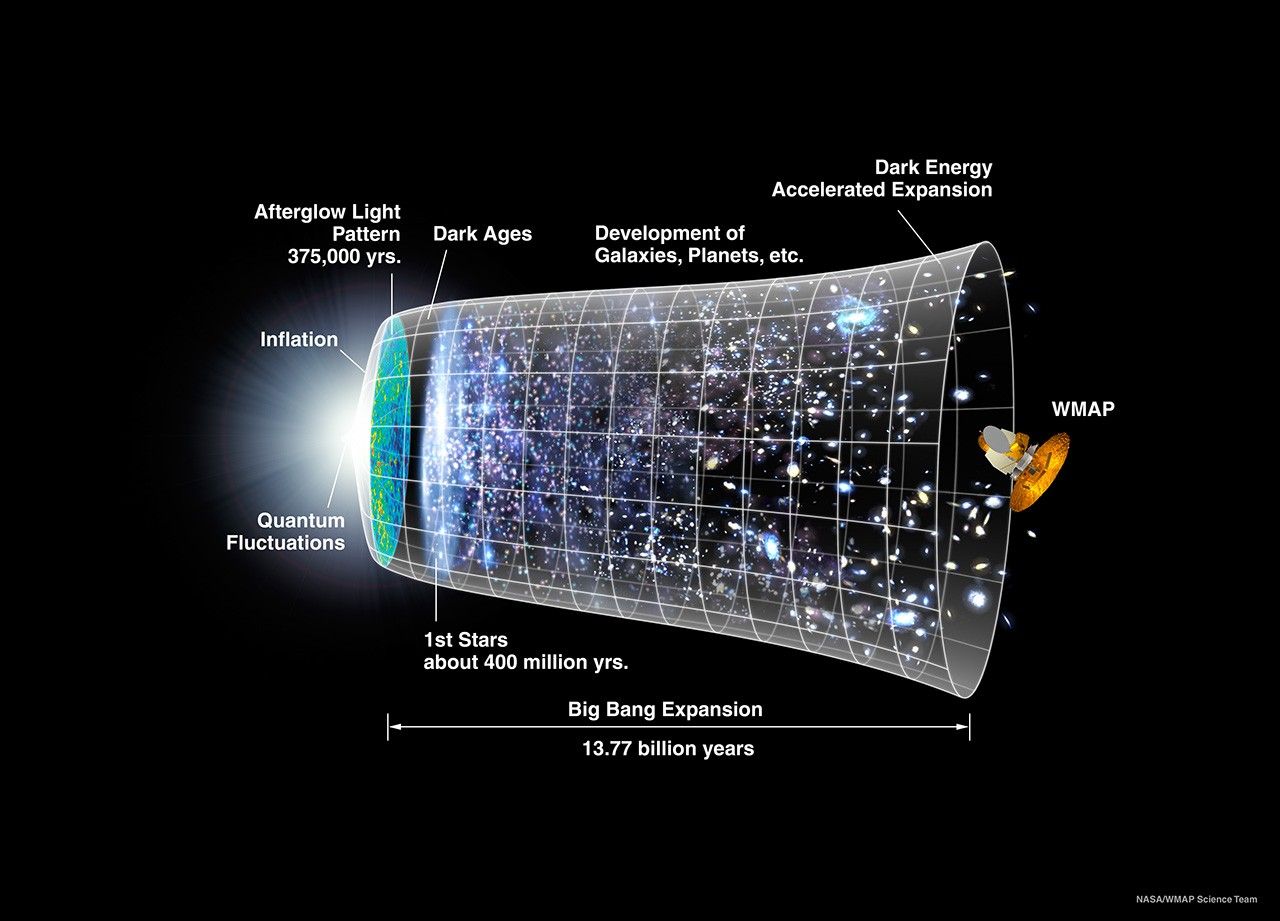
The explanation traces back to conditions the young universe simply cannot hide. For its first few hundred thousand years, the universe was hot and dense enough that matter existed as an opaque plasma of free electrons and atomic nuclei, and light could not travel far before scattering off an electron — much like fog scatters a car’s headlights. Roughly 380,000 years after the Big Bang, the universe had cooled to around 3,000 Kelvin, cool enough for electrons and protons to combine into neutral hydrogen atoms. With no free electrons left to scatter it, light was suddenly free to travel in straight lines across billions of light-years. That moment is called recombination, and the light released at that instant is the cosmic microwave background.
Since then, the universe’s continued expansion has stretched those photons’ wavelengths by a factor of roughly a thousand, dragging what began as visible and infrared light down into the microwave band and cooling its effective temperature to just 2.7 Kelvin — about 2.7 degrees above absolute zero. It is, in effect, a photograph of the universe taken 380,000 years after its birth, still arriving from every direction because the surface it was emitted from surrounds us in every direction we look.
From accidental signal to precision science
Penzias and Wilson’s 1965 measurement was a single number at a single wavelength — good enough to confirm the CMB existed, but far too crude to say much else about it. Testing the theory properly meant mapping the sky, measuring the radiation’s exact spectrum, and hunting for tiny variations in temperature from one direction to the next — variations theory said should be there, encoded as the seeds of future galaxies.
That task fell to three space missions across three decades. NASA’s Cosmic Background Explorer (COBE), launched in 1989, made the first measurements from orbit, free of the atmospheric interference that limits ground-based instruments. Its Far Infrared Absolute Spectrophotometer measured the CMB’s spectrum to a precision of 0.03% and found it matched the spectrum of a perfect blackbody at 2.725 Kelvin almost exactly — a result so clean it remains one of the best-fit blackbody curves ever measured for anything, astrophysical or otherwise.

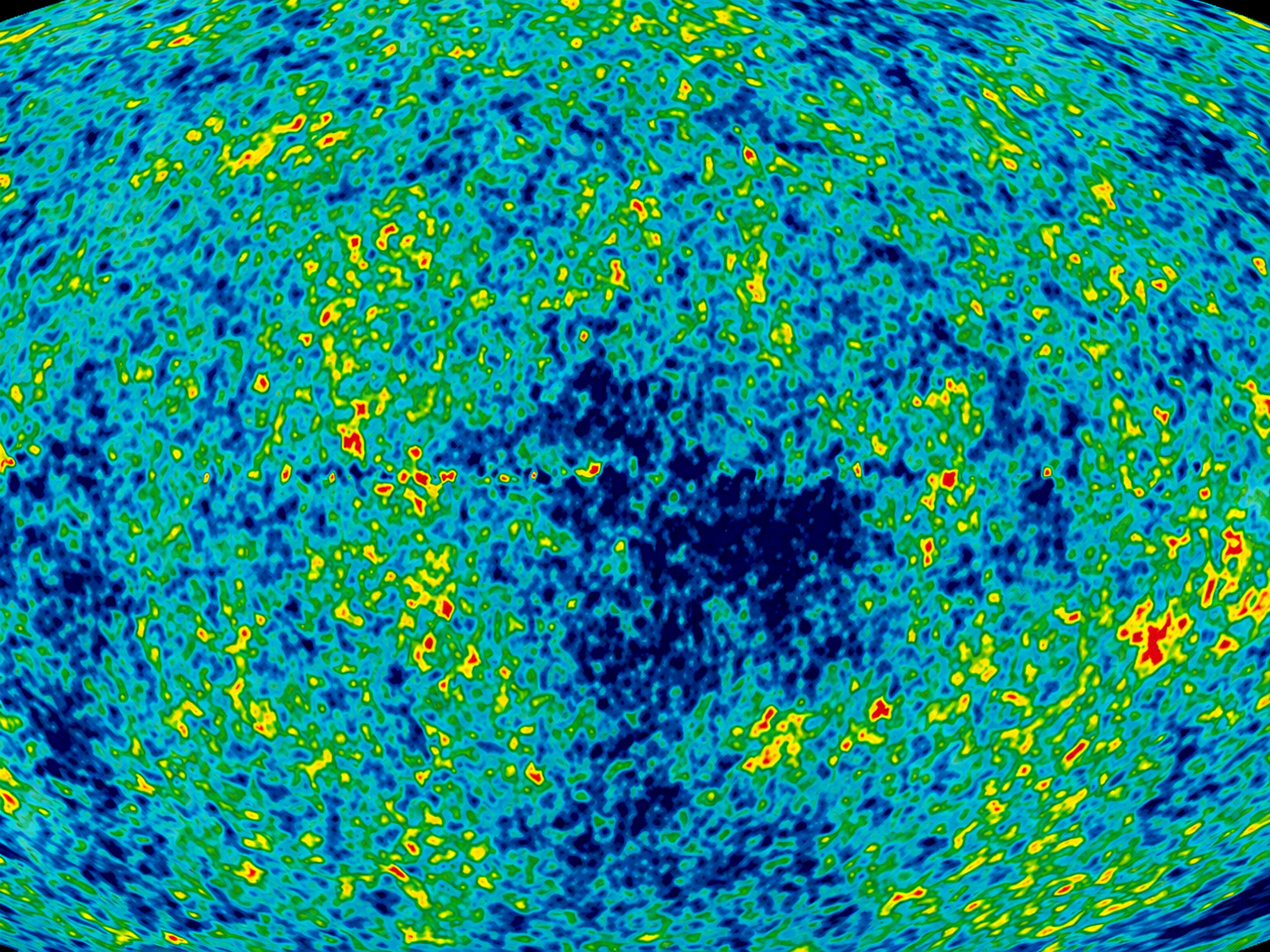
COBE’s second instrument, the Differential Microwave Radiometer, found something theory had predicted but no one had yet seen: the CMB was not perfectly uniform. Its temperature varied by about one part in 100,000 from point to point on the sky — fluctuations so faint that isolating them meant stripping away the much brighter foreground glow of dust and gas in our own galaxy first. What remained was the oldest baby picture of the cosmos, a map of the density variations that would, over billions of years, collapse under gravity into the galaxies and galaxy clusters seen today. John Mather and George Smoot, who led COBE’s two instrument teams, shared the 2006 Nobel Prize in Physics for the discovery.

Precision cosmology takes over
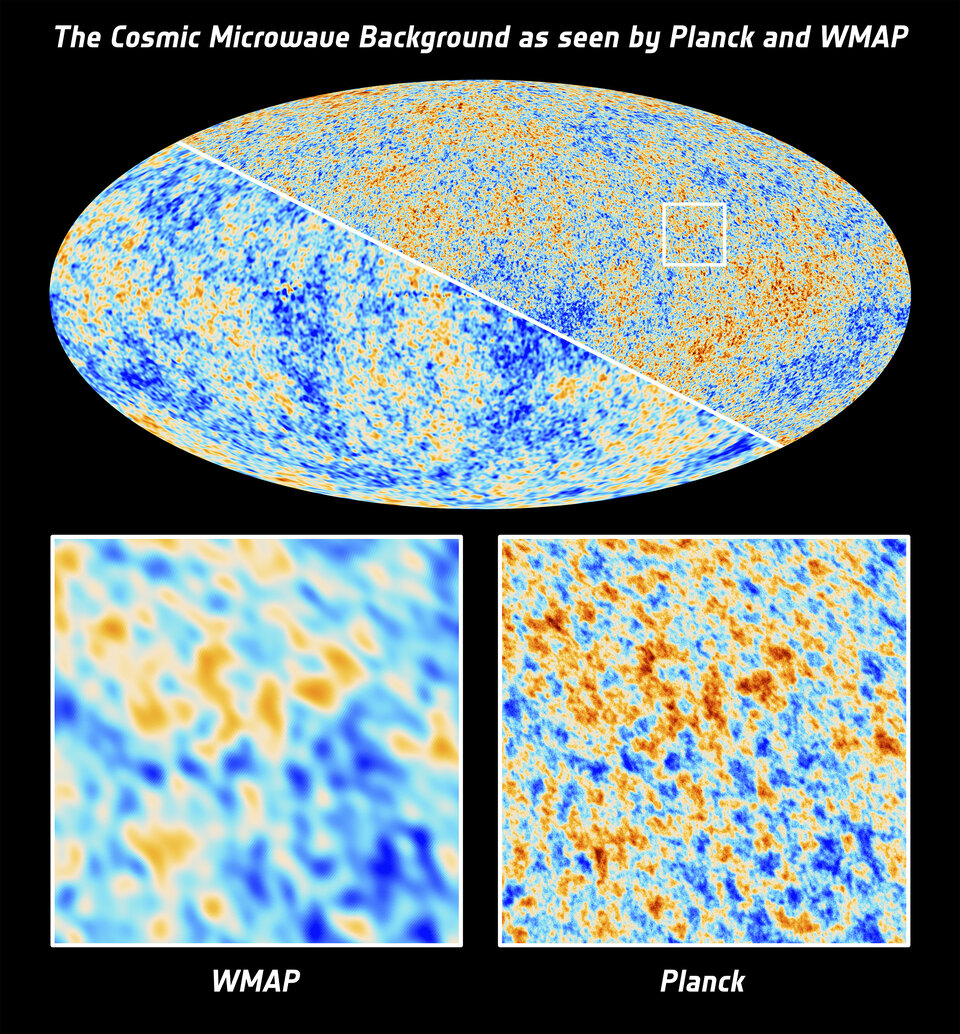
What COBE glimpsed at coarse resolution, NASA’s Wilkinson Microwave Anisotropy Probe (WMAP) resolved in sharp detail after its 2001 launch. Stationed at the Sun-Earth L2 point, WMAP compared temperatures between pairs of points across the sky rather than measuring absolute temperature directly, an approach that canceled out many sources of instrumental error. The result was the first fine-resolution, full-sky map of the CMB — and, from it, the tightest constraints yet on the universe’s basic properties: an age of 13.77 billion years, accurate to within half a percent; a geometry flat to within 0.4 percent; and a composition of roughly 5 percent ordinary matter, 25 percent dark matter, and 70 percent dark energy. WMAP’s three most-cited papers rank among the most influential in physics and astronomy published during the 2000s.
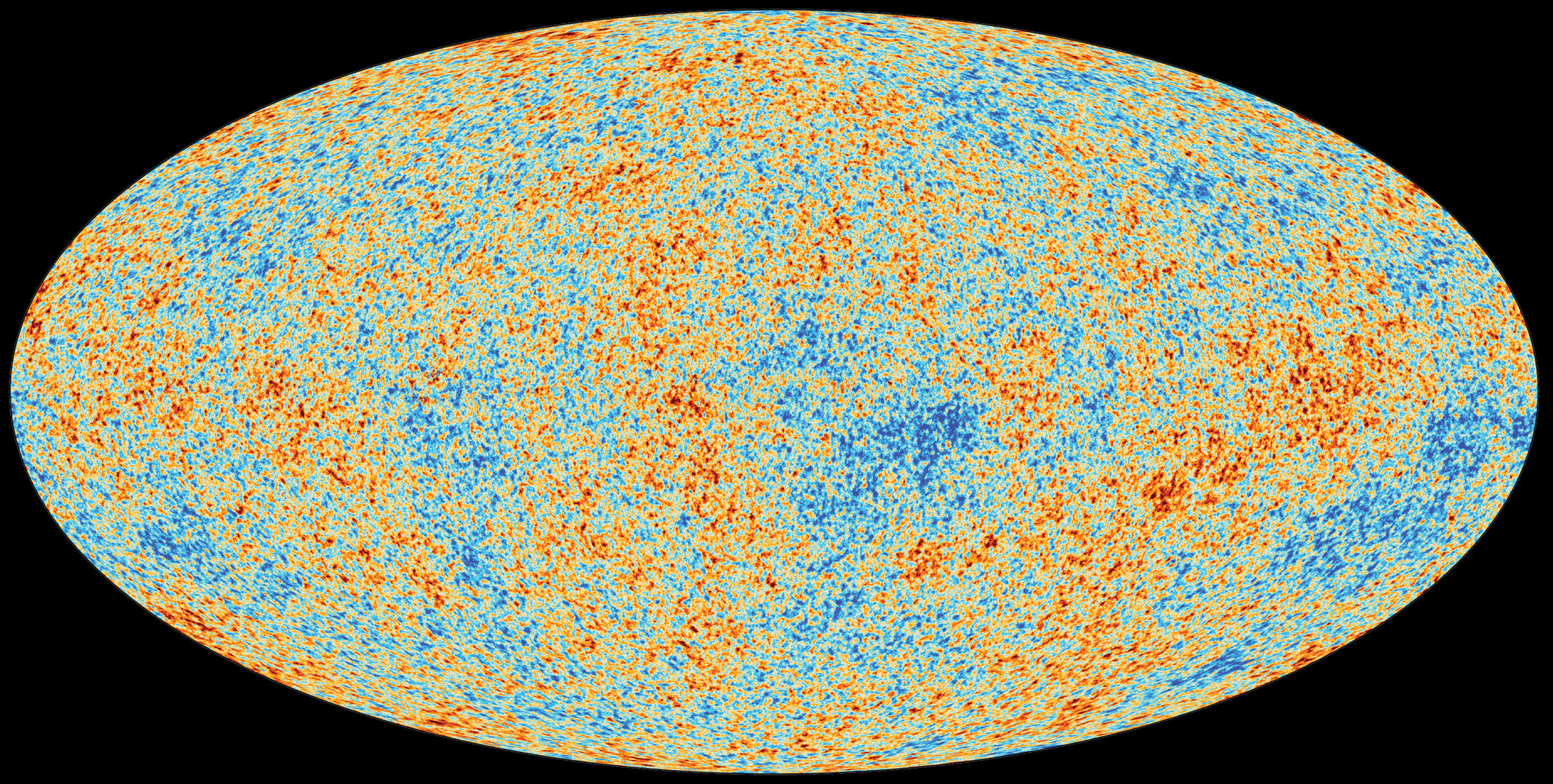
ESA’s Planck satellite, launched in 2009, pushed the measurement further still, observing in more frequency bands and at higher sensitivity than WMAP, which let scientists separate the CMB more cleanly from foreground emission across the whole sky. Planck reached what scientists describe as a natural limit: the radiation from cosmic structures formed long after the Big Bang creates its own background noise, and Planck extracted essentially all the information the CMB’s temperature pattern can yield. Some of its results are considered definitive — no future temperature-mapping experiment is expected to improve on them.
Why it matters
The CMB is the furthest back in time that any telescope can ever see using light. Before recombination, the universe was opaque, so no telescope — no matter how powerful — will ever image the universe as it existed in its first 380,000 years directly. That makes the CMB a hard boundary on direct observation, and everything cosmologists know about the universe’s earliest moments before that boundary comes from theoretical inference, not direct sight.
Within that limit, though, the CMB has done more to pin down the basic structure of the cosmos than perhaps any other single body of data. It turned the Big Bang from one plausible model among several into the only framework that convincingly explains why this uniform, blackbody radiation exists at all. It confirmed, independently of galaxy-counting or supernova measurements, that dark matter and dark energy dominate the universe’s total content. And its faint temperature ripples matched, in detail, the specific statistical pattern predicted by cosmic inflation — the idea that the universe underwent an extraordinarily brief burst of exponential expansion a fraction of a second after the Big Bang — including the prediction that the pattern should follow a bell curve with equal numbers of hot and cold spots across the sky.
What’s still unsettled
None of this closes the book on early-universe cosmology. Dark matter and dark energy together make up about 95 percent of the universe’s content in the standard cosmological model built on CMB data, and neither has been directly detected or explained at a fundamental level — they are inferred from their gravitational and expansion effects, not observed directly. Inflation, too, remains a successful framework rather than a settled mechanism: it explains the CMB’s patterns well, but the physical field responsible for driving it has never been identified. And precision measurements from different methods — the CMB versus observations of the nearby universe — have in recent years turned up small but persistent disagreements over exactly how fast the universe is expanding today, a tension cosmologists have not yet resolved.
The takeaway
What began as an unexplained hiss in a satellite-tracking antenna turned into the closest thing cosmology has to a photograph of its own birth. Penzias and Wilson didn’t set out to test the Big Bang; they just refused to ignore a signal that didn’t make sense. Six decades and three space missions later, that signal has been measured down to millionths of a degree, mapped across the entire sky, and used to fix the universe’s age, shape, and composition with a precision nobody in 1964 could have anticipated — while still leaving the deepest questions about what dark matter, dark energy, and inflation actually are wide open for whoever picks up the thread next.
Sources
- Penzias & Wilson, A Measurement of Excess Antenna Temperature at 4080 Mc/s: https://ui.adsabs.harvard.edu/abs/1965ApJ…142..419P
- NASA COBE Science: https://science.nasa.gov/mission/cobe/science/
- NASA WMAP Overview: https://science.nasa.gov/mission/wmap/wmap-overview/
- NASA WMAP CMB History: https://wmap.gsfc.nasa.gov/media/081031/index.html
- ESA Planck and the Cosmic Microwave Background: https://www.esa.int/Science_Exploration/Space_Science/Planck/Planck_and_the_cosmic_microwave_background
- ESA Cosmic Microwave Background Radiation: https://www.esa.int/Science_Exploration/Space_Science/Cosmic_Microwave_Background_CMB_radiation
- ESA History of Microwave Astronomy: https://www.esa.int/Science_Exploration/Space_Science/Planck/History_of_microwave_astronomy
- Planck 2013 Results I (arXiv): https://arxiv.org/abs/1303.5062
- Planck Scientific Programme (arXiv): https://arxiv.org/abs/astro-ph/0604069
- The Cosmic Microwave Background Anisotropy Experiments (arXiv): https://arxiv.org/abs/astro-ph/9705135
- Imaging the First Light (arXiv): https://arxiv.org/abs/astro-ph/0402528
- COBE Nobel background: https://www.nobelprize.org/prizes/physics/2006/summary/
- Nobel Prize 1978, Penzias and Wilson: https://www.nobelprize.org/prizes/physics/1978/summary/
- NASA Planck Legacy overview: https://science.nasa.gov/mission/planck/
- ESA Planck Mission: https://www.esa.int/Science_Exploration/Space_Science/Planck
- Astrophysical Journal (journal): https://iopscience.iop.org/journal/0004-637X
- Physical Review D (journal): https://journals.aps.org/prd/
- Reviews of Modern Physics: https://journals.aps.org/rmp/
- Wayne Hu CMB Tutorials: https://background.uchicago.edu/
- NASA Universe 101, The Big Bang: https://map.gsfc.nasa.gov/universe/

One Comment