
Particle Physics: 4 Fundamental Forces & The Standard Model
Everything you have ever touched, eaten, or breathed is built from a startlingly short list of ingredients. Strip away the complexity of atoms, molecules, and matter itself, and you are left with a dozen or so elementary particles and four forces that govern how they interact. That entire framework has a name: the Standard Model of particle physics. It is one of the most rigorously tested theories in the history of science, and it is also, by its own architects’ admission, incomplete.
This article walks through what the Standard Model actually says — the particles it describes, the forces that move them, the mathematical logic that holds it together, and the machines built to test it — before looking honestly at where the theory runs out of road.
Also read: The Explosive Birth of Nuclear Physics: From Radioactivity to Energy
Why a “standard model” at all
By the early twentieth century, physicists had discovered that atoms were not indivisible. Electrons, protons, and neutrons emerged, then a flood of new particles turned up in cosmic rays and, later, in accelerator collisions. For a few decades particle physics looked less like a unified science and more like a zoo of loosely related discoveries.
The theories and discoveries of thousands of physicists since the 1930s eventually converged on the insight that everything in the universe is made from a few basic building blocks, governed by four fundamental forces. That understanding of how the particles and three of the forces relate to one another is what the Standard Model encapsulates, and since being developed in the early 1970s it has explained almost all experimental results and precisely predicted a wide range of phenomena. Over fifty years of experiments, it has held up as one of the best-tested theories in physics.
The matter particles: quarks and leptons
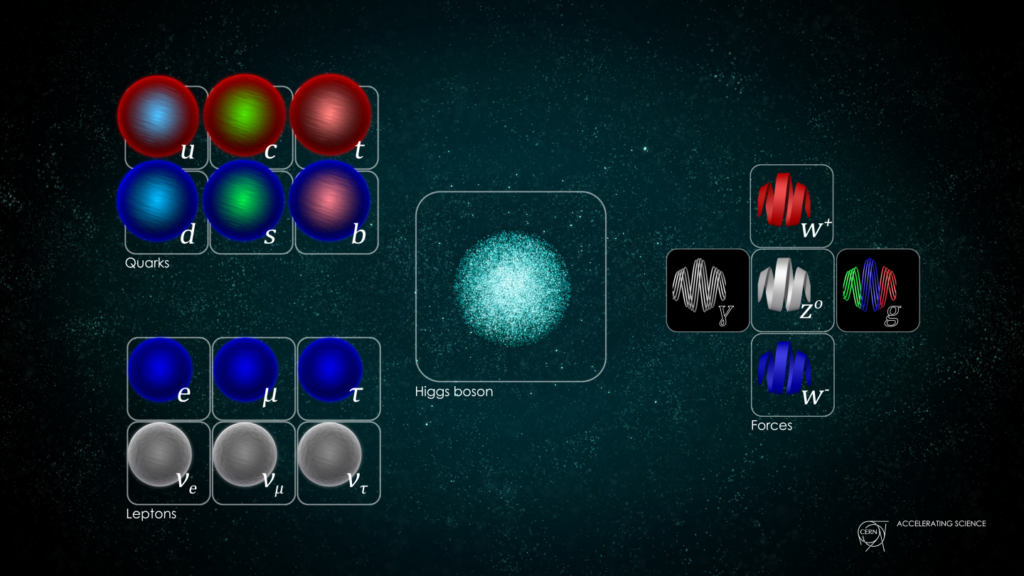
Start with what things are made of. All matter around us is built from elementary particles that occur in two basic types called quarks and leptons, each forming a group of six particles related in pairs, or “generations.”
The lightest and most stable particles belong to the first generation, while heavier, less stable particles belong to the second and third; any heavier particle decays quickly toward the most stable level, so all the ordinary matter around us is made of first-generation particles. The six quarks pair up as the “up” and “down” quarks in the first generation, the “charm” and “strange” in the second, and the “top” and “bottom” (or “beauty”) in the third — and quarks also carry one of three “colour” charges, combining only in ways that produce colourless objects. The six leptons follow the same three-generation pattern: the electron and electron neutrino, the muon and muon neutrino, and the tau and tau neutrino. The electron, muon, and tau all carry electric charge and appreciable mass, while the neutrinos are electrically neutral and almost massless.
In practice, this means the visible universe is almost embarrassingly economical. A proton is two up quarks and a down quark bound together; a neutron is one up and two down. Electrons orbit the nucleus. Everything else — muons, taus, the heavier quarks — only shows up fleetingly, in cosmic ray showers or accelerator collisions, before decaying back down to the stable first generation.
The four forces, and the particles that carry them
Particles would be inert without something to make them interact. There are four fundamental forces at work in the universe — the strong force, the weak force, the electromagnetic force, and gravity — each working over different ranges and with different strengths. Gravity is the weakest but has infinite range; the electromagnetic force also has infinite range but is far stronger than gravity; the strong and weak forces act only over very short, subatomic ranges, with the strong force the most powerful of all four and the weak force, despite its name, still considerably stronger than gravity.
Three of these forces work by the exchange of force-carrier particles belonging to a broader class called bosons: the strong force is carried by the gluon, the electromagnetic force by the photon, and the weak force by the W and Z bosons. A graviton is predicted for gravity but has never been observed. The Standard Model incorporates the electromagnetic, strong, and weak forces along with their carrier particles, and explains well how each acts on matter — but gravity itself sits outside the framework, since no one has yet found a way to make general relativity and quantum theory mathematically compatible within it. Fortunately, at the scale of individual particles gravity’s effect is negligible, so the Standard Model works despite the omission.
| Force | Carrier particle | Relative strength | Range |
|---|---|---|---|
| Strong | Gluon | Strongest | Subatomic (confined inside nuclei) |
| Electromagnetic | Photon | Second strongest | Infinite |
| Weak | W and Z bosons | Third strongest | Subatomic, very short |
| Gravity | Graviton (undetected, not part of the Standard Model) | Weakest | Infinite |
Gauge theories: the logic underneath the particle list
The deeper reason the Standard Model holds together is not just a list of particles — it is a specific mathematical structure called a gauge theory. A gauge theory starts from a symmetry: a transformation you can apply to a physical system that leaves its observable predictions unchanged. Demand that this symmetry hold not just globally but independently at every point in space and time, and something remarkable falls out of the mathematics — new force-carrying fields appear automatically, required by the symmetry itself rather than added in by hand. Those fields are exactly the bosons described above.
The Standard Model layers three such gauge symmetries on top of one another. The model is based on gauge theories, of which the first was quantum electrodynamics, describing the interactions of electrons with light. This was later incorporated into the electroweak theory, describing electromagnetic and weak nuclear interactions together, while quantum chromodynamics supplies the theory of the strong nuclear interactions. Quantum electrodynamics (QED) alone is arguably the most precisely verified theory in physics, matching experiment to better than one part in a billion in some measurements. Electroweak theory then showed that electromagnetism and the weak force are, at high enough energies, a single unified interaction that only appears distinct at the lower energies of everyday experience.
That unification came at a cost: the mathematics initially demanded that all these force carriers be massless, which flatly contradicts the very massive W and Z bosons observed in nature. The resolution was the Higgs mechanism.
The Higgs field and the origin of mass
In the current description of nature, every particle is a wave in a field, much as light is simultaneously a wave in the electromagnetic field and a stream of photons. The Higgs field was proposed in 1964 as a new kind of field filling the entire universe and giving mass to elementary particles; the Higgs boson is a wave in that field, and its discovery confirmed the field’s existence.
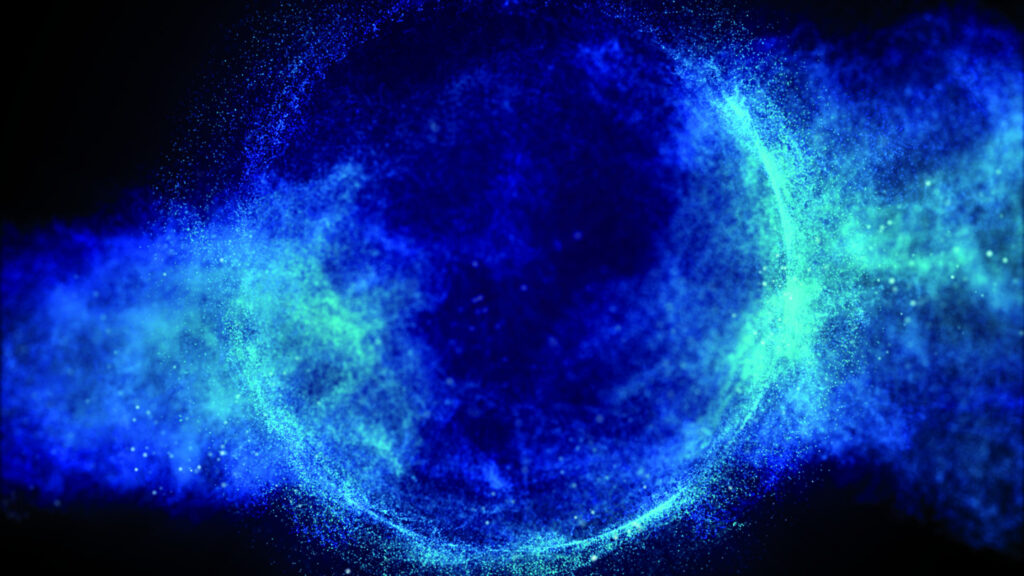
Particles get their mass by interacting with the Higgs field rather than possessing mass of their own — the more strongly a particle interacts with the field, the heavier it turns out to be. Photons do not interact with the field at all and so remain massless, while electrons, quarks, and the W and Z bosons do interact, each acquiring its own characteristic mass. This mass-giving interaction is known as the Brout-Englert-Higgs mechanism, after theorists Robert Brout, François Englert, and Peter Higgs.
The theoretical proposal sat untested for nearly fifty years, because producing and detecting the Higgs boson required smashing particles together at energies no accelerator on Earth could reach — until the Large Hadron Collider.
Particle accelerators: how you actually test any of this
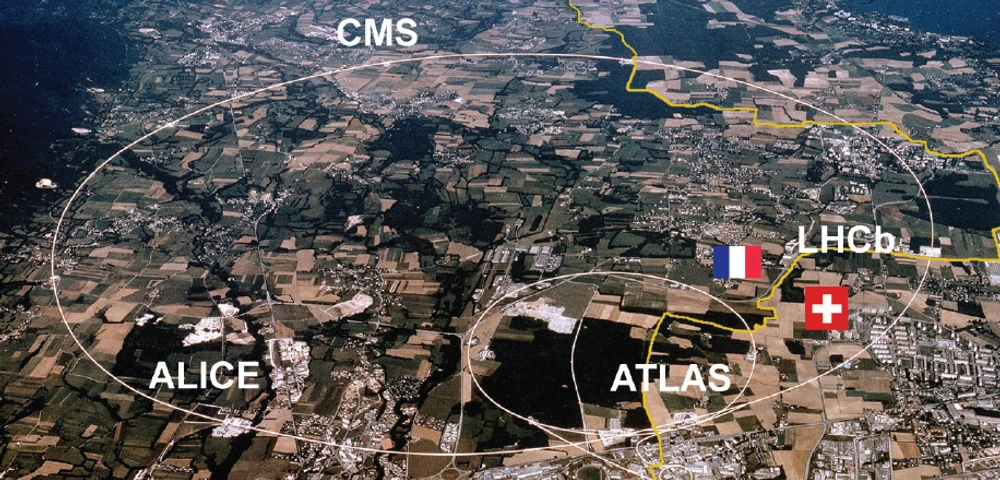
A theory of subatomic particles is only as good as the experiments that can probe it, and probing matter at these scales means colliding it together hard enough to briefly recreate the conditions of the early universe. The Large Hadron Collider (LHC) is the world’s largest and most powerful particle accelerator, pushing protons or ions to near the speed of light around a 27-kilometre ring of superconducting magnets, sitting in a tunnel 100 metres underground on the Franco-Swiss border near Geneva.
Inside the accelerator, two high-energy beams travel in opposite directions through separate ultrahigh-vacuum pipes, steered by a strong magnetic field from superconducting electromagnets built from cable that conducts electricity with no resistance once chilled to -271.3°C — colder than outer space. Thousands of magnets direct the beams, including 1,232 dipole magnets that bend them and 392 quadrupole magnets that focus them, with a final set of magnets squeezing the particles together just before collision — comparable to firing two needles ten kilometres apart with enough precision that they meet halfway.
The beams are made to collide at four points around the ring, corresponding to four major particle detectors — ATLAS, CMS, ALICE, and LHCb — run by international collaborations that sift through the resulting debris for signs of new physics
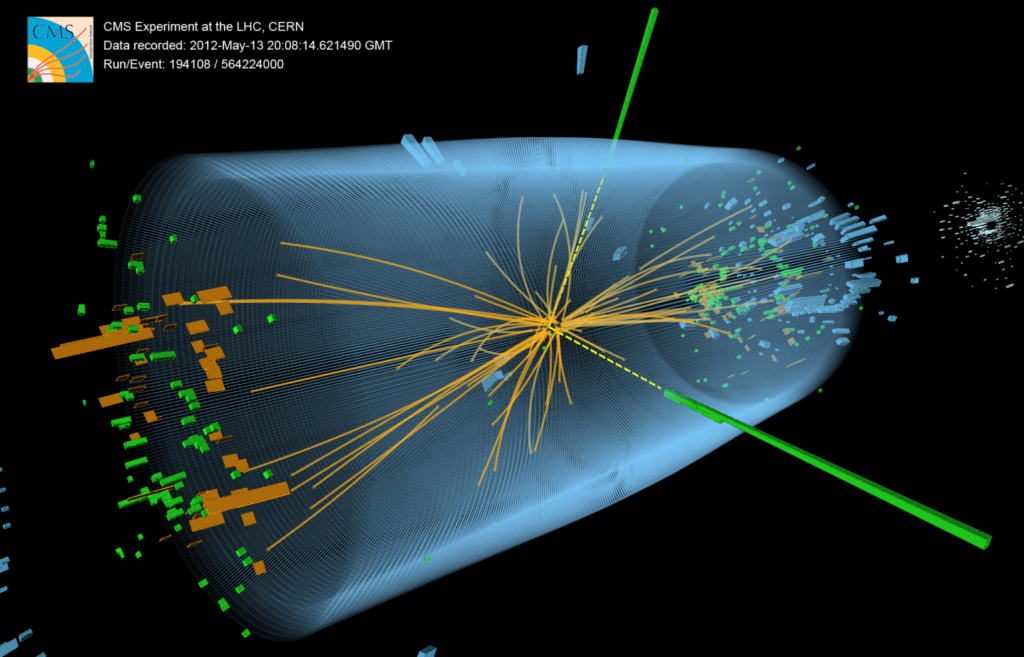
Finding the Higgs boson this way was less like finding a needle in a haystack and more like proving a specific hay-shaped disturbance existed at all. The Higgs boson cannot be discovered by finding it somewhere; it has to be created in a collision and then decays almost immediately into other particles that detectors can register. The challenge is that those decay products are also produced by many other processes, and the Higgs boson appears in only about one collision in a billion — so it took careful statistical analysis of enormous volumes of data to uncover its faint signal in 2012.
On 4 July 2012, the ATLAS and CMS experiments at CERN’s Large Hadron Collider each announced they had observed a new particle in the mass region around 126 GeV, consistent with the long-sought Higgs boson. By examining two and a half times more data, physicists confirmed by March 2013 that some kind of Higgs boson had indeed been found, after checking that the particle had zero spin — the one property unique to the Higgs among all known particles. On 8 October 2013, the Nobel Prize in Physics went jointly to François Englert and Peter Higgs for the theoretical work that led to this discovery.
What the Standard Model gets right
It is easy to undersell how successful this framework has been. It correctly predicted the existence and even approximate masses of the W and Z bosons, the top quark, and the Higgs boson years or decades before each was observed. Quantum electrodynamics predicts quantities like the electron’s magnetic moment to more decimal places than almost any other calculation in science has ever managed, and matches experiment to extraordinary precision. Every particle collider built since the 1970s has, in essence, been trying and failing to break the Standard Model — and instead kept confirming it.
Physicists have continued testing the model even after the Higgs discovery: its interaction with tau leptons was confirmed in 2016, and interactions with top and bottom quarks followed in 2018 — each one matching theoretical predictions rather than overturning them.
Where it runs out of road
None of this makes the Standard Model a final theory, and physicists are the first to say so. The theory incorporates only three of the four fundamental forces, leaving gravity out entirely, and it does not explain what dark matter is, what happened to the antimatter that should have been produced in equal measure to matter after the Big Bang, or why there are three generations of quarks and leptons with such different mass scales.
Neutrino masses are another loose thread: the Standard Model as originally built assumed neutrinos were massless, but experiments have since shown they have a small, nonzero mass, a detail the theory has to be patched to accommodate rather than one it predicts outright. And the Higgs boson’s own mass is, by the theory’s internal logic, oddly small — small enough that many physicists suspect some further mechanism is keeping it that way, though nothing has yet been found to confirm what that mechanism might be.
The takeaway
The Standard Model is not a finished picture of reality, but it is the most successful unfinished picture physics has ever produced: a dozen matter particles, a handful of force carriers, one field that gives everything mass, and a mathematical structure — gauge symmetry — that ties it all together with predictive precision. Every accelerator experiment for half a century has been, in one sense, an attempt to catch it out. So far, it keeps passing the test. The open questions it leaves behind — gravity, dark matter, the matter-antimatter asymmetry — are exactly where the next generation of physics is looking.
Sources
- CERN – The Standard Model: https://home.cern/science/physics/standard-model/
- CERN – The Higgs boson: https://home.cern/science/physics/higgs-boson/
- CERN – Large Hadron Collider: https://home.cern/science/accelerators/large-hadron-collider/
- The Standard Model of Particle Physics (Tom W. B. Kibble, arXiv): https://arxiv.org/abs/1412.4094
- Particle Adventure (Lawrence Berkeley National Laboratory): https://particleadventure.org/
- Review of Particle Physics (Particle Data Group): https://pdg.lbl.gov/
- Nobel Prize – The Higgs Mechanism: https://www.nobelprize.org/prizes/physics/2013/popular-information/