Galileo: The Father of Modern Physics
On a January night in 1609, a court musician’s son in Padua pointed a homemade tube of glass at the sky and, within a matter of weeks, took a hammer to two thousand years of settled belief about how the universe was built. His name was Galileo Galilei, and what he saw through that tube — mountains on the Moon, four tiny lights circling Jupiter, a sun blotched with spots — did not just add new facts to astronomy. It changed what counted as evidence at all. That shift, more than any single discovery, is why Galileo is remembered as the father of modern physics.
A universe that was supposed to be perfect
To understand why Galileo’s observations landed like a shock, you have to know what everyone was taught to believe beforehand. Medieval and Renaissance natural philosophy, inherited largely from Aristotle, held that the cosmos was split into two entirely different realms. Below the Moon, matter was earthly, changeable, and imperfect — things rotted, burned, fell, and decayed. Above the Moon, matter was made of a separate substance often called the aether, and it was supposed to be flawless and unchanging: perfectly smooth spheres, carrying planets and stars in perfectly circular orbits around a stationary Earth.
This wasn’t a fringe idea. It was the physics taught in every European university, reconciled for centuries with Christian theology, and treated as a matter that had already been settled by reason rather than something that still needed checking against the sky. Galileo was born in Pisa in 1564, the son of a semi-itinerant court musician, and enrolled for a medical degree at the University of Pisa in 1580 before abandoning it to study mathematics instead. He spent his twenties and thirties as a mathematics lecturer, first at Pisa and then at Padua, quietly working out problems in mechanics — how things fall, how they roll down inclines, how pendulums swing — that had nothing to do with astronomy at all.
Then, in the summer of 1609, he heard about a Dutch invention called the spyglass.
Grinding his own lenses, and pointing them where no one had
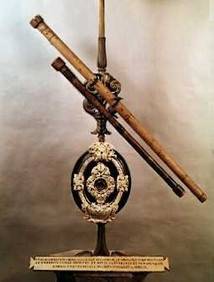
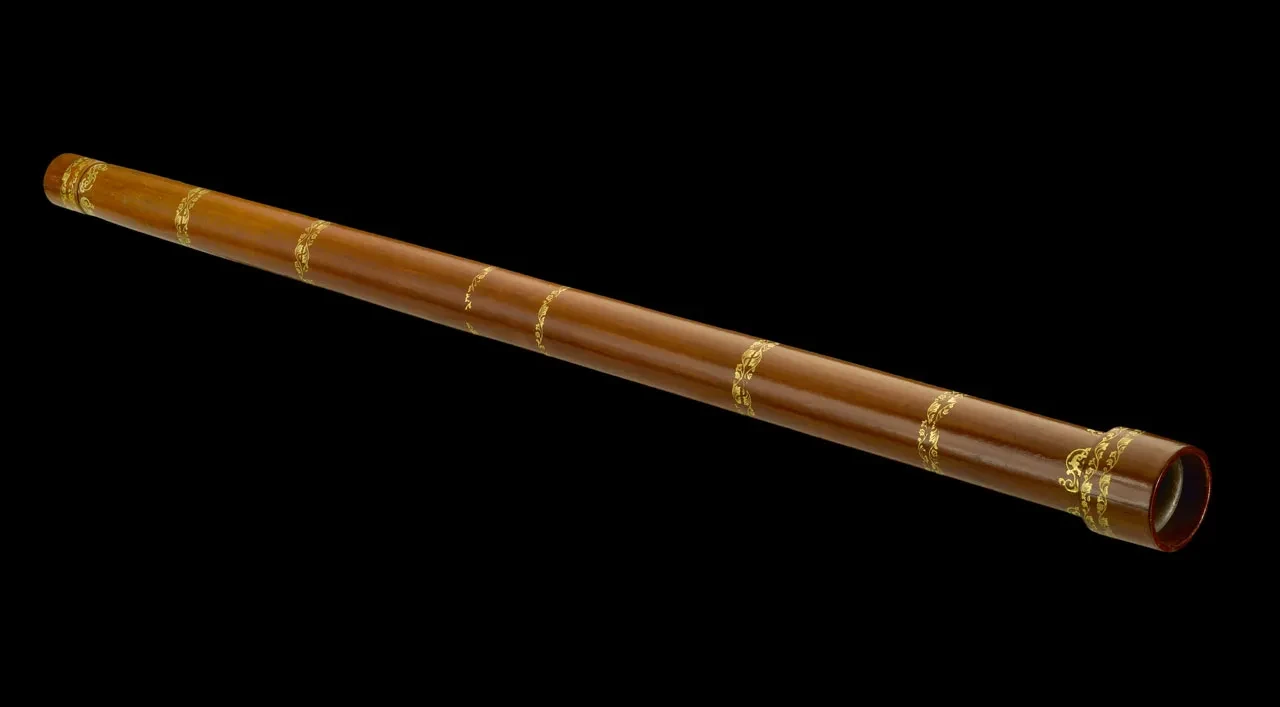
Galileo was already familiar with optical lenses from his household workshop, and he correctly guessed the basic principle of the spyglass even before he had handled one. Dutch instruments of the time could magnify objects two or three times over. Galileo, grinding and polishing his own lenses, quickly built a version that magnified twenty times — and kept improving it.
He didn’t just admire the view. He pointed his telescope at the Moon and saw that its surface was not the smooth, polished sphere that Aristotelian cosmology demanded, but a landscape of mountains and craters. By tracking how the shadows on the Moon lengthened and shortened with the angle of the Sun, he was able to estimate the height of those lunar mountains, and found they were comparable to mountains on Earth. The message was blunt: the Moon looked like Earth’s own backyard, not like a flawless celestial jewel.
Then, on the night of January 7, 1610, he turned his telescope toward Jupiter and noticed three small points of light lined up near the planet. At first he assumed they were background stars, but over the following nights he saw them shift position in a way that made no sense for fixed stars — they stayed close to Jupiter while changing their arrangement relative to one another, and within about a week a fourth point joined them. By January 15, Galileo had concluded, correctly, that these were not stars at all but moons in orbit around Jupiter.
That was the single most important observation Galileo ever made, because it broke a piece of Aristotelian logic that had seemed unbreakable: that everything in the heavens must orbit the Earth. Here were four bodies plainly circling something that was not Earth. Later that same year, watching Venus, he found something equally damaging to the old picture. Venus went through phases just like the Moon, and the geometry of those phases only made sense if Venus was orbiting the Sun rather than the Earth. He also turned his telescope on the hazy band of the Milky Way and discovered it wasn’t misty light at all, but thousands of individual stars packed too closely for the naked eye to separate.
Rather than sit on these results, Galileo rushed his discoveries into print that March as a short pamphlet called Sidereus Nuncius, or The Starry Messenger, partly to establish priority and partly to court favor with the Medici family in his native Florence, whose name he attached to the four new moons of Jupiter. It made him famous across Europe almost overnight. Kepler suggested naming the moons Io, Europa, Ganymede, and Callisto after mythological figures, though the idea took more than two centuries to catch on; in the meantime, and ever since, they’ve been called the Galilean moons in his honor.
The physics nobody had bothered to write down
It’s tempting to think of Galileo purely as an astronomer, since the telescope is what made him a celebrity. But his deeper and, in some ways, more consequential work was happening on the ground, with balls, ramps, and pendulums, years before he ever picked up a spyglass.
Around 1601, Galileo recognized that a pendulum’s swing depends only on the length of its cord, not on how far it swings — a discovery known as isochrony. That observation nudged him toward a bigger idea: that time itself, not just distance or weight, was the missing variable in describing motion. Experiments rolling balls down inclined planes then led him to the law of free fall — that a body dropped from rest covers a distance proportional to the square of the elapsed time. It sounds abstract stated that way, but it was the first time anyone had captured falling motion in a precise mathematical rule rather than a qualitative story about heavy things “seeking their natural place.”
Along the way, Galileo also chipped away at another Aristotelian assumption — that objects need a continuous push to keep moving, and that left alone they naturally come to rest. He worked out that a body on a frictionless, level surface has no natural tendency either toward motion or toward rest; in the absence of outside interference, whatever state of motion it’s in, it stays in. This is the seed of what we now call inertia, and it would later be sharpened and generalized by Newton into one of the three laws that underpin all of classical mechanics. Galileo’s version was not quite the modern one — he generally pictured this conserved motion as following the curve of the Earth rather than a straight line, which is why historians sometimes call it “circular inertia” rather than the linear inertia of Newtonian physics — but the core insight, that motion doesn’t need a constant cause to persist, was his.
This mattered enormously for defending the idea of a moving Earth. Critics of Copernicus had a seemingly commonsense objection: if the Earth is really spinning and hurtling through space, why doesn’t a stone dropped from a tower land far to the west, left behind by the planet’s motion? Galileo’s answer was that a dropped stone keeps the Earth’s eastward motion all the way down, just as a stone dropped from the mast of a smoothly sailing ship keeps the ship’s motion and lands at the foot of the mast rather than behind it. Because we share the Earth’s motion, we can’t use falling objects to detect it — an early and important statement of what physicists now call the relativity of motion.
Assembling the case for a Sun-centered solar system
None of these individual pieces amounted to proof that the Earth orbits the Sun. But together, they dismantled the objections that had made a moving Earth seem physically absurd, while the telescopic discoveries chipped away at the idea that Earth was cosmically unique. A universe where Jupiter has its own family of orbiting moons, where the Moon has mountains like Earth’s, and where inertia lets a spinning planet carry a dropped stone along with it, was a universe that no longer needed the Earth sitting motionless at the center.
Galileo laid all of this out most fully in 1632, in his Dialogue Concerning the Two Chief World Systems, structured as a debate between defenders of the Ptolemaic (Earth-centered) and Copernican (Sun-centered) systems. It’s worth being honest about the weakest link in his case: Galileo believed his strongest proof for a moving Earth was his theory of the tides, which argued that the combined effect of Earth’s daily rotation and its yearly orbit sloshed the oceans back and forth — but the theory doesn’t hold up, since it predicts one high tide per day rather than the two that are actually observed, and it dismisses the Moon’s obvious role in the tides as unfounded speculation. Modern historians generally agree this was Galileo’s biggest scientific misstep. His telescopic evidence and his physics of motion have aged far better than his tidal argument ever did.
A trial, a confession, and a legacy that outlasted both
The Dialogue also triggered the most famous confrontation of Galileo’s life. In 1633 he was summoned to Rome and tried by the Roman Inquisition, found “vehemently suspect of heresy” for holding that the Sun sits at the center of the universe and that the Earth moves, and made to recite a formal abjuration renouncing those views. His prison sentence was immediately commuted to house arrest, which he lived under for the rest of his life, first near Siena and later at his own villa in Arcetri.
It’s worth being precise about what the trial does and doesn’t tell us. It is not evidence that Galileo’s physics was wrong — the Inquisition wasn’t running experiments, it was defending a literal reading of scripture and an inherited philosophical framework against a claim it considered theologically dangerous. Nor is the story quite the clean parable of a lone rational hero crushed by blind dogma that popular retellings sometimes make it. Galileo has been mythologized as a “martyr” for rationality for four centuries, and that reputation, however earned, is itself part of a much messier and more politically tangled history than the shorthand version suggests. What is clear is that house arrest did not stop him from working. Confined to Arcetri, Galileo returned to the mechanics he’d developed decades earlier and, in 1638, published Two New Sciences — smuggled out of Italy for printing in Holland — which laid out his mathematical treatment of falling bodies, projectile motion, and the strength of materials. It’s arguably his most complete scientific achievement, finished under house arrest, on a subject the Church had no reason to censor.
Why this still matters
Galileo’s lasting contribution isn’t any single discovery — not the moons of Jupiter, not the law of free fall, not even his defense of Copernicus. It’s the method underneath all of them: the insistence that claims about nature have to answer to careful observation and measurement, not just to authority or intuition, and that mathematics is the language in which those observations should be expressed and tested. Aristotelian physics had run for nearly two thousand years on reasoned argument from first principles, with actual measurement playing a distinctly secondary role. Galileo built devices, measured things precisely, and let a stubborn result overturn a plausible-sounding theory. That habit — build the apparatus, take the measurement, trust the number over the intuition — is the ancestor of the way physics, and most of experimental science, still operates today.
His unfinished business also mattered. Galileo’s laws of motion, his early notion of inertia, and his insistence that matter obeys uniform mathematical rules gave later scientists a foundation to build on. Newton, born the same year Galileo died, would take these threads and weave them into a single, unified system of mechanics and gravitation. Galileo didn’t get there first, but he cleared the ground and handed over the tools.
Sources
- Stanford Encyclopedia of Philosophy — Galileo Galilei
- Museo Galileo — Works of Galileo Galilei
- Sidereus Nuncius (Digital Edition) — sidereusnuncius.org
- NASA — 415 Years Ago: Astronomer Galileo Discovers Jupiter’s Moons
- NASA History — 410 Years Ago: Galileo Discovers Jupiter’s Moons
- NASA Science — Planetary Motion: The History of an Idea That Launched the Scientific Revolution
- Vatican Observatory — Galileo: A Quick Summary
- OpenStax Astronomy 2e — The Birth of Modern Astronomy
- Cambridge University Press — Seeing Beyond Aristotle: Galileo’s Controversies
- Royal Museums Greenwich — What Did Galileo Discover?
- Studies in History and Philosophy of Science — Galileo and Prior Philosophy
- arXiv — Galileo Knowledge of Optics and the Functioning of the Telescope Revised
- arXiv — On the Accuracy of Galileo’s Observations
- arXiv — Learning from Galileo’s Errors
- arXiv — A Quantitative Analysis of Galilei’s Observations of Jupiter Satellites from the Sidereus Nuncius
- arXiv — Falling Bodies: The Obvious, the Subtle, and the Wrong
- arXiv — Doubting, Testing, and Confirming Galileo
- Dictionary of Scientific Biography — Galileo Galilei (PDF)
- Le Opere di Galileo Galilei, National Edition — liberliber.it
- Project Gutenberg — The Starry Messenger
- University of Chicago Press — Sidereus Nuncius (Albert Van Helden Translation)
- University of California Press — Dialogue Concerning the Two Chief World Systems
- University of California Press — The Galileo Affair: A Documentary History
- University of Notre Dame Press — Galileo’s Early Notebooks
- University of Wisconsin Press — On Motion and On Mechanics
- Britannica — Galileo Galilei: Telescopic Discoveries
- Physical Review Journals — journals.aps.org
- Nature Portfolio — nature.com
- Science (AAAS) — science.org
- The Astrophysical Journal — iopscience.iop.org
- Monthly Notices of the Royal Astronomical Society — academic.oup.com/mnras
- Astronomy & Astrophysics — aanda.org
- Classical and Quantum Gravity — iopscience.iop.org
- Journal of the History of Ideas — jhiblog.org
- Internet Archive — Historical Editions of Galileo’s Works
- Library of Congress — Sidereus Nuncius First Edition
- Cambridge Digital Library — Sidereus Nuncius
- Stanford Digital Repository — Sidereus Nuncius
- Max Planck Institute — Galileo’s Telescope