How Newton Explained the Universe
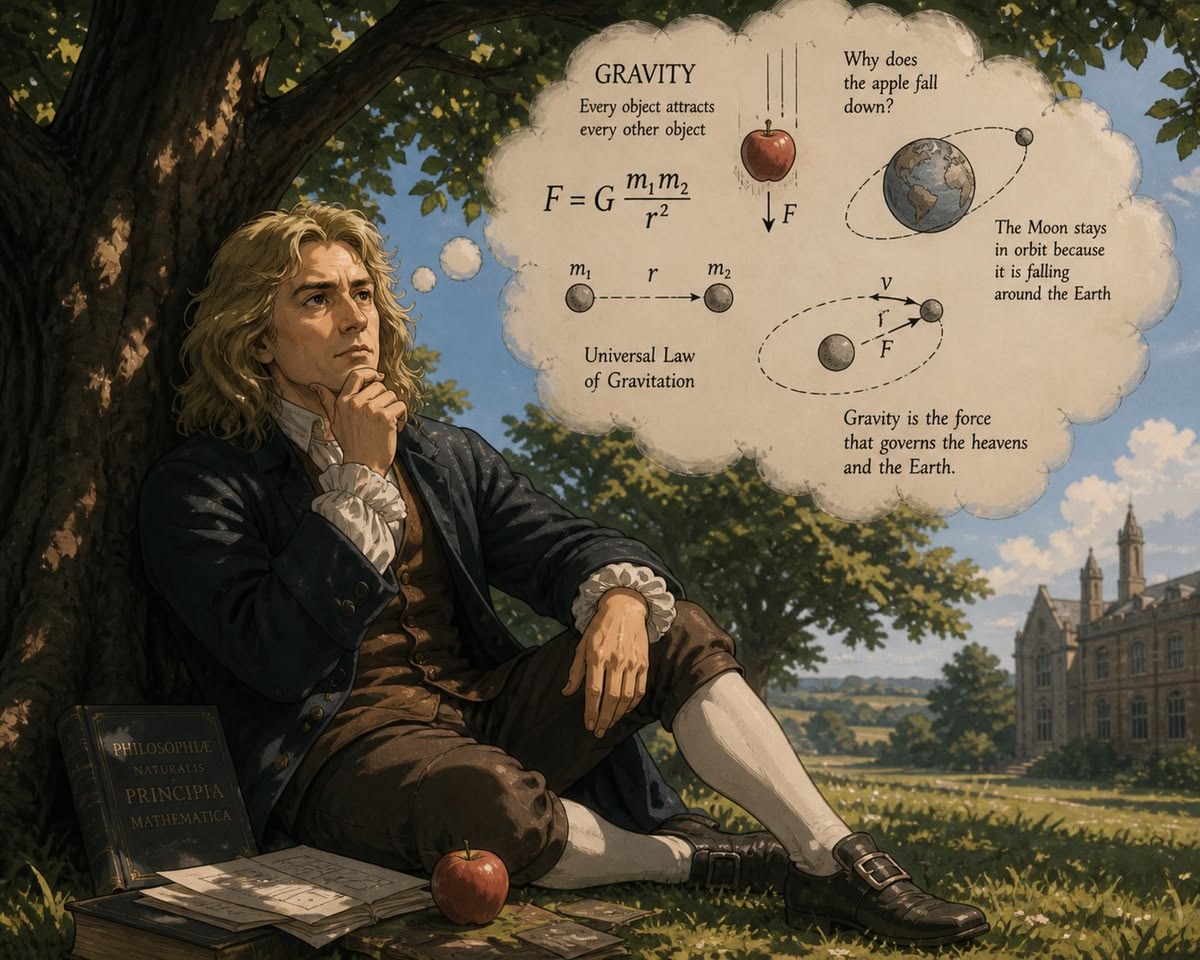
In the autumn of 1684, the astronomer Edmond Halley traveled to Cambridge to ask Isaac Newton a single question: if the Sun pulls the planets with a force that weakens as the square of the distance, what shape orbit results? Newton answered immediately — an ellipse — and told Halley he had already worked it out. He hadn’t misplaced the calculation so much as never bothered to publish it. Pressed to write it up properly, Newton spent the better part of three years producing the Philosophiae Naturalis Principia Mathematica, a book that did something genuinely new: it took the same force that pulls an apple to the ground and used it to explain the shape of planetary orbits, the timing of ocean tides, and the paths of comets, all from one mathematical rule.
Also read: 3 Revolutionary Laws of Newton That Changed the World
That unification is really the story here. Not that Newton discovered gravity — people had always known things fall — but that he showed falling and orbiting are the same phenomenon, governed by the same law, expressible in the same equation. This piece walks through how that single idea reached from a dropped apple all the way out to the edge of the solar system, what it explained, and where it eventually ran into trouble.
From a falling apple to an orbiting Moon
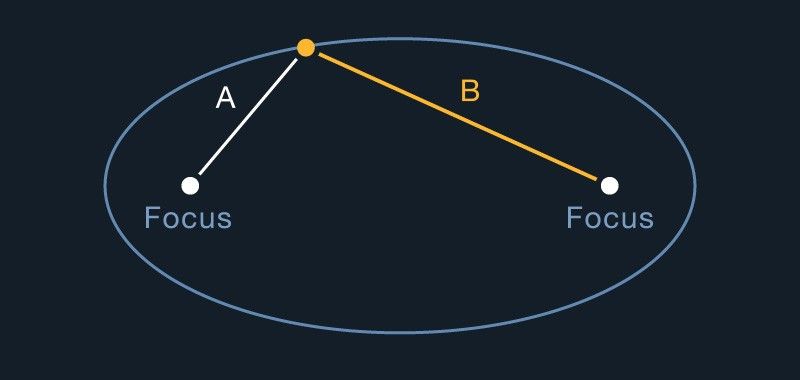
Before Newton, the heavens and the Earth ran on separate rulebooks. This split went back to Aristotle: the terrestrial world was a place of change and decay, where heavy things naturally fell toward the center; the celestial world was perfect and unchanging, where planets and stars moved in eternal circles for no reason that needed explaining, because circular motion was simply what perfect things did. Kepler had already cracked the shape of the problem decades earlier, showing from Tycho Brahe’s observations that planets move not in circles but in ellipses, sweeping out equal areas in equal times. What Kepler didn’t have was a reason. He gestured at a magnetism-like influence radiating from the Sun, but nothing in his system explained why an ellipse, specifically, was the orbit nature chose.
Newton’s route into the problem was mechanical rather than geometric. He started from a question he’d been mulling since his twenties, during the plague years he spent away from Cambridge: what if the force holding the Moon in its orbit is the identical force that pulls an apple to the ground? An orbiting body, in Newton’s framework, isn’t doing something fundamentally different from a falling one — it’s continuously falling toward the central body, but moving sideways fast enough that it keeps missing. Aim a cannonball fast enough, and instead of landing, it curves all the way around the Earth’s surface; give it more speed still, and it settles into an elliptical path that never comes down. The Moon is doing exactly this, all the time, at roughly a kilometer per second.
Gravitation, as NASA’s overview of orbital mechanics puts it, is simply the mutual attraction of all masses in the universe, an effect that weakens with the square of the distance but, in principle, never disappears entirely. Newton’s law of universal gravitation gives this attraction a precise form: every particle of matter pulls every other particle with a force proportional to the product of their masses and inversely proportional to the square of the distance between them. Run that law through the mathematics of centripetal motion, and an inverse-square force pointed at a fixed center turns out to produce exactly the family of curves Kepler had already found empirically — ellipses, with the Sun sitting not at the center but at one focus. Newton didn’t fit his law to Kepler’s ellipses after the fact; he derived the ellipse as the necessary consequence of an inverse-square pull, which is a much stronger kind of proof.
The machinery underneath: three laws and one force
The Principia opens with three statements about motion that do the structural work everything else depends on. A body at rest or moving in a straight line stays that way unless a force interferes with it. A force produces a change of motion proportional to itself, directed along the line the force acts. And every action has an equal and opposite reaction. None of these three laws mentions gravity specifically — they’re the general grammar of mechanics, applicable to billiard balls, cannonballs, and planets alike. Gravity is simply one particular force plugged into that grammar, distinguished only by depending on mass and distance in that specific inverse-square way.
What made this genuinely difficult, rather than merely audacious, is that a planet’s orbit isn’t determined by the Sun’s pull alone. Newton had to prove that a spherical body’s gravity behaves, from the outside, exactly as if all its mass were concentrated at a single point at its center — a result that holds cleanly for inverse-square forces and spherical symmetry, but for essentially no other combination of force-law and shape. Without that theorem, treating the Sun and planets as point masses would have been a convenient approximation rather than a mathematically justified move. Newton also had to show that the geometry of centripetal motion — equal areas swept out in equal times, the signature of any purely central force — matched what Kepler had already measured, and that the exponent in the force law could be read off directly from the shape of the orbit. Section 2 and Section 3 of Book 1 of the Principia, still the most-read parts of the work today, are where this machinery gets built.
Why the sea rises twice a day
Gravity’s inverse-square dependence on distance has a subtle consequence that Newton was the first to work out properly: it doesn’t pull on an extended body uniformly. The side of the Earth nearer the Moon feels a slightly stronger pull than the side farther away, and the solid Earth itself, along with the oceans draped over it, gets stretched very slightly along the Earth-Moon line. This is the gravity gradient effect, and it produces not one tidal bulge but two — one on the side facing the Moon, caused by its comparatively stronger pull there, and one on the far side, caused by that side being pulled less strongly than the Earth’s center is. Because the Earth rotates underneath these two bulges roughly once a day, most coastlines see two high tides and two low tides in about 24 hours, with the Sun’s much weaker but still measurable pull adding a smaller, secondary modulation depending on whether Sun and Moon are aligned or working against each other.
Before the Principia, the tides were one of the great unsolved puzzles of natural philosophy — Galileo had proposed an explanation involving the Earth’s rotation and revolution that turned out to be wrong, and Descartes had invoked his vortices. Newton’s tidal theory, laid out in Book 3, was the first to connect the twice-daily rhythm of the tides to a specific, testable physical cause: the differential pull of the Moon and Sun across the width of the Earth. It wasn’t perfect — Newton’s numbers for the relative strength of the Moon’s pull versus the Sun’s were revised substantially between editions of the book, and the theory says nothing about the complicating effects of coastlines, ocean depth, and friction that make real-world tide tables so locally variable — but the basic mechanism he identified is still the one taught today.
Comets: visitors, not omens
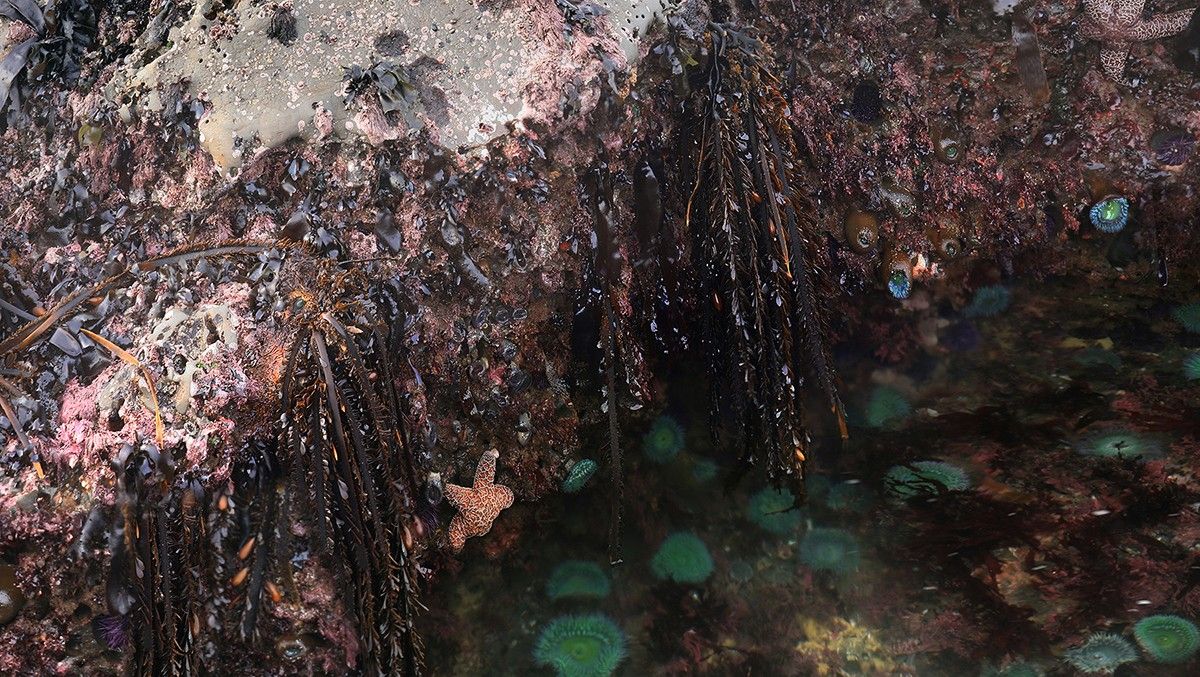
For most of history, comets were treated as things that happened in the sky rather than objects that moved through it according to rules — portents, not physics. Newton’s theory of gravity changed that by treating a comet exactly like a planet: a body responding to the Sun’s inverse-square pull, except typically on a far more elongated path. Where a planet’s orbit is a nearly circular ellipse, a comet’s is often a long, thin ellipse that swings it in close to the Sun before flinging it back out to the solar system’s edge, sometimes for centuries at a stretch. Some comets, on Newton’s analysis, follow paths so stretched that they’re barely distinguishable from a parabola — meaning, in effect, a one-time visit, never to be seen from Earth again unless a planet’s gravity bends the path into a closed loop on the way out.
This was more than a reclassification. Newton worked out the actual trajectory of the great comet of 1680–81 using observations of its path and showed the same inverse-square law that governed the Moon and the planets accounted for its motion too. Edmond Halley took the method and ran further with it, using Newton’s orbital mechanics to notice that the comets observed in 1531, 1607, and 1682 shared strikingly similar orbits — and predicted, correctly, that they were the same object returning roughly every 76 years. Halley didn’t live to see the comet’s 1758 return, but its arrival, on schedule, was one of the most dramatic public vindications Newtonian gravity ever received. A comet named for a man who’d only calculated its return, using a theory built by his friend, showed up exactly when the mathematics said it would.
What Newtonian mechanics actually delivered
By the second half of the eighteenth century, the promise of the Principia had mostly been cashed in. Astronomers used gravity to account for the deviations of planets from simple Keplerian ellipses — deviations caused by the planets tugging on each other, which Newton’s theory predicted should exist and let mathematicians calculate in detail. The wobble of Earth’s axis, known as the precession of the equinoxes, was traced to the Sun and Moon’s gravitational pull on the Earth’s equatorial bulge. Later, the discovery of Neptune in 1846 became the theory’s most spectacular confirmation: astronomers noticed Uranus wasn’t moving quite the way Newtonian gravity said it should, worked backward to calculate where an unseen planet would have to be to cause the discrepancy, and pointed a telescope at that exact patch of sky. Neptune was there.
The deeper shift Newton produced was philosophical as much as technical. Before the Principia, the fact that Kepler’s rules worked was itself something of a mystery — several competing methods for calculating planetary positions achieved comparable accuracy, and there was no principled way to say which, if any, described the true motion rather than a convenient approximation. Newton’s derivation gave the ellipse a reason to be the answer, and in doing so made physical theory, for the first time, a more reliable guide to nature than direct observation — famously demonstrated when Newton used gravitational theory to compute the motion of the Moon more precisely than existing tables of naked-eye observations could manage. That trust in mathematical law over raw measurement became the working assumption of physics for the next two centuries, all the way up to Einstein.
Where the picture started to crack
Newton himself was the first to flag the theory’s weak point. He could describe gravity’s mathematical behavior with total precision but was candidly unwilling to say what it actually was — how a force could reach across the empty distance between the Sun and the Earth with nothing physically in between. “I do not feign hypotheses,” he wrote in the General Scholium added to the second edition, meaning he’d deduced the law from the phenomena and would not speculate about its underlying mechanism. Continental critics, Huygens chief among them, found this deeply unsatisfying — action at a distance, with no contact mechanism at all, looked to them less like physics than like magic dressed in equations.
The theory also had specific, measurable loose ends that took decades, in some cases a century, to resolve. The most glaring was a stubborn factor-of-two error in Newton’s calculation of how fast the Moon’s orbit slowly rotates in space — a discrepancy that wasn’t fully resolved until Alexis-Claude Clairaut’s work in the 1740s. Newton’s account of atmospheric and fluid resistance in Book 2, aimed at demolishing Descartes’s vortex theory, rested on assumptions about how resistance forces combine that turned out, as later analysis by d’Alembert showed, to be fundamentally mistaken — not a rounding error, but a real gap in the physics.
The deepest crack, though, didn’t show up until 1915. Mercury’s orbit precesses very slightly faster than Newtonian gravity, accounting for every known planetary perturbation, predicts it should — a discrepancy of about 43 arcseconds per century that nineteenth-century astronomers tried to explain by hypothesizing an undiscovered planet, Vulcan, orbiting closer to the Sun than Mercury. No such planet exists. Einstein’s general theory of relativity resolved the discrepancy exactly, by replacing Newton’s picture of gravity as a force acting instantaneously across space with the idea that mass curves spacetime itself, and that planets simply follow the straightest available paths through that curved geometry. Crucially, general relativity doesn’t discard Newton so much as absorb him: in the everyday regime of moderate masses and low speeds, Einstein’s equations reduce almost exactly to Newton’s, in the same way Newton had shown Galileo’s rules for falling bodies were a limiting case of his own more general law. It’s only near very massive or fast-moving objects — close to a black hole, in the precise timing of a GPS satellite, in the gravitational waves radiated by colliding neutron stars — that the two theories part ways enough to matter.
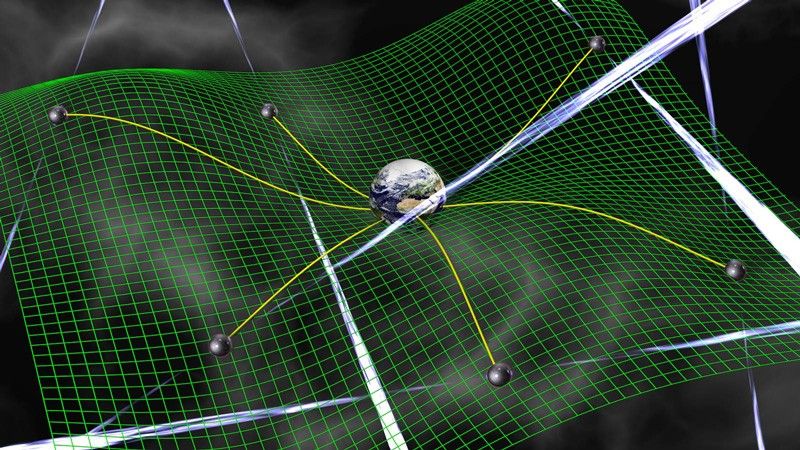
General relativity, for its part, is not the final word either. It has no quantum foundation, unlike the other fundamental forces, which is why physicists still test it in the most extreme environments available — near black hole event horizons, in merging binary systems, anywhere gravity is strong enough that the gap between Newton’s approximation and the deeper theory might widen further still.
The takeaway
What makes the Principia worth returning to isn’t that Newton got everything right — he didn’t, and he knew it. It’s that he took four apparently unrelated observations, a falling apple, an orbiting Moon, a rising tide, a comet’s arc across the sky, and showed they were four expressions of one law. That kind of unification, more than any single equation, is what physics has been chasing ever since, from Einstein’s absorption of Newton into general relativity to the ongoing hunt for a theory that folds gravity in with quantum mechanics. Newton didn’t close the book on gravity. He was the first to show the book had a single, coherent story running through it at all.
Sources
- Isaac Newton, Philosophiae Naturalis Principia Mathematica (The Newton Project, University of Oxford): https://newtonproject.ox.ac.uk/texts/introduction
- Stanford Encyclopedia of Philosophy: Newton’s Philosophiae Naturalis Principia Mathematica
- NASA Science, Basics of Space Flight — Chapter 3: Gravity & Mechanics: Page One | Page Two | Page Three
- NASA Science: Forces
- NASA Earth Observatory: Planetary Motion
- NASA Science: General Relativity and the Nature of Spacetime


One Comment