General Relativity and its Mind-Bending Predictions That Changed Our View of Space
How a patent clerk’s thought experiment about falling elevators became our best description of gravity, black holes, and the shape of the universe itself in the .
Also read: 1905: Einstein’s miracle year
In 1915, Albert Einstein handed physics a strange new idea: gravity is not a force reaching out across space. It is the shape of space itself. Drop an apple, and it does not fall because the Earth pulls on it. It falls because the Earth has bent the space around it, and the apple is simply following the straightest path available in a landscape that is no longer flat. That single reframing — gravity as geometry rather than force — is the heart of Einstein’s General Theory of Relativity, and it would go on to predict black holes, gravitational waves, and the bending of starlight decades before any of them could be observed.
A century later, every major prediction of the theory has been tested and confirmed, from a 1919 solar eclipse photographed on a remote African island to the first-ever image of a black hole’s shadow in 2019. This is the story of how Einstein got there, what the theory actually says, and how we know it’s right.
Gravity Was Never Supposed to Be a Force
By 1915, Einstein had already overturned physics once. His 1905 Special Theory of Relativity showed that space and time were not fixed, absolute backdrops — they stretched and shifted depending on how fast you were moving. But special relativity had a blind spot: it only worked for objects moving at constant speed, and it said nothing at all about gravity. Newton’s 200-year-old law of universal gravitation, meanwhile, treated gravity as an instantaneous force acting across empty space — which quietly contradicted special relativity’s rule that nothing, not even a gravitational tug, can travel faster than light.
Einstein spent the next decade chasing a theory that could fold gravity into the same framework as space and time. The breakthrough came from a thought experiment he later called “the happiest thought of my life.”
The Equivalence Principle: Falling Feels Like Nothing
Imagine a person standing in a windowless elevator. If the elevator sits on the ground, they feel their normal weight pressing their feet to the floor. Now imagine that same elevator, far out in empty space, being pulled upward by a rocket accelerating at exactly 9.8 meters per second squared — the same as Earth’s gravity. Inside, the person would feel an identical pressure on their feet. With no windows, there is no experiment they could run inside the elevator to tell the two situations apart.
Einstein called this the equivalence principle: locally, the effects of gravity and the effects of acceleration are indistinguishable. As the physicist M. Bobrowsky put it in describing Einstein’s reasoning, if you’re in a rocket accelerating at one g, it feels exactly like standing on Earth. Flip the thought experiment around, and a person in an elevator whose cable has snapped — falling freely toward the ground — would feel weightless, just like an astronaut orbiting Earth. Free fall, Einstein realized, is not gravity acting on you. It’s the absence of any felt force at all.
This was the seed of everything that followed. If acceleration and gravity are truly the same thing, then gravity can’t be a force pulling objects through space — it has to be a feature of space and time themselves, one that free-falling objects simply move through without resistance.
Gravity as Geometry: Spacetime Bends
Einstein spent the years after 1907 working out the mathematics that could turn this insight into a full theory, eventually publishing “The Foundation of the General Theory of Relativity” in 1916. The finished picture fuses space and time into a single four-dimensional fabric called spacetime. Mass and energy don’t reach out and pull on distant objects; they curve the spacetime around them, the way a bowling ball placed on a stretched rubber sheet creates a dip that a marble will roll toward. Objects moving through curved spacetime — planets, light, falling apples — simply follow the straightest possible path available, called a geodesic. It only looks like a force from the outside.
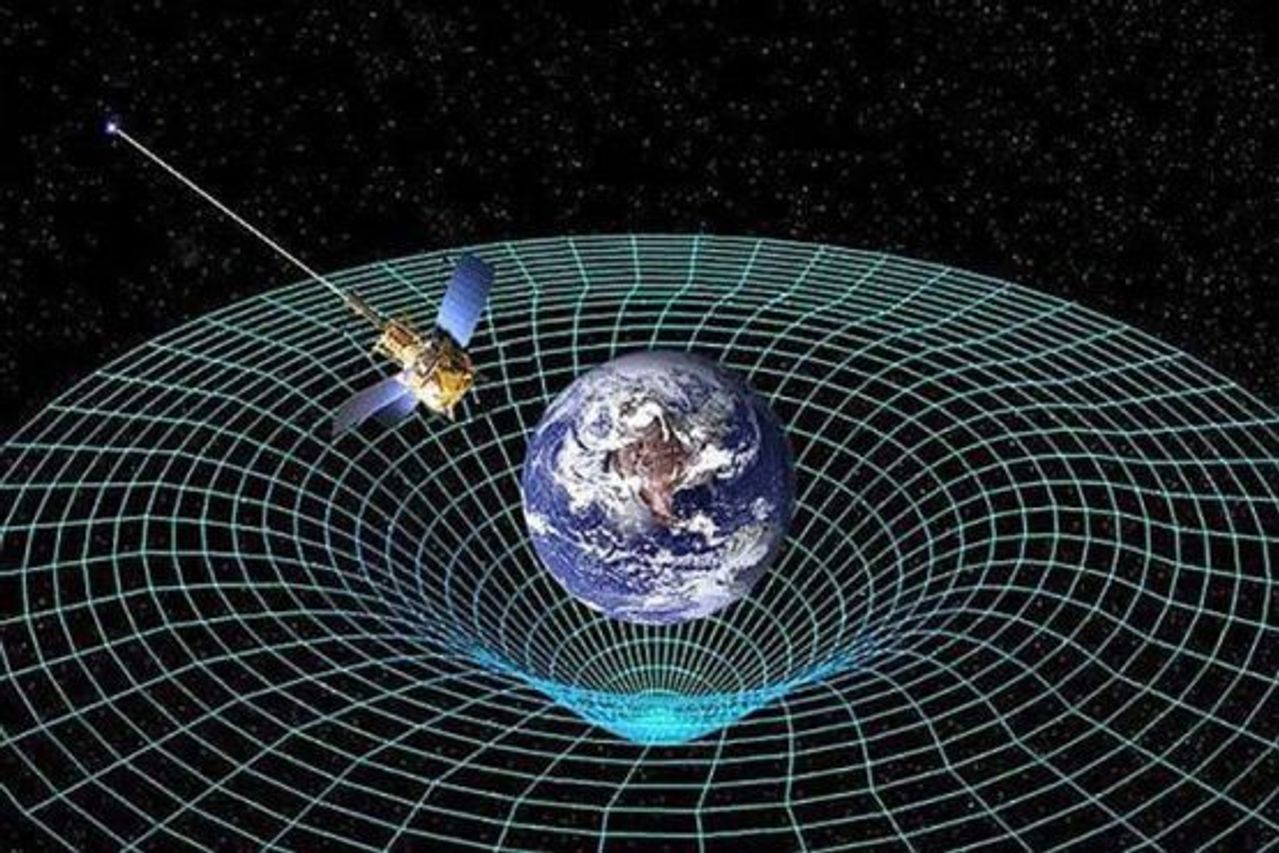
Artist’s concept of Gravity Probe B orbiting Earth to measure the curvature of spacetime. Credit: NASA
This is a genuinely different claim from Newton’s. Newton asked how strongly two masses pull on each other. Einstein asked how mass and energy reshape the geometry of the space and time around them — and then asked how everything else moves through that reshaped geometry. NASA’s Physics of the Cosmos program frames the modern version of this question directly: general relativity is tested most stringently not in gentle fields like our own solar system, but in extreme conditions such as near the event horizons of black holes, where velocities approach a meaningful fraction of the speed of light and gravity’s grip on spacetime is at its most severe.
One immediate consequence of this geometric picture is that light itself, having energy, must also follow the curves of spacetime. That single idea — that gravity bends the path of light — became the theory’s first great public test, and its most famous prediction: black holes.
Predicting the Unseeable: Black Holes
Within months of Einstein publishing his field equations, the German physicist Karl Schwarzschild found an exact solution describing the spacetime around a single, perfectly spherical mass. Buried in that solution was something extraordinary: if enough mass were packed into a small enough region, spacetime would curve so sharply that nothing — not even light — could climb back out. Decades later, this region acquired a name: the black hole.
A black hole isn’t a hole in any literal sense. It’s an extreme concentration of matter so dense that, just beneath its surface — the event horizon — the curvature of spacetime is severe enough to trap light itself. The event horizon isn’t a physical surface like the ground beneath your feet; it’s simply the boundary beyond which nothing can escape. Because black holes emit no light of their own, astronomers find them indirectly: by watching stars whirl unusually fast around an invisible point, by detecting the X-rays thrown off by superheated gas spiraling inward, or by catching the way their gravity bends and magnifies light from objects behind them.
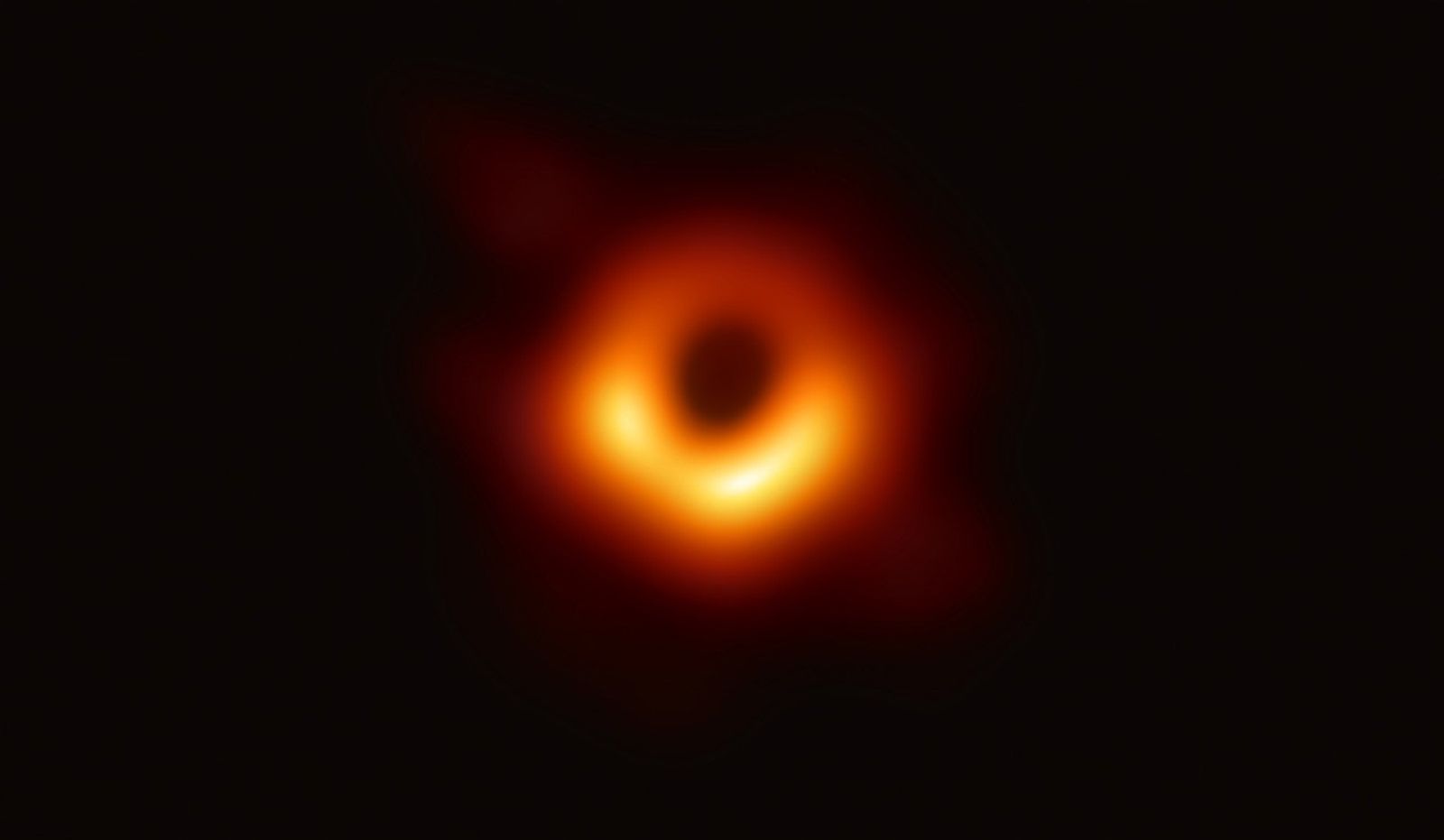
The first-ever image of a black hole’s shadow, captured at the center of galaxy M87 by the Event Horizon Telescope in 2019. Credit: Event Horizon Telescope Collaboration
For over a century, black holes lived only in the mathematics. That changed in 2019, when the Event Horizon Telescope collaboration released the first direct image of a black hole’s shadow, at the center of the galaxy M87. NASA’s Chandra X-ray Observatory, NuSTAR, Swift, and Fermi all trained their instruments on the same target in a coordinated campaign, adding X-ray and gamma-ray context to the historic optical result. It was, in a very real sense, a hundred-year-old prediction finally photographed.
Starlight That Bends: The 1919 Eclipse
Black holes would take a century to confirm directly, but general relativity’s first great test came almost immediately — and it hinged on something far more visible: starlight grazing the edge of the Sun.
If mass curves spacetime, then light passing close to a massive object like the Sun should be deflected, ever so slightly, from a straight line. The effect is tiny and, under normal daylight, utterly swamped by the Sun’s glare. But during a total solar eclipse, with the Sun’s disk blotted out by the Moon, the stars near its edge become briefly visible — and their positions could be compared against photographs of the same patch of sky taken months earlier, when the Sun was nowhere near them.
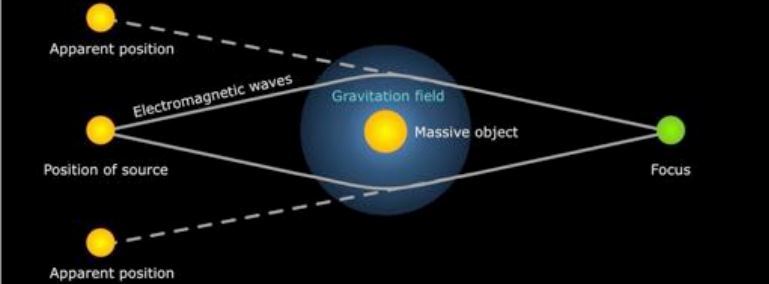
If General Relativity was right, starlight passing near the Sun would bend, making background stars appear shifted during a total eclipse. Credit: NASA
On May 29, 1919, the British astronomers Arthur Eddington, Frank Watson Dyson, and Andrew Crommelin put this to the test. Two expeditions set out — one to the island of Príncipe off West Africa, the other to Sobral in Brazil — to photograph a total eclipse with an unusually long, nearly seven-minute duration of totality, set against a rich background star cluster called the Hyades. Skies stayed mostly clear over Sobral, yielding twenty usable photographic plates; clouds parted just long enough at Príncipe for two more.
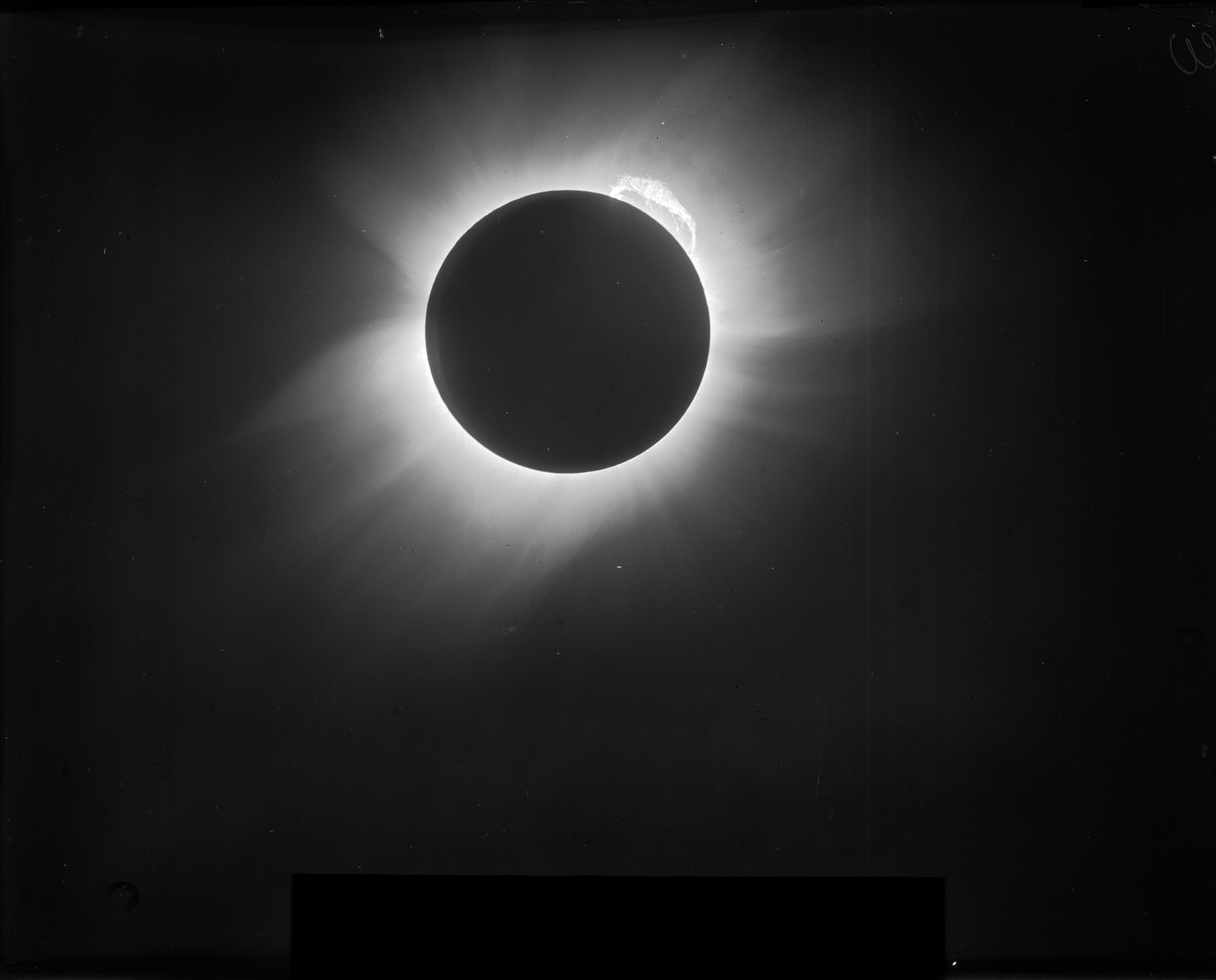
One of the original 1919 eclipse plates from Sobral, Brazil, used to test Einstein’s prediction. Credit: F. W. Dyson, A. S. Eddington, and C. Davidson
Comparing the eclipse plates against the earlier night-sky photographs, the team found the stars’ positions had shifted by an amount, in their words, “discordant by an amount much beyond the limits of accidental error” — and the shift matched Einstein’s prediction, not Newton’s older, smaller estimate of light bending. When the Royal Society announced the results that November, newspapers around the world ran headlines like “Revolution in Science” and “Einstein Theory Triumphs.” Einstein went from an obscure theoretical physicist to a global celebrity almost overnight.
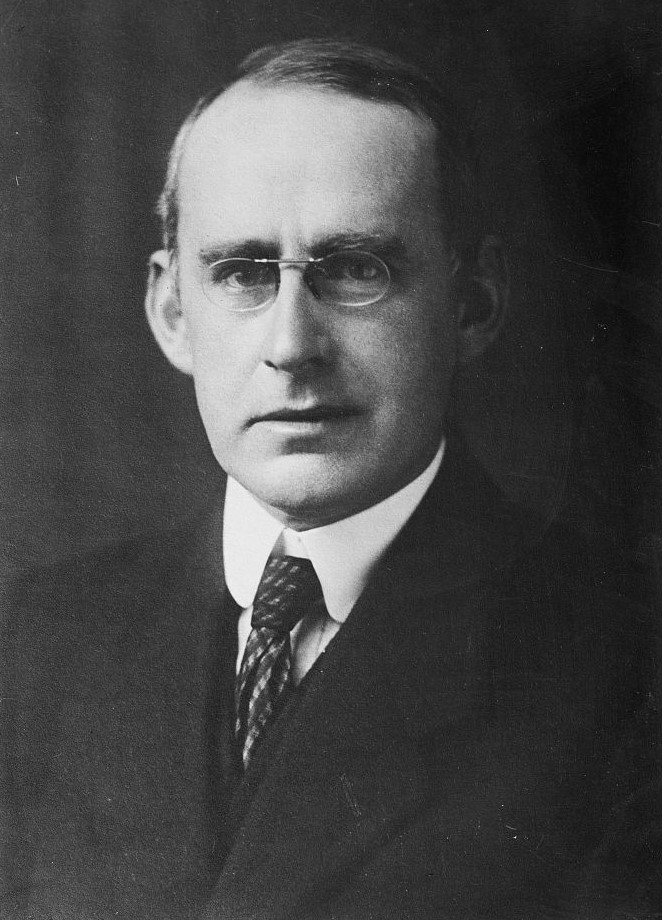
Sir Arthur Stanley Eddington (1882–1944), who led the 1919 eclipse expedition to Príncipe. Credit: Library of Congress, Prints & Photographs Division, George Grantham Bain Collection
Some contemporaries questioned whether Eddington’s equipment was truly precise enough to detect the effect. But the doubts didn’t survive long: over the following decades, ever more sensitive measurements — and eventually entirely new techniques — confirmed the same bending, to increasing precision.
A Century of Confirmation
The eclipse experiment turned out to be only the opening act. Light bending around massive objects is now a routine astronomical tool called gravitational lensing, in which a foreground galaxy or galaxy cluster acts like a natural telescope, magnifying and sometimes multiplying the image of a much more distant object behind it. The Hubble Space Telescope has used this effect to spot multiple images of the same lensed galaxy, to map the invisible distribution of dark matter across galaxy clusters, and even to weigh an isolated white dwarf star by measuring how precisely its gravity bent a background star’s light.
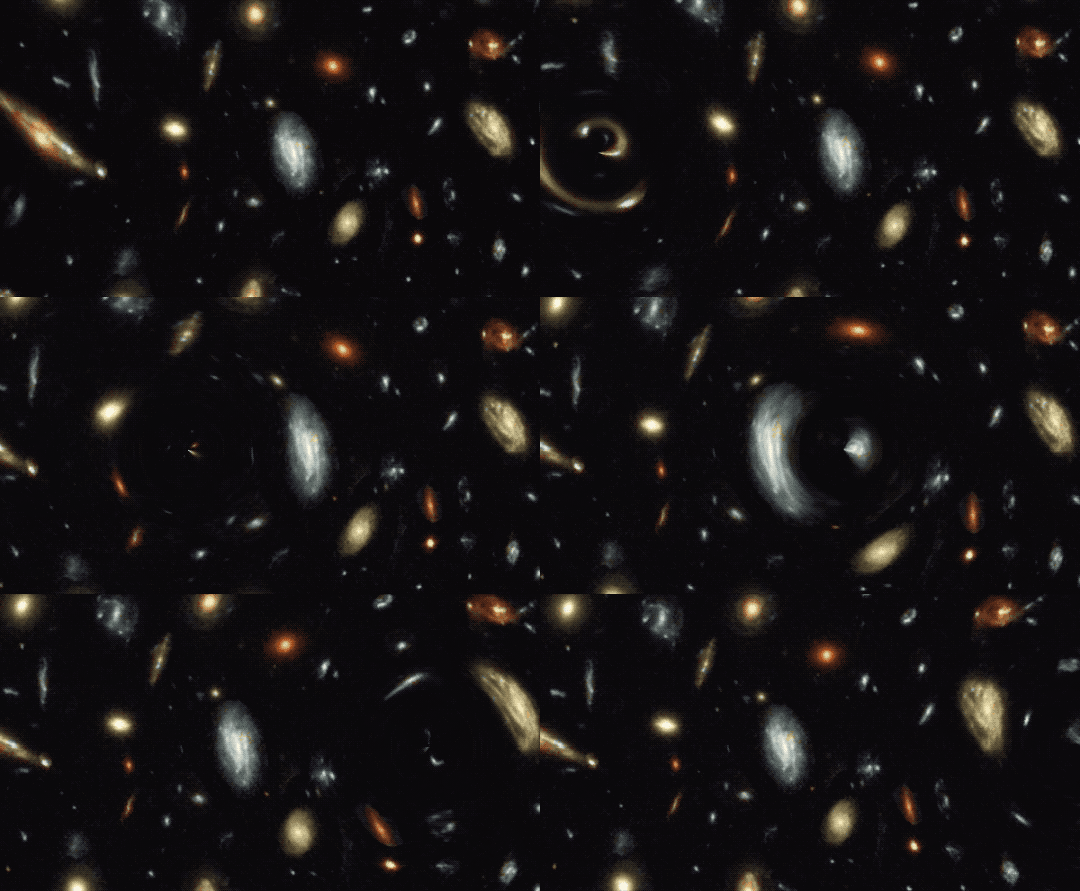
A simulation showing how a gravitational lens distorts and brightens the light of background galaxies as it passes in front of them. Credit: NASA, Frank Summers (STScI)
Other tests followed, each probing a different consequence of the theory. Radio signals from NASA’s Mariner VI and VII spacecraft, and later the Viking landers and Cassini, were delayed by measurable fractions of a second when they passed close to the Sun on their way back to Earth — exactly as general relativity predicts for light traveling through curved spacetime. Gravity Probe B, launched in 2004, used four ultra-precise gyroscopes orbiting Earth to detect the tiny way our planet’s rotation drags spacetime around with it, confirming the effect in 2011. In 2015, the Laser Interferometer Gravitational-Wave Observatory detected gravitational waves directly for the first time — ripples in spacetime from two merging black holes 1.3 billion light-years away, a phenomenon Einstein had predicted a century earlier but assumed might never be observable.
The theory’s reach extends into everyday technology, too. GPS satellites carry onboard clocks that run measurably faster than clocks on the ground, because they sit in a weaker part of Earth’s gravitational field — an effect general relativity predicts precisely. Left uncorrected, that drift would throw GPS positioning off by several miles a day.
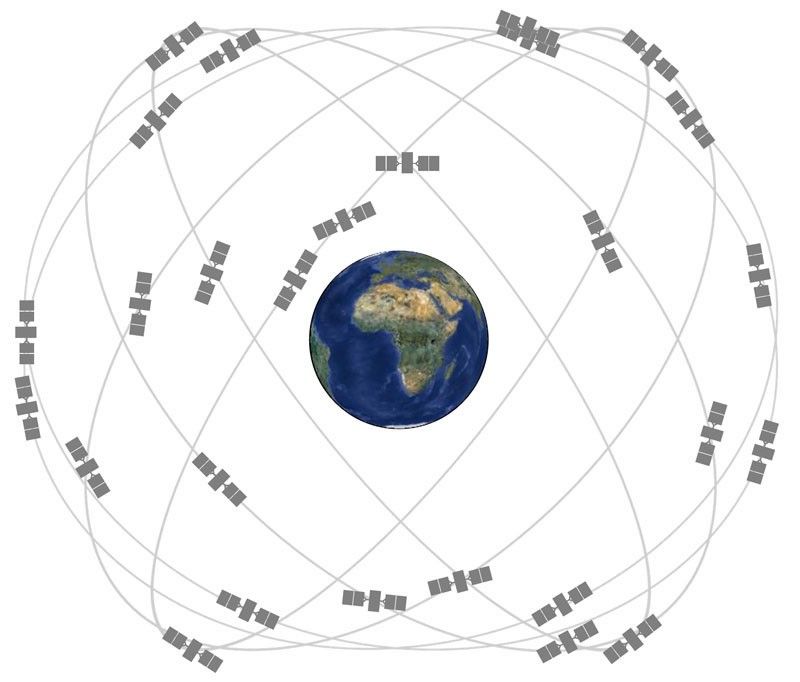
GPS satellites rely on corrections from both special and general relativity to keep their onboard clocks synchronized with clocks on Earth. Credit: NASA
What General Relativity Doesn’t Explain
For all its successes, general relativity is understood to be incomplete. It has no quantum foundation — unlike the electromagnetic, weak, and strong forces, which are all well described by quantum mechanics, gravity currently sits outside that framework entirely. Most tests of the theory to date have been carried out in relatively weak gravitational fields, within the solar system or using binary pulsars; the theory’s true breaking point, if it has one, is expected to show up only in the most extreme environments, such as the immediate vicinity of merging black holes, where gravity is strongest and velocities approach the speed of light. Reconciling general relativity with quantum mechanics — producing a workable theory of quantum gravity — remains one of the open problems in fundamental physics.
The Takeaway
What began as a thought experiment about a person in a falling elevator turned into the theory that explains why light bends around stars, why black holes exist, why gravitational waves ripple across the universe, and why the GPS in your pocket needs to account for the curvature of spacetime just to tell you where you are. General relativity didn’t just correct Newton’s gravity — it replaced the very idea of gravity as a force with something stranger and, so far, unbroken: a universe whose geometry is shaped by everything in it, and which in turn shapes how everything moves.
Sources
- Albert Einstein (1916), “The Foundation of the General Theory of Relativity”
- NASA Science – General Relativity and the Nature of Spacetime
- NASA Science – 10 Things Einstein Got Right
- NASA – Einstein and General Relativity
- NASA Goddard – Eddington’s Test of General Relativity
- NASA Science – Hubble Gravitational Lenses
- NASA – 100 Years of Tests of General Relativity
- Clifford M. Will – The Confrontation between General Relativity and Experiment
- Clifford M. Will – The Confrontation between General Relativity and Experiment (2005)
- Physics Reports – The Confrontation Between General Relativity and Experiment: An Update
- Precision Gravity Tests and the Einstein Equivalence Principle
- Testing General Relativity with Present and Future Astrophysical Observations
- Living Reviews in Relativity: https://link.springer.com/journal/41114
- Physical Review D: https://journals.aps.org/prd/
- Physical Review Letters: https://journals.aps.org/prl/
- Reviews of Modern Physics: https://journals.aps.org/rmp/
- Classical and Quantum Gravity: https://iopscience.iop.org/journal/0264-9381
- The Astrophysical Journal: https://iopscience.iop.org/journal/0004-637X
- Monthly Notices of the Royal Astronomical Society: https://academic.oup.com/mnras
- Astronomy & Astrophysics: https://www.aanda.org/
- Einstein Online – Equivalence Principle: https://www.einstein-online.info/en/
- Einstein Online – General Relativity: https://www.einstein-online.info/en/spotlight/general_relativity/
- Einstein Online – Black Holes: https://www.einstein-online.info/en/spotlight/black_holes/
- ESA – Gravity and General Relativity: https://www.esa.int/
- CERN – Einstein’s Theory of Relativity: https://home.cern/science/physics
- Perimeter Institute – General Relativity Resources: https://perimeterinstitute.ca/
- Caltech LIGO – Gravitational Waves: https://www.ligo.caltech.edu/
- LIGO Scientific Collaboration: https://www.ligo.org/
- Event Horizon Telescope Collaboration: https://eventhorizontelescope.org/
- Schwarzschild, K. (1916), “On the Gravitational Field of a Point Mass”: https://einsteinpapers.press.princeton.edu/
- Arthur Eddington – Space, Time and Gravitation: https://archive.org/details/spacetimegravita00eddi
- Misner, Thorne & Wheeler – Gravitation: https://press.princeton.edu/books/hardcover/9780691177793/gravitation
- Sean Carroll – Spacetime and Geometry: https://www.cambridge.org/
- Bernard Schutz – A First Course in General Relativity: https://www.cambridge.org/
- Robert M. Wald – General Relativity: https://press.uchicago.edu/
- Edwin F. Taylor & John A. Wheeler – Exploring Black Holes: https://www.pearson.com/
- MIT OpenCourseWare – General Relativity: https://ocw.mit.edu/
- Stanford Encyclopedia of Philosophy – Spacetime Theories: https://plato.stanford.edu/entries/spacetime-theories/
- NASA – Black Holes: https://science.nasa.gov/universe/black-holes/
- ESA – Gravity Missions: https://www.esa.int/Applications/Observing_the_Earth
- APS Physics – General Relativity Collection: https://physics.aps.org/

2 Comments