
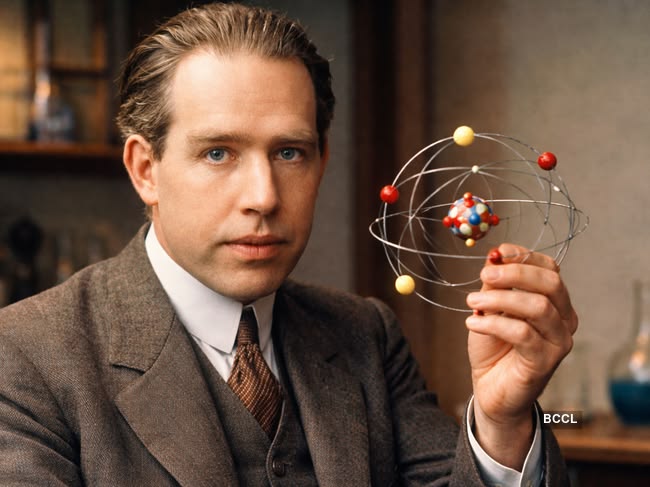
Atoms and Quantum Leap: Mind-Blowing Truths About Bohr’s Model
In March 1913, a 27-year-old Danish physicist sent Ernest Rutherford, his former supervisor in Manchester, a paper that shouldn’t have worked. It borrowed a strange, unproven idea from Max Planck’s theory of heat radiation and welded it onto Rutherford’s own nuclear atom, and in doing so it explained something no one had been able to explain for decades: why hydrogen gas, when excited by an electric spark, glows in only four exact colours, never in between. Niels Bohr’s model was full of assumptions that classical physics flatly forbade. It also worked, with a precision that startled even Bohr’s harshest critics.
This article walks through what Bohr actually proposed, why quantizing an electron’s orbit rescues the atom from collapse, how the model reproduces the hydrogen spectrum almost exactly, and where — despite its triumphs — it eventually ran out of road, opening the door to the quantum mechanics that replaced it.
Also read: Rutherford and the Discovery of the Atomic Nucleus
An atom that couldn’t survive its own physics
By 1913, Rutherford had already shown that an atom is mostly empty space, with almost all of its mass and all of its positive charge packed into a tiny central nucleus, and its electrons occupying the much larger volume around it. The problem was that nothing in known physics explained how such an atom could hold together. An electron circling a nucleus is a charged particle undergoing constant acceleration, and Maxwell’s electromagnetism said any accelerating charge must radiate energy continuously. A classical electron in Rutherford’s atom would lose energy every instant, spiral inward, and crash into the nucleus in a fraction of a second. By the ordinary rules of physics, atoms simply should not exist.
Bohr met Rutherford in 1912 and spent time in his Manchester laboratory, working on the new nuclear model. He became convinced the atom was real, but he also saw that classical mechanics could never make it stable. Rather than abandon the nuclear atom, Bohr decided to abandon a piece of classical physics instead — specifically, the assumption that an orbiting electron must radiate energy at all.
Quantized orbits: the fix that broke the rules
Bohr’s solution, published in July 1913 as the first of a three-part paper titled “On the Constitution of Atoms and Molecules,” rested on a small number of postulates that were, by his own admission, borrowed rather than derived. The electron moves around the nucleus in a circular orbit, exactly as Rutherford’s model already allowed. But Bohr added a restriction with no classical justification: only certain orbits are permitted, specifically those in which the electron’s angular momentum is a whole-number multiple of a fixed unit built from Planck’s constant. Electrons in these special “stationary states” do not radiate at all, no matter how hard classical electromagnetism insists they should. Radiation only appears when an electron jumps from one allowed orbit to another, and the energy of the emitted or absorbed light is exactly equal to the energy difference between the two orbits.

It’s worth being precise about what this bought Bohr. The quantization condition wasn’t derived from some deeper principle; it was imposed because it worked. But once imposed, it forces the atom’s properties into a specific, calculable shape. Combining the quantum condition with ordinary Newtonian mechanics and Coulomb’s law for the electrostatic pull between the electron and the proton, Bohr could solve directly for the size of each allowed orbit and the electron’s speed within it. The orbit radii turn out to grow with the square of a whole number — call it n — so the second orbit is four times the size of the first, the third is nine times the size, and so on. That innermost orbit, for n = 1, works out to about 0.529 angstroms across: the Bohr radius, and still the standard unit physicists use to describe atomic-scale distances.
Where the spectral lines came from
The orbit sizes were a satisfying result, but the real test was energy. Because each orbit has both kinetic energy from the electron’s motion and potential energy from its electrical attraction to the nucleus, Bohr could calculate a total energy for every allowed orbit. That energy comes out negative and shrinks toward zero as n grows, meaning the electron is most tightly bound in the smallest orbit, the ground state, and becomes progressively easier to strip away in higher orbits. For hydrogen’s ground state, the model predicts a binding energy of 13.6 electron volts — the ionization energy needed to remove the electron entirely — a number that matched experiment squarely.
The real payoff, though, came from the transition rule. If an electron falls from a higher orbit to a lower one, the atom emits a single photon whose energy equals the exact difference between the two orbit energies. Because the orbit energies only take specific values, the emitted photon energies — and therefore the emitted wavelengths — are also restricted to a specific, discrete set. Run through the algebra, and the formula for the wavelength of light emitted in a transition between orbit m and orbit n falls directly out of Bohr’s postulates.

This was the moment the model stopped being a curiosity. Physicists already had an empirical formula for hydrogen’s visible spectral lines, worked out by Johann Balmer in 1885 purely by fitting numbers to the four known lines, with no theoretical grounding at all. Bohr’s derivation reproduced the Balmer formula exactly, transitions ending on the second orbit, and it predicted an entire family of spectral series nobody had catalogued yet: an ultraviolet series (later confirmed by Theodore Lyman) for transitions ending on the innermost orbit, and infrared series (found by Friedrich Paschen and others) for transitions ending on the third, fourth, and fifth orbits. Bohr’s formula even reproduced the Rydberg constant — the proportionality factor in these spectral formulas, previously just a number fitted to data — from fundamental constants like the electron’s charge, its mass, and Planck’s constant. A quantity that had been pure empirical bookkeeping for thirty years suddenly had a physical derivation behind it.
A model too accurate to dismiss
Bohr sent his results to Rutherford in a paper dated March 6, 1913, explaining how the new atomic model accounted for the hydrogen spectrum, and the full theory appeared in the Philosophical Magazine that July. The reception among physicists who actually checked the numbers was hard to argue with. One of the clearest confirmations came almost immediately: a mysterious spectral series in stellar and laboratory light, previously attributed to an unknown form of hydrogen, matched Bohr’s prediction for singly ionized helium — a helium atom stripped of one electron, leaving a hydrogen-like system with double the nuclear charge. Alfred Fowler’s precise measurements of this series in 1913 lined up with Bohr’s formula once the ratio of electron to nuclear mass was properly accounted for, a refinement Bohr worked out in response.

The recognition followed quickly. Bohr became head of Copenhagen University’s Institute for Theoretical Physics, later renamed the Niels Bohr Institute, which grew into one of the defining research centres of twentieth-century physics. In 1922, Bohr received the Nobel Prize in Physics “for his services in the investigation of the structure of atoms and of the radiation emanating from them.” His Nobel lecture, delivered that December under the title “The Structure of the Atom,” walked through the same logic: a nuclear atom borrowed from Rutherford, stabilised by a quantum postulate borrowed from Planck, and tested against a spectrum that had resisted explanation for a generation.
Where the model started to crack
Bohr’s theory was not exact even on its own terms, and it started showing strain almost immediately. High-resolution spectroscopy revealed that some of hydrogen’s spectral lines were not single lines at all but closely spaced doublets — a detail the simple circular-orbit model had no way to produce. In 1916, the German physicist Arnold Sommerfeld extended Bohr’s picture by allowing elliptical orbits in addition to circular ones, and by incorporating the small relativistic change in an electron’s mass as its speed varies along an elliptical path. The Bohr–Sommerfeld model, as it became known, correctly reproduced this fine structure and briefly looked like a complete triumph, reinforcing confidence in both quantum theory and relativity at once.
But the extended theory bought only a few more years. Bohr’s original insight that let all this work — the idea that quantum results should blend smoothly into classical predictions at large orbit numbers, which he formalised as the correspondence principle — was a powerful guide, but it was not a foundation that could be extended indefinitely. The Bohr–Sommerfeld approach worked well for hydrogen and hydrogen-like ions with a single electron, but it could not be made to work for helium, an atom with just two electrons. Every attempt to apply the model’s orbit-and-quantization logic to helium’s ground-state energy failed, sometimes badly. It fared even worse against the anomalous Zeeman effect, the way spectral lines split under a magnetic field in a pattern the model couldn’t reproduce without an as-yet-undiscovered property of the electron: spin. By the early 1920s, physicists including Bohr himself recognised that the old quantum theory, semiclassical, built on literal orbits with imposed quantization rules, had reached a wall it could not climb over.
From orbits to waves: the road to modern quantum mechanics
The way past that wall turned out to require giving up orbits altogether. In 1924, Louis de Broglie proposed that electrons, like light, have a wave nature, an idea that gave Bohr’s quantization rule a new and more satisfying interpretation: an allowed orbit is simply one where a whole number of electron wavelengths fits around the circumference, so the wave reinforces itself rather than cancelling out. That single picture explained where Bohr’s quantum condition had come from in the first place, something Bohr’s original postulates never did.

The decisive break came in 1925 and 1926. Werner Heisenberg, working at Bohr’s institute, developed matrix mechanics, a formulation that dropped the idea of a literal electron trajectory entirely and worked instead with abstract arrays of observable quantities like transition frequencies and intensities. Independently, Erwin Schrödinger developed wave mechanics, building directly on de Broglie’s matter waves and describing the electron with a continuous wave function rather than a point moving along a path. The two approaches were soon shown to be mathematically equivalent, and together they constitute modern quantum mechanics. Crucially, both frameworks reproduce Bohr’s 1913 energy levels and the hydrogen spectrum exactly, while also correctly handling helium, multi-electron atoms, and the fine structure and magnetic effects that had broken the old theory. Bohr’s model wasn’t discarded as wrong so much as absorbed: its energy levels turned out to be the right answer, arrived at for reasons Bohr himself couldn’t have justified in 1913.
What Bohr actually got right
It would be easy, looking back from modern quantum mechanics, to file Bohr’s 1913 model away as a rough sketch that happened to get lucky. That undersells it. The model was the first time anyone showed that treating energy as fundamentally discrete inside the atom — not just in Planck’s blackbody radiation or Einstein’s photoelectric effect, but in the structure of matter itself — could be turned into numbers that matched real spectroscopic measurements to several decimal places. It gave physicists a working, quantitative reason to take quantum ideas seriously as a description of atoms rather than a mathematical trick for a narrow set of problems. The Bohr radius, the energy-level diagram with its n = 1, 2, 3 . . . states, and the picture of photon emission as a jump between fixed states all survived, essentially unchanged, into the fully quantum-mechanical theory that came after it. Bohr spent the model’s own limits, its failure with helium, its inability to explain the intensities of spectral lines, its reliance on postulates rather than derivations, doing exactly what a good physical model is supposed to do: showing precisely where the next theory needed to go.
Sources
- Nobel Prize: Niels Bohr – Facts: https://www.nobelprize.org/prizes/physics/1922/bohr/facts/
- Nobel Prize: Niels Bohr – Biographical: https://www.nobelprize.org/prizes/physics/1922/bohr/biographical/
- Nobel Prize: Niels Bohr – Nobel Lecture: The Structure of the Atom: https://www.nobelprize.org/prizes/physics/1922/bohr/lecture/
- Nature: The Structure of the Atom (Niels Bohr, 1923): https://www.nature.com/articles/112029a0
- American Physical Society: March 6, 1913 – Bohr Describes His Model of the Atom to Rutherford: https://www.aps.org/apsnews/2012/03/bohr-model-atom-rutherford
- OpenStax University Physics Vol. 3: Bohr’s Model of the Hydrogen Atom: https://openstax.org/books/university-physics-volume-3/pages/6-4-bohrs-model-of-the-hydrogen-atom
- OpenStax College Physics 2e: Bohr’s Theory of the Hydrogen Atom: https://openstax.org/books/college-physics-2e/pages/30-3-bohrs-theory-of-the-hydrogen-atom
- Khan Academy: Bohr’s Model of Hydrogen: https://www.khanacademy.org/science/physics/quantum-physics/bohr-model/a/bohrs-model-of-hydrogen
- Purdue University Chemistry: Niels Bohr and the Atomic Model: https://chemed.chem.purdue.edu/genchem/history/bohr.html
- Physical Review: The Hydrogen Spectrum in the New Quantum Theory (Carl Eckart, 1926): https://journals.aps.org/pr/abstract/10.1103/PhysRev.28.927
- Journal of Chemical Education: The Bohr Atomic Model: Niels Bohr: https://pubs.acs.org/doi/10.1021/ed039p534
- ScienceDirect Topics: Atomic Spectrum: https://www.sciencedirect.com/topics/physics-and-astronomy/atomic-spectrum
- arXiv: The Hydrogen Atom: A Review on the Birth of Modern Quantum Mechanics: https://arxiv.org/abs/1501.05894
- arXiv: Bohr’s Atomic Model Revisited: https://arxiv.org/abs/0806.0652
- arXiv: A Quantum Mechanical Justification of Bohr Atomic Model: https://arxiv.org/abs/2105.03267
- arXiv: The Many Faces of the Bohr Atom: https://arxiv.org/abs/1309.4200
- arXiv: Bohr’s 1913 Molecular Model Revisited: https://arxiv.org/abs/physics/0508161
- Niels Bohr Institute, University of Copenhagen: https://www.nbi.ku.dk/english/
- MIT OpenCourseWare: Quantum Physics I: https://ocw.mit.edu/courses/8-04-quantum-physics-i-spring-2016/
- MIT OpenCourseWare: Physics II – Atomic and Optical Physics Resources: https://ocw.mit.edu/
- HyperPhysics: Bohr Model of the Hydrogen Atom: http://hyperphysics.phy-astr.gsu.edu/
- Encyclopaedia Britannica: Bohr Atomic Model: https://www.britannica.com/science/Bohr-atom
- Encyclopaedia Britannica: Niels Bohr: https://www.britannica.com/biography/Niels-Bohr
- The Feynman Lectures on Physics, Volume III (Quantum Mechanics): https://www.feynmanlectures.caltech.edu/III_toc.html
- Physics LibreTexts: The Bohr Model of the Atom: https://phys.libretexts.org/
- American Institute of Physics History Center: Niels Bohr: https://history.aip.org/
- APS Physics: Physical Review Journals Archive: https://journals.aps.org/
- SpringerLink: Hydrogen Atom and Early Quantum Theory Resources: https://link.springer.com/
- Cambridge University Press: The Theory of Spectra and Atomic Constitution (Niels Bohr): https://www.cambridge.org/
- Internet Archive: The Theory of Spectra and Atomic Constitution (Niels Bohr): https://archive.org/
- Project Gutenberg: Historical Physics Texts Collection: https://www.gutenberg.org/






One Comment