The Unsolved Problems of Physics and the Future of Science
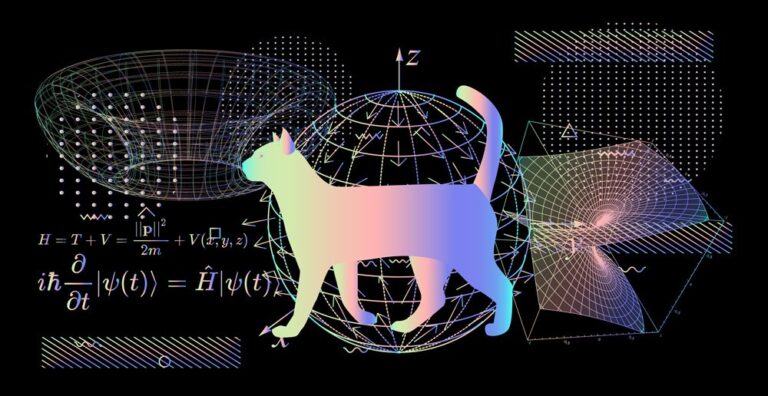
Physics has two extraordinarily successful theories, and they refuse to get along. General relativity describes gravity as the curving of spacetime and predicts the large-scale universe with remarkable precision. Quantum mechanics describes everything else — particles, forces, atoms — with equally remarkable precision. Put the two together, though, and the mathematics breaks down. Ask what happens at the center of a black hole, or in the first sliver of a second after the Big Bang, and general relativity and quantum mechanics start giving answers that can’t both be right. Layered on top of that unsolved puzzle is another one: roughly 95 percent of the universe’s mass and energy is made of something no instrument has ever directly detected, split between two separate mysteries called dark matter and dark energy. And nobody has yet built a confirmed “theory of everything” that unifies gravity with the other three forces of nature. This is the honest state of fundamental physics today — two great theories that don’t fit together, two invisible ingredients nobody understands, and a decades-long hunt for something deeper. Here’s where that hunt actually stands.
Also read: How Ancient Humans First Tried to Understand Nature
Two Perfect Theories That Refuse to Merge
The trouble starts with a basic mismatch in how the two theories treat reality. General relativity says spacetime itself is dynamical — it bends, stretches, and responds to mass and energy, and there’s no fixed stage on which physics happens. Quantum mechanics, by contrast, was built assuming a stage: a fixed background of space and time against which particles and fields do their probabilistic, discrete, quantized dance. Neither theory was designed with the other’s assumptions in mind, and the problem of merging them — quantum gravity — has been open for more than seventy years.
The mismatch gets concrete in something physicists call the problem of time. In general relativity, time is relative and dynamical, just another dimension woven into a spacetime that can curve and change. In ordinary quantum theory, time is an external, fixed parameter that just ticks along in the background, and every equation is written with respect to it. Try to write a single quantum theory of gravity and you immediately have to decide what time even means — before quantizing, after quantizing, or not at all. Different research programs answer that question differently, and the disagreement isn’t a technicality: it shapes what a quantum description of a black hole’s interior, or the universe’s first instant, is even allowed to say.
Two research programs have done more work on this problem than any others: string theory and loop quantum gravity. They start from opposite instincts, and neither has been confirmed.
String Theory: Everything Is a Vibration
String theory’s starting idea is disarmingly simple: swap out the point-like particles of the Standard Model for tiny, one-dimensional vibrating strings. Different vibration patterns correspond to different particles — electrons, quarks, photons — the way different notes come from the same guitar string plucked differently. Among the possible vibration patterns is one that behaves exactly like a graviton, the hypothetical particle that would carry the force of gravity. Gravity isn’t bolted on; it falls out of the theory automatically, which is part of why string theory became the most widely studied candidate for a quantum theory of gravity.
The cost of that elegance is steep. The theory’s equations only make consistent sense in ten or eleven dimensions, six or seven more than the four we experience, which have to be curled up at scales far too small to observe. The theory also requires supersymmetry, a symmetry that predicts a heavier partner particle for every particle we know, none of which has ever been found. And a 2009 status report on the theory by physicists Matthias Blau and Stefan Theisen was candid about how much remains open: the review’s own framing emphasized outstanding questions over settled results. Their assessment found genuine successes only in narrow corners — deriving black hole entropy for certain special, highly symmetric black holes, and computing some high-energy scattering behavior — while the theory’s full, background-independent formulation is still not understood. Nobody yet knows how to derive, uniquely, the ordinary four-dimensional physics of the Standard Model from string theory, or even whether it comes out as one possibility among many.
What makes string theory unusually ambitious, compared to its main rival, is scope: it doesn’t just aim to quantize gravity. It aims to unify gravity with electromagnetism and the strong and weak nuclear forces in one single mathematical framework — a genuine theory of everything, if it works.
Loop Quantum Gravity: Space Built From Its Own Threads
Loop quantum gravity starts from the opposite instinct. Rather than adding gravity into the existing toolbox of particle physics, it takes general relativity’s central lesson — that spacetime has no fixed background — and insists on carrying that lesson all the way into the quantum theory. There is no stage. Space itself, the theory argues, must be built directly out of quantum building blocks, with no metric assumed in advance.
Physicist Carlo Rovelli, one of the theory’s founders, has described its main achievement as a mathematically rigorous, background-independent quantization of general relativity — something string theory has not managed. The elementary objects of the theory are graphs called spin networks, whose nodes and links represent quantized chunks of volume and area. Zoom into space at the smallest scales the theory describes and, instead of smooth continuity, you find discreteness: a Planck-scale graininess that gives a concrete mathematical shape to physicist John Wheeler’s old intuition of a foamy, granular “spacetime foam.”
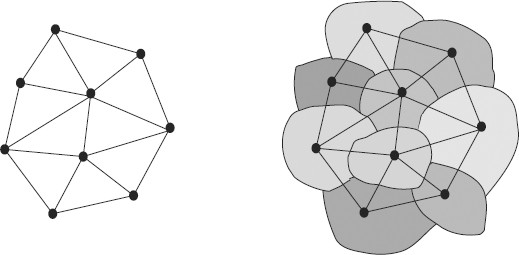
A spin network and the elementary “chunks,” or quanta, of space it describes — the basic geometric object of loop quantum gravity. (Living Reviews in Relativity)
The theory’s concrete results include computed, discrete spectra for area and volume; a derivation of the Bekenstein–Hawking formula for black hole entropy; and — because the framework can handle the extreme curvature near a singularity without the equations simply breaking — a way to investigate what might have preceded the Big Bang, or what happens deep inside a black hole, questions general relativity alone cannot answer. What the theory has not yet delivered is a fully settled account of dynamics: how a quantum spacetime evolves in time. Several competing versions of that piece exist, and nobody has rigorously shown that ordinary, smooth general relativity emerges from the theory at everyday scales. And unlike string theory, loop quantum gravity was never built to unify all the forces — only gravity and quantum mechanics. A complete theory of everything was never the goal.
Neither approach has any direct experimental support, and that’s not a knock on either one — it’s a feature of the whole field. The scale at which quantum gravity effects should appear, the Planck length, is around 10⁻³³ centimeters, far beyond anything any instrument built so far could probe. Every specific beyond-the-Standard-Model prediction tested so far, from any approach, has come back negative. Absent an experiment to arbitrate, string theory and loop quantum gravity — along with less mainstream approaches like causal dynamical triangulations, causal sets, and noncommutative geometry — remain competing, mathematically serious proposals rather than confirmed physics.
The Universe’s Missing Mass: Dark Matter
Quantum gravity isn’t the only place where twentieth-century physics ran into something it couldn’t explain. In the 1930s, Swiss astronomer Fritz Zwicky measured how fast galaxies moved inside the Coma galaxy cluster and found they were moving far too quickly for the visible matter to hold the cluster together gravitationally. He proposed an invisible mass to make up the difference. The idea sat at the margins of astronomy for decades until the 1970s, when American astronomer Vera Rubin measured how stars orbit spiral galaxies at different distances from the galactic center and found the same anomaly: stars at the edges of galaxies were orbiting just as fast as stars near the core, when ordinary gravity predicted they should be moving much slower. Something invisible, and far more massive than the visible stars and gas, had to be enveloping every galaxy in a vast halo.
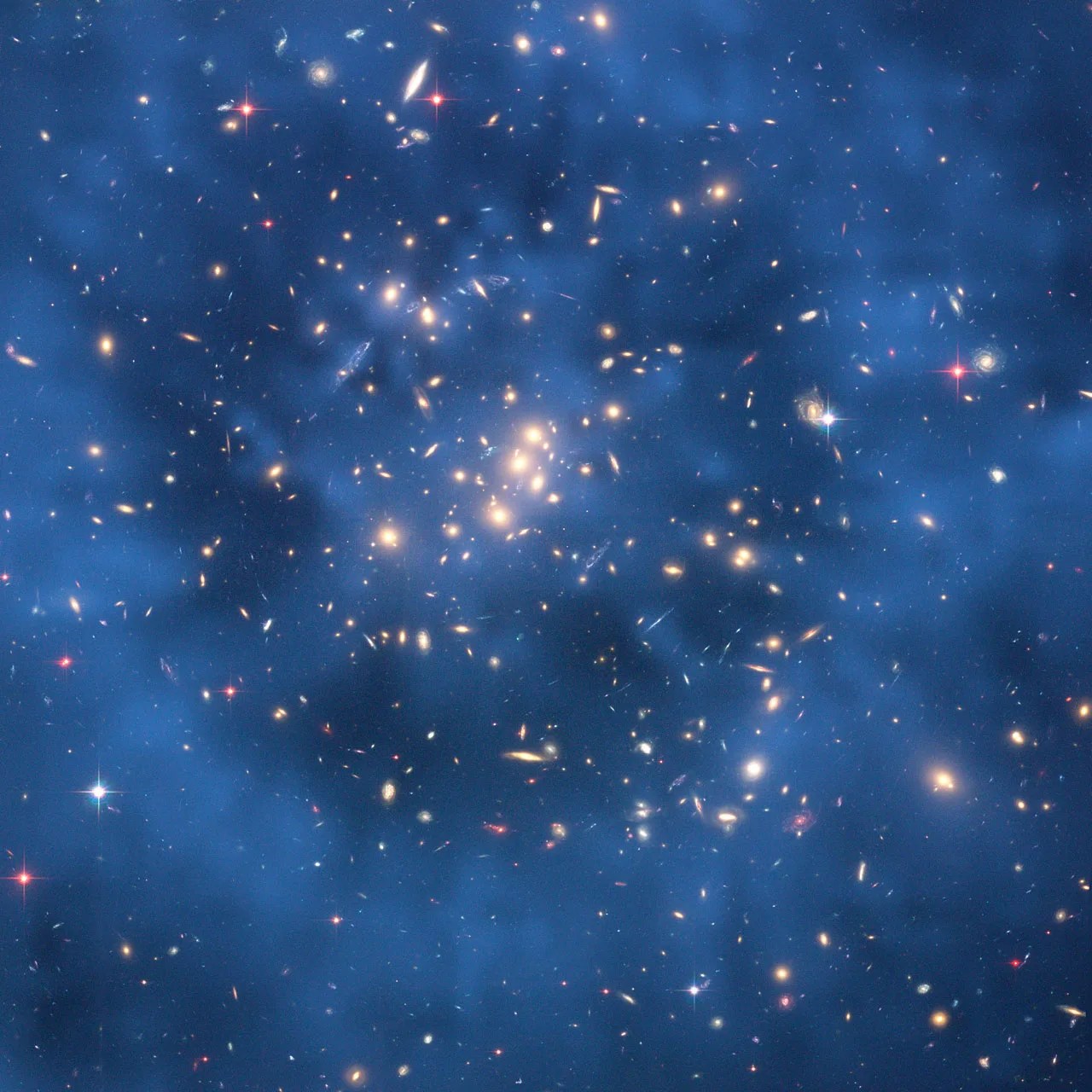
This Hubble Space Telescope image shows galaxy cluster CL0024+17; a ring of dark matter roughly five million light-years across, detected through its gravitational lensing of background galaxies, has been mapped and overlaid in blue. (NASA, ESA, M.J. Jee and H. Ford et al., Johns Hopkins University)
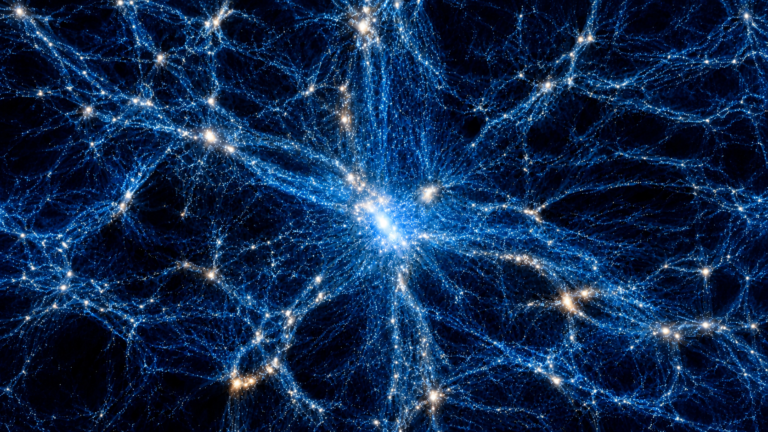
Dark matter is now estimated to account for roughly 85 percent of all the matter in the universe, yet no telescope operating at any wavelength — optical, radio, X-ray — has ever detected it directly, because it does not appear to absorb, emit, or reflect light. What astronomers know about it comes entirely from its gravity: how it bends light from distant galaxies, how it holds clusters together, how it appears to weave a cosmic web of filaments that ordinary matter later collapsed onto to form galaxies.
The leading particle candidates are exotic, weakly interacting particles that would rarely touch ordinary matter at all. CERN’s Large Hadron Collider — at 27 kilometers around, the largest particle accelerator ever built, operating since 2008 and already responsible for confirming the Higgs boson in 2012 — has spent years hunting for exactly this kind of particle, looking for missing energy and momentum left behind when a hypothetical dark matter particle escapes a detector unseen. So far, nothing has turned up.

Inside one of CERN’s accelerator tunnels. Facilities like the Large Hadron Collider are among the primary tools physicists use to search for dark matter candidates directly, by looking for what a collision leaves missing. (CERN)
The repeated null results have kept a genuine alternative alive: that dark matter isn’t a particle at all, but a sign that gravity itself behaves differently than Einstein’s equations predict at galactic scales — an idea studied under names like Modified Newtonian Dynamics. No alternative has matched the standard picture’s overall explanatory power across every observation, but the fact that serious physicists keep testing them is a reminder that this remains an open question, not a closed one.
A Universe That’s Speeding Up: Dark Energy
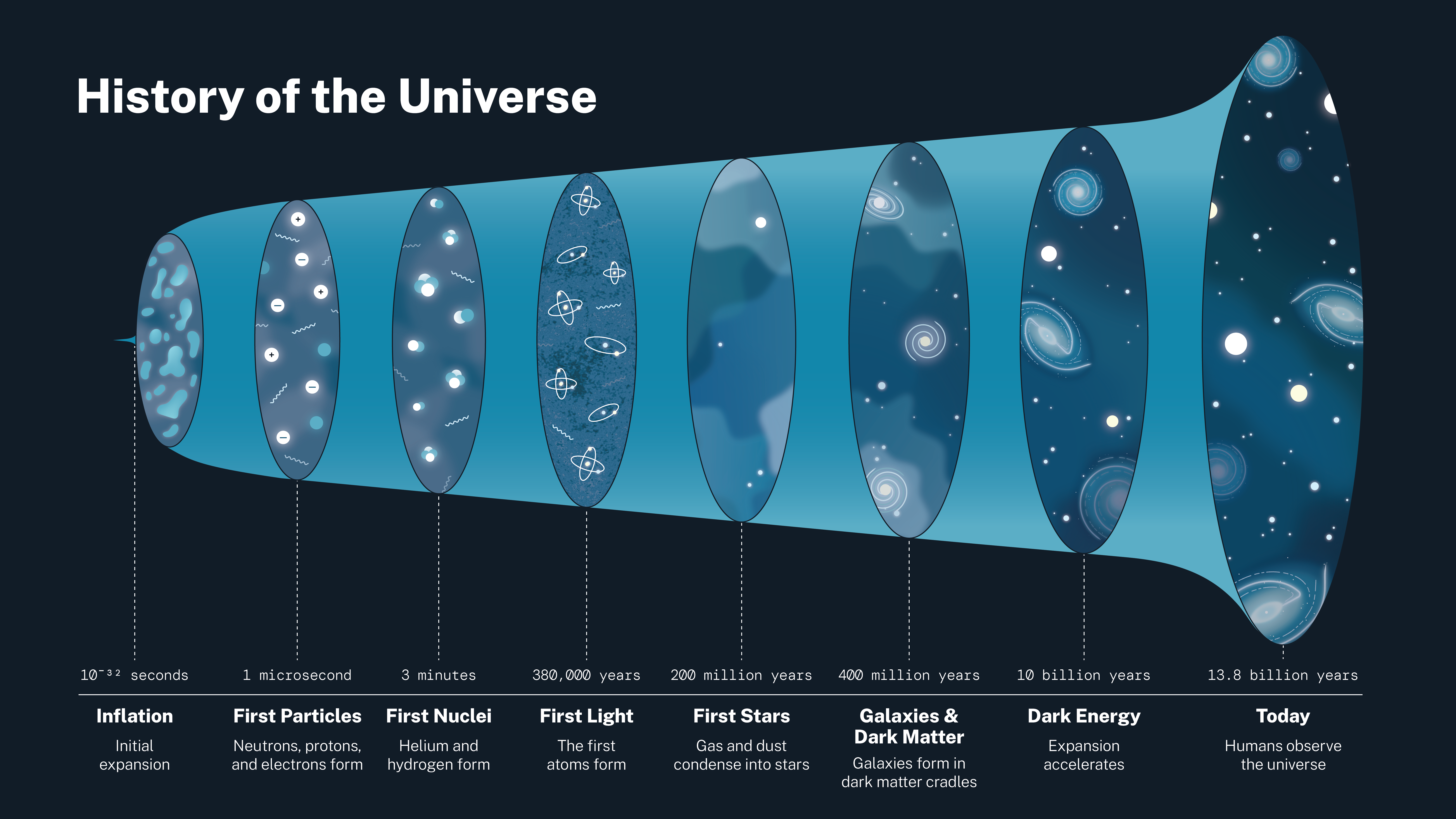
Dark energy is a separate mystery, discovered more than sixty years after Zwicky’s first hints of dark matter, and through a completely different kind of evidence. Astronomers had known since the late 1920s, from Edwin Hubble’s observations of galaxy redshifts, that the universe is expanding. The reasonable assumption was that gravity should be slowing that expansion down over time. In 1998, two independent teams, led by Saul Perlmutter, Brian Schmidt, and Adam Riess, set out to measure exactly how much the expansion was decelerating, using a class of exploding stars called Type Ia supernovae that shine with a known, reliable brightness and so can be used to gauge cosmic distances.
What they found instead upended cosmology. The supernovae were dimmer, and therefore farther away, than a slowing universe would allow — meaning the expansion had actually been speeding up for billions of years. The three astronomers shared the 2011 Nobel Prize in Physics for the discovery. Whatever is driving that acceleration was given a placeholder name: dark energy. Current estimates put it at somewhere around 68 to 73 percent of everything in the universe, making it, by mass-energy, the single largest constituent of the cosmos — and the least understood.
The history of cosmic expansion: gravity slowed the expansion for billions of years after the Big Bang, until dark energy began accelerating it roughly nine billion years in. (NASA)
Four broad explanations currently compete for physicists’ attention. The first is vacuum energy: the idea that empty space itself carries a background energy, tied to the cosmological constant Einstein originally inserted into his equations to keep the universe static, then removed once Hubble showed it was expanding, reportedly calling it his biggest blunder. The trouble is that when quantum field theory tries to calculate how much vacuum energy should exist, the predicted number comes out absurdly larger than what’s observed — the still-unresolved cosmological constant problem. The second is quintessence, a dynamic energy field that can vary across space and time, named after the mythical fifth element of ancient philosophy. The third points to cosmic strings, hypothetical wrinkles in spacetime formed in the universe’s earliest moments. And the fourth is the same kind of idea raised for dark matter: that general relativity itself needs revision at cosmic scales, an option Einstein himself sketched in a little-known 1919 proposal called unimodular gravity. None of the four has won out, and modified-gravity alternatives to dark energy, like f(R) gravity, remain active areas of study precisely because the standard picture hasn’t closed the question.
Chasing a Theory of Everything
Even setting quantum gravity and the dark universe aside, physics has a third unfinished project: unification. The Standard Model already unifies electromagnetism with the weak and strong nuclear forces into a single mathematical structure, one of the most successful achievements in the history of science. Gravity is the holdout. A genuine “theory of everything” would fold gravity into that same structure, describing all four fundamental forces — and, by extension, everything from subatomic particles to galaxy clusters — within one consistent framework.
String theory is the approach that takes this ambition most literally, since unification across all the forces was built into its goals from the start. Loop quantum gravity, deliberately, does not share that goal; its founders were explicit that the aim is to reconcile gravity with quantum mechanics, not to produce a unified theory of everything. Other, less mainstream research directions — causal dynamical triangulations, causal sets, twistor theory, noncommutative geometry — approach the same basic problem from different mathematical starting points, with different priorities and different notions of what “quantizing gravity” should even mean.
That diversity of approaches sometimes reads as disarray, but working physicists tend to see it differently: with no experiment yet able to test Planck-scale physics directly, competing ideas checked against internal consistency and mathematical rigor are the only way the field can make progress at all. Historically, that kind of open competition between theories, absent decisive data, is not unusual — and it has sometimes taken a very long time to resolve.
Why None of This Is Solved — and Why That’s the Point
Add it up, and modern physics is left with two enormously successful theories that cannot yet be combined, two separate invisible components making up roughly 95 percent of the universe, and no confirmed theory unifying any of it. None of the leading candidate solutions — string theory, loop quantum gravity, WIMPs, MOND, vacuum energy, quintessence — has direct experimental confirmation. That can sound like a field stuck in place. It isn’t.
Every one of these open questions is under active, well-funded investigation right now, often for the first time with instruments built specifically to test the ideas rather than stumble onto evidence by accident. Ground- and space-based observatories are being purpose-built to map dark matter’s distribution and track dark energy’s behavior across cosmic history, while particle accelerators keep pushing the search for new particles to higher energies. On the theoretical side, both string theory and loop quantum gravity continue to be refined, tested for internal consistency, and checked against every new observation cosmology produces.
None of this guarantees an answer soon, or ever. But it’s worth sitting with what “unsolved” actually means here: not that physics has failed, but that it has correctly identified, with unusual precision, exactly where its current understanding runs out. That’s a harder and more interesting place to be than having a complete theory that happens to be wrong. A century from now, whichever ideas turn out to be right, this is likely to be remembered as the era when physicists finally knew precisely what they didn’t know.
Sources
- Nature Portfolio — Quantum Gravity Research — https://www.nature.com/search?article_type=research&subject=quantum-gravity
- Science — https://www.science.org/
- Reviews of Modern Physics — https://journals.aps.org/rmp/
- Physical Review D — https://journals.aps.org/prd/
- Physical Review Letters — https://journals.aps.org/prl/
- Living Reviews in Relativity — Loop Quantum Gravity — https://link.springer.com/article/10.12942/lrr-2008-5
- String Theory as a Theory of Quantum Gravity: A Status Report — https://link.springer.com/article/10.1007/s10714-008-0752-z
- Critical Overview of Loops and Foams — https://www.sciencedirect.com/science/article/abs/pii/S0370157311001529
- Quantum Gravity: A Progress Report (arXiv) — https://arxiv.org/abs/gr-qc/0108040
- The Problem of Time in Quantum Gravity (arXiv) — https://arxiv.org/abs/1009.2157
- Theoretical Models of Dark Energy (arXiv) — https://arxiv.org/abs/1212.4726
- NASA — The Universe — https://science.nasa.gov/universe/
- NASA — Dark Matter — https://science.nasa.gov/universe/dark-matter/
- NASA — Dark Energy — https://science.nasa.gov/universe/dark-energy/
- ESA Science & Exploration — https://www.esa.int/Science_Exploration
- CERN — https://home.cern/
- Perimeter Institute — https://perimeterinstitute.ca/
- Caltech — https://www.caltech.edu/
- MIT OpenCourseWare Physics — https://ocw.mit.edu/search/?d=Physics
- Stanford Physics — https://physics.stanford.edu/
- Princeton Physics — https://physics.princeton.edu/
- Harvard Physics — https://physics.harvard.edu/
- Oxford Physics — https://www.physics.ox.ac.uk/
- Cambridge DAMTP — https://www.damtp.cam.ac.uk/
- Fermilab — https://www.fnal.gov/
- SLAC — https://www6.slac.stanford.edu/
- Max Planck Institute for Gravitational Physics — https://www.aei.mpg.de/
- APS Physics — https://physics.aps.org/
- Quanta Magazine — https://www.quantamagazine.org/
- Scientific American Space & Physics — https://www.scientificamerican.com/space/