Black Holes: 1 Century From Einstein’s Equation to an Incredible Photo
Black holes spent half a century as a mathematical embarrassment before they became an observational fact. They began as an unwanted consequence of a single equation, solved almost by accident in the middle of a war, and they ended up as the subject of a direct photograph taken by a network of telescopes spanning the planet. That arc, from a page of algebra to an actual image, is one of the most complete stories in modern physics: a prediction that outlived the skepticism of the person who made it possible, and a phenomenon that turned out to be stranger and more real than anyone expected.
This piece follows that arc in four steps. First, what a black hole actually is, stripped of jargon. Second, how the idea came out of Einstein’s equations within weeks of their publication. Third, how a seemingly unrelated question about quantum mechanics forced physicists to admit that black holes are not perfectly black. And finally, how, a century after the mathematics, astronomers pointed a telescope the size of Earth at the center of our galaxy and photographed the thing itself.
Also read: General Relativity and its Mind-Bending Predictions That Changed Our View of Space
Table of Contents
What a black hole actually is
Strip away the mystique and a black hole is a straightforward idea: enough mass has been packed into a small enough region that gravity near it becomes strong enough to trap even light. Nothing exotic is required for the underlying physics to hold — only enough density. The boundary past which escape becomes impossible is called the event horizon. It is not a physical surface, not a wall of any kind; it is simply the point of no return, the last address from which a beam of light could still, in principle, climb back out.

Black holes don’t emit or reflect light, which makes them invisible in the most literal sense. What gives them away is their effect on everything around them: gas and dust heated into glowing accretion disks, stars whipped into fast, tight orbits, and the bending of light from anything that happens to sit behind them. None of this makes a black hole a cosmic vacuum cleaner — from a safe distance, its gravity pulls exactly as hard as any other object of the same mass would. And a black hole is not a wormhole or a portal; it does not lead anywhere.
Context: an unwelcome guest in Einstein’s equations
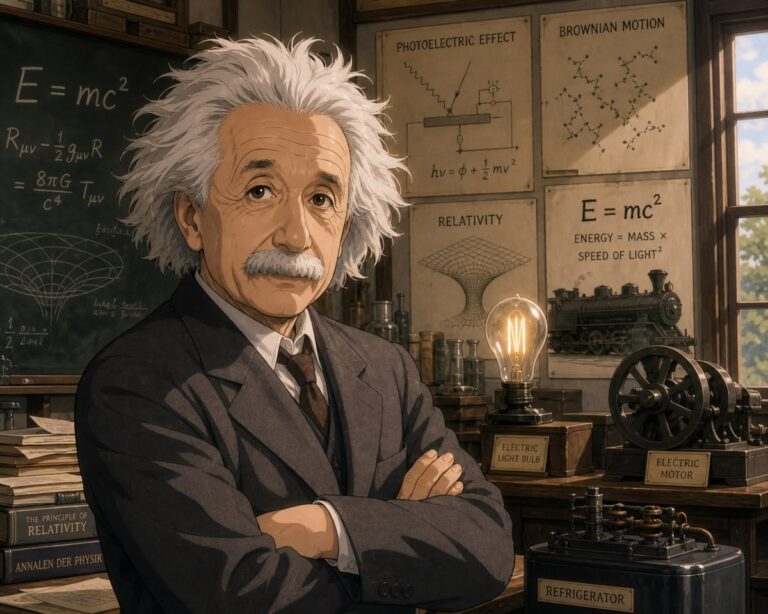
In November 1915, Einstein published the field equations of general relativity, a set of ten coupled, nonlinear differential equations relating the geometry of spacetime to the distribution of mass and energy inside it. They are notoriously difficult to solve in general. Einstein himself expected that only approximate solutions would be tractable for the foreseeable future.
He was wrong, and the correction came almost immediately. Karl Schwarzschild, a German astronomer serving on the Russian front during the First World War, worked out an exact solution for the simplest possible case: the spacetime surrounding a single, non-rotating, spherically symmetric mass. He mailed the derivation to Einstein at the end of 1915 and had it published within months. Schwarzschild died of an autoimmune disease he contracted at the front in May 1916, only weeks after his second paper on the subject appeared — he never lived to see what his own solution implied.
The mechanism: what Schwarzschild’s solution actually says
Schwarzschild’s solution describes the curvature of spacetime outside a spherical mass, and it contains a mathematical feature that seemed, at first, like a curiosity to be dismissed: at a specific radius from the mass — now called the Schwarzschild radius — the equations blow up. For an object like the Sun, that radius is about three kilometers; for Earth, under a centimeter. As long as all the actual mass of a star or planet is spread out well beyond that radius, the singular behavior at the Schwarzschild radius is irrelevant, since it sits inside the object where the vacuum solution no longer applies.
But nothing in the mathematics forbids the mass itself from being compressed inside that radius. If it is, the Schwarzschild radius becomes a genuine, physical event horizon: a one-way boundary in spacetime itself, not in space alone. For decades, most physicists, including Einstein, treated this as a pathology of the mathematics rather than a real physical possibility — a sign that the theory was being pushed past where it applied, not a prediction to be taken at face value. It took work on stellar collapse in the following decades, and the term “black hole,” popularized by John Wheeler in the late 1960s, before the idea shed its reputation as a mathematical oddity and was accepted as a description of real astrophysical objects.
A second twist: black holes are not perfectly black
For most of the twentieth century, the defining feature of a black hole was that nothing came out of it — a purely classical, general-relativistic object with a horizon that traps everything, permanently. That picture cracked in 1974 and 1975, when Stephen Hawking applied quantum field theory to the spacetime around a black hole and found something unexpected: black holes should emit a faint, thermal spread of particles, now called Hawking radiation, at a temperature set by the black hole’s mass — the more massive the black hole, the colder that temperature. In a 1976 paper with James Hartle, using a path-integral approach, Hawking showed that a Schwarzschild black hole should radiate scalar particles with a thermal spectrum, giving a cleaner derivation of the same result.
Hawking radiation is absurdly weak for any astrophysical black hole — for one with the mass of a star, the corresponding temperature is a tiny fraction of a degree above absolute zero, utterly swamped by the cosmic microwave background. It has never been directly detected. Its significance is theoretical rather than observational: it means black holes slowly lose mass and, given enough time, evaporate, and it forced physicists to confront the tension between general relativity and quantum mechanics head-on. If a black hole radiates and eventually disappears, what happens to the information about everything that fell in? Hawking’s own 1976 paper on the breakdown of predictability in gravitational collapse argued that the information might simply be lost — a conclusion that set off a debate, still not fully settled, known as the black hole information paradox.
Evidence: from inference to an actual photograph
For most of the twentieth century, black holes were inferred, never seen. Astronomers tracked the orbits of stars whipping around an invisible, compact mass at the center of the Milky Way — work that won the 2020 Nobel Prize in Physics — and inferred the presence of black holes elsewhere from X-rays pouring off their accretion disks. Direct imaging seemed out of reach: a black hole’s event horizon is simply too small, on the sky, for any single telescope to resolve.
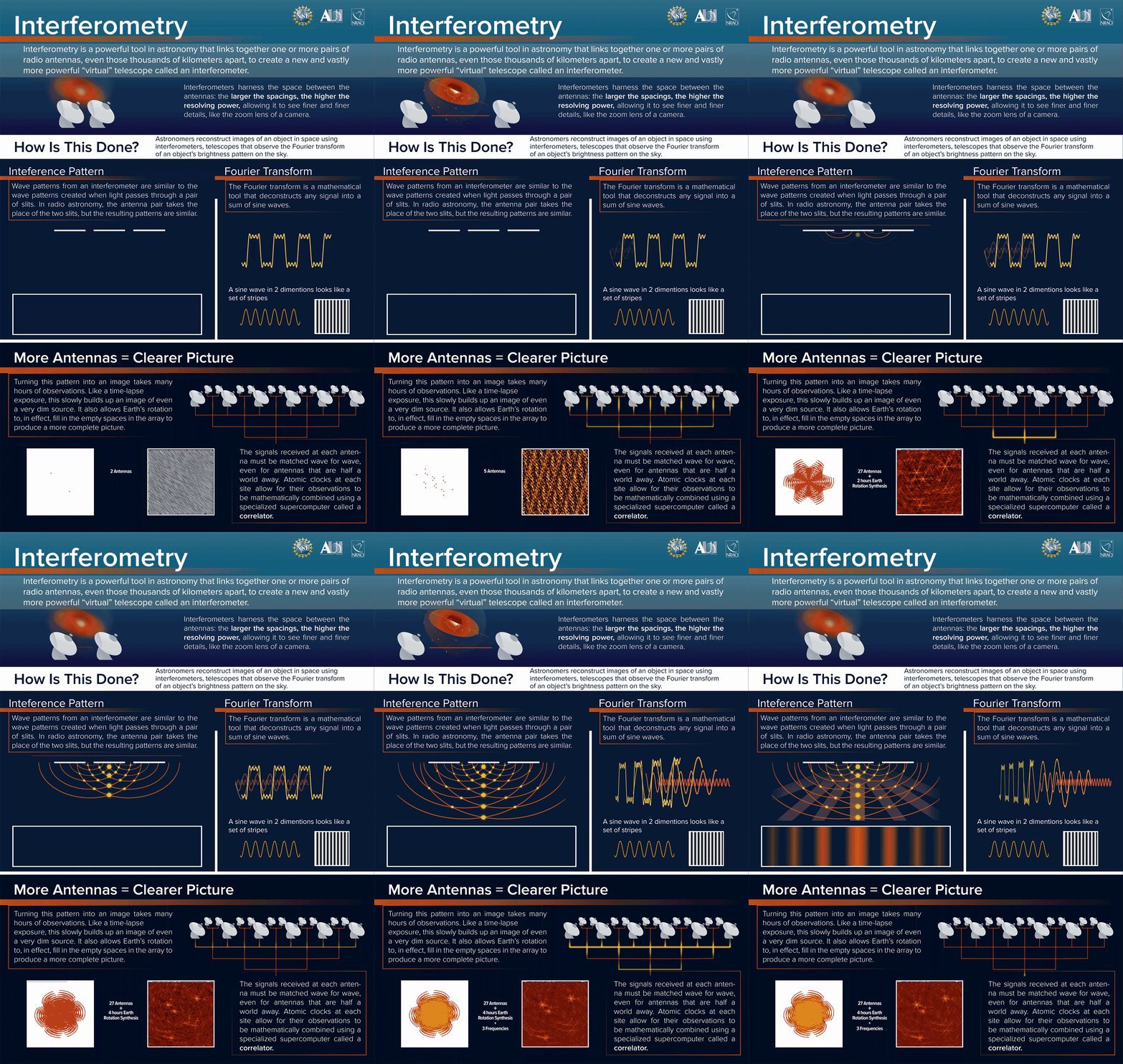
The Event Horizon Telescope solved that problem by turning the planet itself into a telescope. Using a technique called very long baseline interferometry, it links radio observatories on different continents so their combined data mimics a single dish roughly the size of Earth. In 2019 that network produced the first-ever image of a black hole, at the center of the galaxy M87, 55 million light-years away. In 2022, the EHT collaboration turned the same technique on our own galactic center and released the first image of Sagittarius A*, the supermassive black hole at the heart of the Milky Way.
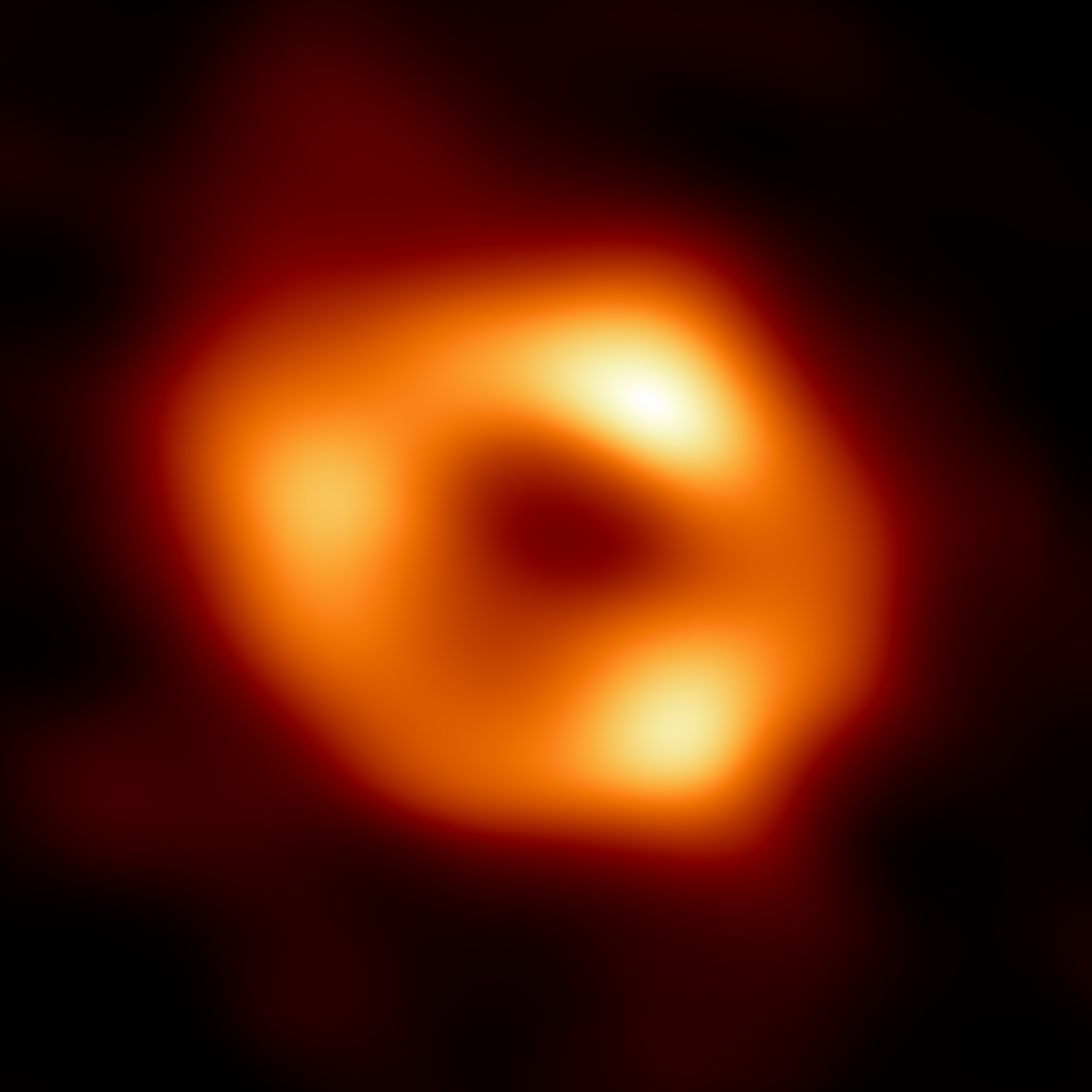
The EHT collaboration’s own papers on the result describe a bright, thick ring roughly 52 microarcseconds across, with a dim interior and modest brightness variation around its rim. Extensive comparison against numerical simulations showed the image to be consistent with a rotating (Kerr) black hole of about four million solar masses — matching, independently, the mass inferred decades earlier from stellar orbits — and disfavored a black hole viewed nearly edge-on or one with no spin at all. Follow-up papers from the same 2023 release used the image to test general relativity directly against the data, and found the shadow size consistent with the theory’s predictions to within observational uncertainty.
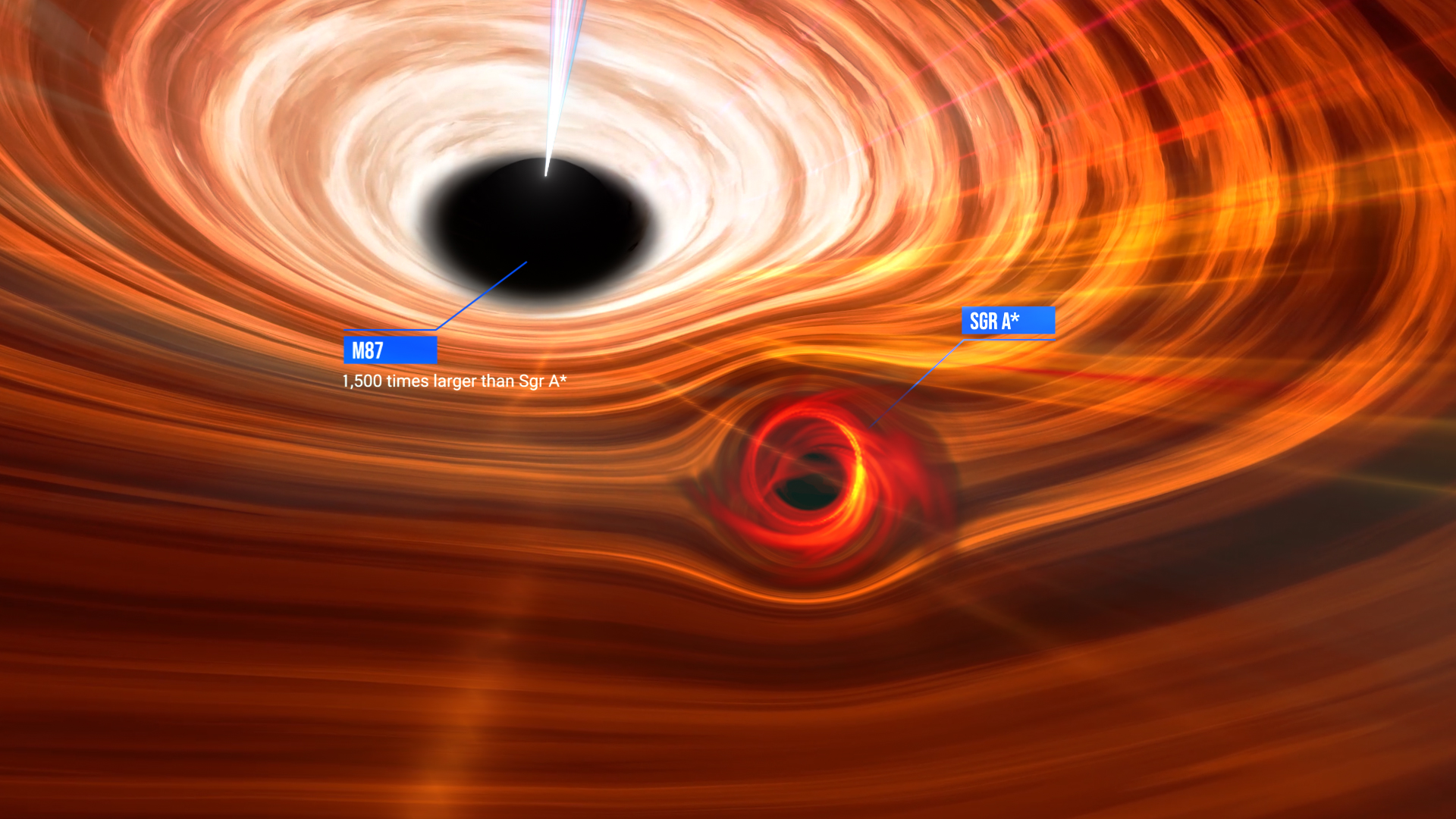
What makes the Sagittarius A* result more than a repeat of the M87 image is the comparison between them. M87’s black hole is about 1,500 times more massive than the Milky Way’s, and the two systems evolve on wildly different timescales, yet both produced a shadow whose size matches the predictions of general relativity. That agreement, spanning three orders of magnitude in mass, is exactly what the theory demands if it is describing something universal rather than a coincidence specific to one object.
Why it matters
The path from Schwarzschild’s 1916 solution to the 2022 image closes a loop that is rare in physics: a mathematical structure that its own discoverer treated with suspicion turned out to correspond to real objects, observable in exactly the way the mathematics said they should look. It is also a working laboratory for gravity at its most extreme. Every black hole image, every measurement of a shadow’s size and shape, is a test of general relativity in a regime — strong, highly curved spacetime — that is essentially untestable anywhere else. So far, general relativity has passed every one of those tests.
Black holes also sit at the meeting point of the two great unfinished projects of twentieth-century physics: general relativity, which describes gravity as curved spacetime, and quantum mechanics, which describes everything else. Hawking radiation exists precisely because someone was willing to apply quantum field theory to a black hole’s horizon, and the puzzles that emerged from that exercise — most of all, the information paradox — remain some of the sharpest open problems pointing toward whatever theory eventually unifies gravity with quantum mechanics.
What is still unresolved
A few things are worth being precise about. The interior of a black hole, and the singularity that general relativity predicts at its center, is not something any current observation probes — the mathematics of general relativity predicts infinite density there, which most physicists take as a sign that the classical theory breaks down and a full theory of quantum gravity is needed, not as a literal description of what is inside. Hawking radiation itself remains theoretical; it has not been measured for any astrophysical black hole, and it may never be, given how faint it is expected to be. And the information paradox is still an active area of research and disagreement, not a settled question — later work, including Hawking’s own, revisited his 1976 conclusion without fully resolving it.
The EHT images are themselves reconstructions, built by combining data from widely separated telescopes and comparing the results against a large library of simulated black holes rather than read off directly like an ordinary photograph. That doesn’t make them any less real, but it’s a different kind of “seeing” than a camera pointed at a nearby object, and the EHT collaboration’s own papers are explicit about the uncertainties involved.
Closing
Schwarzschild solved Einstein’s equations exactly, in the trenches, within weeks of their publication, and produced a result that even Einstein was reluctant to take literally. It took over a century, a war-time postal system, decades of theoretical work on collapsing stars, one of the strangest results in twentieth-century quantum theory, and finally a radio telescope the size of the planet, for that mathematical curiosity to become a photograph. Black holes are no longer a limit case to be explained away. They are objects in the sky, with a mass, a spin, and a shadow that matches the equations almost exactly — proof that sometimes the strangest consequence of a theory is simply the one nobody had looked for yet.
Sources
- Karl Schwarzschild, On the Gravitational Field of a Mass Point according to Einstein’s Theory
- S. Chandrasekhar, The Mathematical Theory of Black Holes
- NASA Science: Black Holes
- Event Horizon Telescope Publications
- First Sagittarius A* Event Horizon Telescope Results I
- First Sagittarius A* Event Horizon Telescope Results V
- First Sagittarius A* Event Horizon Telescope Results VI
- Horizon-scale tests from EHT image of Sagittarius A*
- Physical Review D: Path-integral derivation of black-hole radiance
- Stephen Hawking: Breakdown of predictability in gravitational collapse
- APS Physical Review D
- The Astrophysical Journal
- Monthly Notices of the Royal Astronomical Society
- Astronomy & Astrophysics
- Reviews of Modern Physics
- Living Reviews in Relativity
- Einstein Online: Black Holes
- ESA Science: Black Holes
- CERN Quantum Gravity resources
- MIT OpenCourseWare – General Relativity
- Perimeter Institute – Black Holes
- Caltech LIGO
- LIGO Scientific Collaboration
- NASA Chandra: Sagittarius A*
- Event Horizon Telescope Home

One Comment